







In many Zimbabwean households, domestic workers occupy a private, often invisible space. They prepare meals, care for children, clean bedrooms, and witness family dynamics that outsiders rarely see.
They hear arguments, notice silences, and learn routines. This proximity creates trust—but when respect erodes, that same closeness can become volatile.
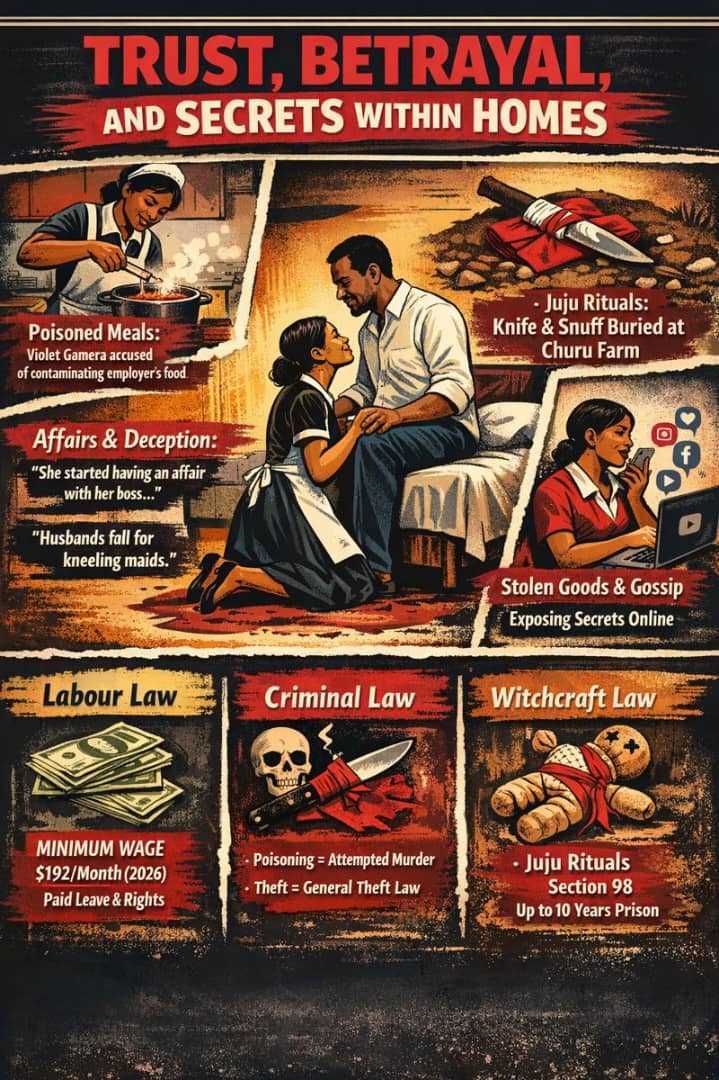
In October 2025, that fragile trust was tested when Violet Gamera, a domestic worker from Chiredzi, was accused of contaminating her employer’s rice with an unknown substance. The employer fell ill shortly after eating the meal. Although laboratory tests were inconclusive and investigations are ongoing, the allegation alone sent ripples of fear through households relying on live-in help.
“We never thought something like this could happen in our own home,” said a relative of the employer, who requested anonymity. “You eat every day trusting the same hands. After that incident, nothing feels normal.”
Earlier in the same year, in August 2025, another case brought the tension between employers and domestic workers into sharp public focus, this time involving allegations of witchcraft. Socialite and personal stylist Natalie “Enchantress” Mhandu was accused of performing a harmful ritual with the assistance of her former maid, Elizabeth Mharirire, at Churu Farm. According to the State, the ritual targeted Mhandu’s friend, Tatenda Butau, and involved burying a knife wrapped in red cloth and sprinkling snuff powder.
Mharirire stated that she had accompanied Mhandu to the traditional healer, only to later find suspicious materials in her room and bathroom, prompting her to alert Butau. Court papers indicate that Butau retrieved the buried items and filed a police report under Section 98 of the Criminal Law Act, which criminalises harmful traditional practices intended to cause injury. Mhandu has denied the claims, calling them a fabrication from a “vindictive former maid.” The matter is now before Mbare Magistrates’ Court, with investigations ongoing.
“The proximity domestic workers have in our homes gives them access to intimate details,” one employer said. “When trust is broken, the consequences are deeply personal.”
Related Stories
Sexual misconduct remains another recurring source of conflict. In one high-profile case, Joseph Kapfudza allegedly had a sexual relationship with his 17-year-old maid, reportedly seeking a son after fathering five daughters. Observers note that the daily access maids have to private spaces creates opportunities for exploitation, while the imbalance of power often leaves them vulnerable.
Social commentators have labelled some men involved in such affairs “daddy kneelers,” exploiting submissive behaviour for personal gratification. Yet not all domestic workers exploit these roles. Susan Mutami recalled a maid known as Mai Anesu who, in 2006, refused to disclose her boss’s affair, demonstrating loyalty and discretion.
Experts point out that these tensions arise from a system with little formal protection. Domestic workers are recognised under the Labour Act [Chapter 28:01] and the 2020 National Employment Council (NEC) Domestic Workers Wages Order, which sets a minimum monthly wage of US$192 in 2026 and provides leave and safeguards against discrimination. Criminal law intervenes only for extreme acts: poisoning is covered under assault or attempted murder laws, theft under general statutes, and harmful traditional practices under Section 98 of the Criminal Law Act, carrying penalties of up to ten years in prison where harm is intended.
Domestic workers themselves describe resentment growing quietly. “You cook, you clean, you raise their children, but you are treated like you are nothing,” one maid said. “Some girls think, ‘Let them feel what I feel.’ I don’t support it, but I understand the anger.” Another added, “When you complain about salary or being shouted at, suddenly you are called dangerous. Some employers think we don’t feel pain.”
Employers, in turn, express fear when trust collapses. “My maid is disrespecting me,” one said. “She knows all my secrets.”
Cases involving theft, gossip, sexual misconduct, and even allegations of juju — like the Mhandu case — illustrate how disputes that begin quietly in kitchens and bedrooms can spiral into lasting damage, eroding household stability and reputations. Low wages, lack of formal contracts, blurred boundaries, and deep power imbalances create fertile ground for conflict.
“We live inside their lives,” said a former maid. “If there is no respect, something will break.”
And when it does, the fallout rarely stays contained within the home. It spills into courts, communities, and public discourse — exposing the uncomfortable truth that behind closed doors, trust is both the household’s greatest strength and its most fragile fault line.










Leave Comments