








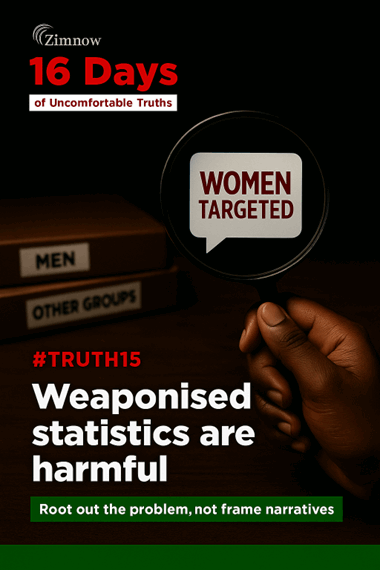
Each year, the 16 Days theme is supported by statistics that quickly become talking points. This year, the focus on digital abuse of women has brought a familiar pattern. Headlines and presentations stress that women, especially women journalists and women in public life, are under attack online. We hear numbers, we see graphs, and we absorb the message: women are targets.
The problem is not that the statistics are fabricated. The problem is how they are produced and framed.
Many of the surveys used to back such themes are circulated within female networks. Questionnaires are sent to women’s associations, women’s professional groups, women’s WhatsApp lists, and female membership databases. The respondents, almost by design, are women who have already been taught to view the world through a particular lens. They have been primed by years of gender training, sensitization workshops, and advocacy messaging. When asked whether they have experienced online abuse, many are ready with answers, examples, and vocabulary.
Meanwhile, there is no full effort to send similar surveys into mixed or male databases. No broad national polling of everyone who uses the internet. No dedicated systematic capturing of how the male segment of the population experiences trolling, threats, intimidation, or humiliation online. There is no infrastructure designed to hear them at the same scale.
The result is predictable. We gather a large pool of women’s experiences because they were the only ones invited to answer. Then we present the findings as if they represent the whole battlefield. We say women are under siege online. We say women are uniquely targeted. What we do not say is that we paid lip service to asking the men.
Outside the gender silo, there are other strands of research and lived experience that point to a different driver of digital abuse. It is not gender, but rather visibility and position. People who are public-facing attract more hostility regardless of gender.
Journalists, influencers, politicians, outspoken citizens, activists, and anyone who dares to have an opinion in the open arena become targets. In Zimbabwe, government officials of all stripes are trolled daily.
Male ministers are insulted, mocked, and threatened. Male councillors and MPs endure crude name-calling and family attacks in comment sections. Yet when we lift only female ministers from this pool and present them as gender targets, we distort the picture.
The unintended consequence is serious. Instead of preparing women for hard-hat spaces, we warn them away from them. Young women watching the narrative unfold begin to believe that leadership, journalism, politics, and public speaking are dangerous specifically for women.
They do not hear that these are tough spaces for anyone and that everyone who enters them must be prepared to face a rough crowd. It would be more honest to say that public-facing roles require digital armor and that we must build safety rules and enforcement mechanisms for all who step into them.
Related Stories
By insisting that women are singled out as victims, we also reinforce a toxic stereotype. Men are expected to be strong enough to endure anything the internet throws at them. Women are invited to stand under a compassion umbrella. Men are told to deal. Women are told to retreat or be protected. Neither is a recipe for healthy digital citizenship.
There is another layer. If the messaging is “stop harassing women,” it does not necessarily speak to the mindset of the abuser. Many attackers are driven by what someone represents rather than who they are. They go for profile, opinion, party, tribe, class, and influence.
Picking out only the women from their target list and framing their abuse as gender-based allows perpetrators to think, “This is not about me. I just attack whoever is visible.” The communication misses them and therefore fails to change them.
A more effective approach would start by admitting that our evidence base is skewed. We should acknowledge that current statistics heavily reflect women’s experiences because the tools and channels we use are built around women’s networks.
Then we should invest in gathering broader data that includes everyone. Men, women, youth, anybody with a digital footprint. Once we know how online abuse cuts across society, we can design interventions that address the culture, not just a category.
True advocates for safe spaces should be able to say, "Our goal is to change behavior everywhere, for everyone." Women will benefit from that change without being framed as fragile. Men will have no reason to resist reforms that make the internet more civil for all, not just more gentle for some.
Policies and laws can then demand that platform owners act decisively whenever bullying and harassment occur, without waiting to see the gender of the victim before they take it seriously.
We need platform rules that bite, enforcement that is swift and neutral, and social norms that declare harassment unacceptable, full stop. That protects women far more effectively than one more campaign that tells them they are targets.
If we carry on building narratives on selective statistics, we will keep producing two losses. We will keep intimidating the very women we say we want to elevate. And we will keep ignoring the broader culture of cruelty that makes digital spaces unsafe for everyone.
The internet is not a women’s danger zone. It is a human danger zone when left unchecked. The real work is to redesign it so that those who choose to speak can do so without being destroyed, whether they are female ministers, male journalists, or young citizens with something to say.
To do that, we need the whole truth, not just the half that fits the theme of the year.









Leave Comments