







Engineering and agricultural equipment group Zimplow Holdings posted a significantly improved financial performance for the year ended December 31, 2025, with revenue rising 13 percent to US$33.54 million and loss before tax narrowing by 85 percent as its agriculture-focused businesses returned to profitability.
The company reported that its recovery was largely driven by strong performances from Farmec, Mealie Brand and Scanlink, despite operating in what it described as a difficult economic environment marked by liquidity constraints, inflationary pressures and supply chain disruptions.
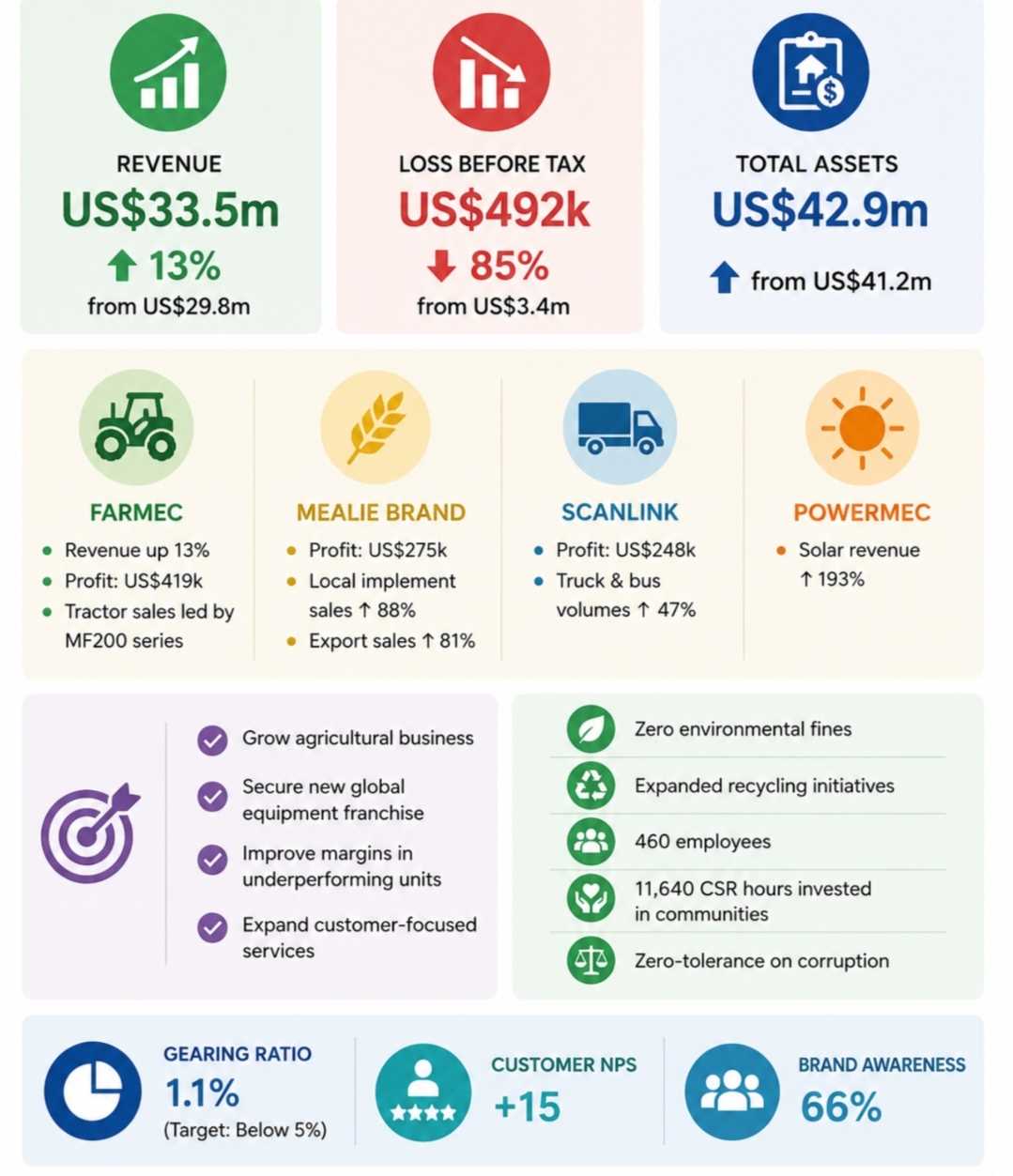
Revenue increased from US$29.78 million in 2024 to US$33.54 million in 2025, while loss before tax narrowed to US$492,180 from US$3.44 million recorded in the previous year.
Operating losses also declined sharply to US$118,513 compared to US$3.16 million in 2024.
In its annual report, the group said the improved performance reflected the success of measures implemented to protect margins and contain costs.
“Zimplow Holdings Limited demonstrated remarkable resilience in the 2025 financial year, navigating a complex macroeconomic environment characterised by liquidity constraints, supply chain disruptions and inflationary pressures,” the company said.
The group added that through “stringent cost management, proactive inventory strategies and operational efficiency,” it had managed to significantly improve profitability while strengthening its balance sheet.
Agriculture emerged as the biggest growth driver during the year.
Farmec recorded a 13 percent increase in revenue and posted a profit before tax of US$418,923, supported by strong demand for Massey Ferguson tractors, particularly the MF200 series, which accounted for 78 percent of total tractor volumes sold.
The division also benefited from a 20 percent increase in parts sales and a 47 percent rise in service hours.
Meanwhile, Mealie Brand returned to profitability with a profit before tax of US$275,165 after implement volumes increased by 88 percent locally and 81 percent in export markets.
The company said growing adoption of mechanised farming among smallholder farmers continued to support demand for its products.
Related Stories
“Implement volumes surged by 88 percent locally and 81 percent in export markets, while two-wheel tractor volumes rose by 39 percent, reflecting a shift towards mechanised smallholder farming,” the report noted.
Commercial vehicle distributor Scanlink also contributed positively after recording a profit before tax of US$248,477.
The company attributed the performance to a 47 percent increase in truck and bus volumes, supported by sustained demand for Scania products.
While generator supplier Powermec experienced a slight decline in turnover due to supply challenges, the division successfully expanded its renewable energy business.
The report said solar revenue grew by 193 percent during the year as demand for alternative energy solutions increased.
Zimplow said it intends to deepen its focus on agriculture, improve profitability across underperforming units and secure a new international equipment franchise following the loss of the Develon distributorship.
Management identified customer-centricity, capital efficiency and regional growth as key strategic priorities for 2026.
The group said it remains confident about future growth prospects.
“With a strengthened balance sheet and a strategic pivot towards customer-centric excellence, the Group is well-positioned for sustainable long-term value creation across the agricultural, mining, infrastructure and logistics sectors,” the company said.
Zimplow also highlighted its strong financial position, noting that its gearing ratio stood at just 1.1 percent, well below its target threshold.
The company further reported investing more than 11,600 corporate social responsibility hours into community development initiatives while maintaining a workforce of 460 employees during the year.
As part of its sustainability commitments, Zimplow expanded solar installations, improved recycling programmes and maintained what it described as a zero-tolerance approach to bribery and corruption across its operations.








Leave Comments