






As the June 30 deadline issued by anti-immigrant activists in South Africa looms over foreign nationals, the easiest response is condemnation. Social media has proved that. But condemnation without root analysis cannot lead to solutions.
Many poor South Africans are not choosing hatred as a hobby. They live inside a country where the end of apartheid promised dignity, yet millions still queue for jobs that do not exist, public services stretched thin, housing out of reach, and safety that cannot be taken for granted.
They see informal traders surviving where they are failing. They hear foreign accents in clinics, markets, taxis, construction sites and rented rooms. They hear politicians speak of borders and crime. They feel abandoned, and then someone offers them an enemy close enough to touch.
South Africa has real problems. But the foreigner did not create them. And turning anger into intimidation, looting or attacks against migrants will not solve them.
Zimbabweans, Malawians, Mozambicans, Nigerians, Congolese, Basotho and others in South Africa are not the architects of broken municipalities, failing hospitals, jobless townships, organised crime networks or political patronage systems.
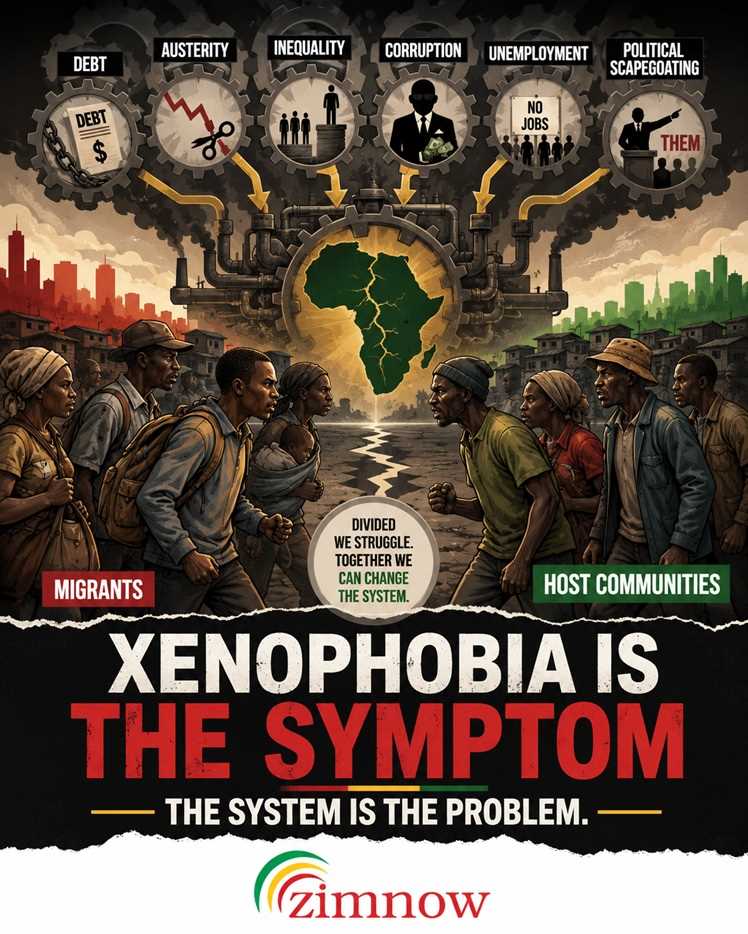
Many are themselves victims of economies damaged by hunger, instability, currency collapse, debt, austerity, corruption and lack of opportunity, pressures that often began long before the latest government failure or political slogan.
This is the cruel joke of our continent: the poor are being turned against the poor while the systems that produced their desperation remain largely untouched.
Africa has been here before
It is too easy to condemn South Africans as uniquely xenophobic. They are not.
Ghana expelled large numbers of West African migrants in 1969. Nigeria expelled undocumented migrants, including Ghanaians, in the 1980s. The phrase "Ghana Must Go" still carries that memory. More recently, Ghanaian and Nigerian traders have clashed over retail space and business rights.
In Harare's Market Square area and Kaguvi Street resentment surfaced against Nigerian traders in downtown, framed as protecting local economic space. Mozambicans and Malawians have been subjected to social discrimination and downright criminal abuse.
Xenophobia does not always arrive wearing the same uniform. In Ghana and Nigeria, it came through laws resulting in expulsions. In South Africa today it is marching under anti-immigrant banners. In Zimbabwe, it currently wears the jacket of reserved sector protectionism.
In Europe and America, it has entered through the ballot box as the far-right swing tells its own story.
But always, the facts are the same. When economies fail to protect citizens, outsiders become the cheapest explanation.
The real problem is not about choosing sides
An estimated 3 million Africans have crossed borders into South Africa because home could no longer carry them. And it cannot be denied that their presence in South Africa has real impact, positive and negative, for South Africans.
On the positive side, migrants work in farms, mines, construction, domestic service, hospitality, transport, health care, education and informal trade. They rent rooms, buy food, pay for transport, use local suppliers and keep parts of township and city economies moving. Some run small businesses that employ South Africans. Others bring skills into sectors where the country needs labour.
But there are also real pressure points. In poor communities already battling unemployment, overcrowded clinics, housing shortages, crime and weak service delivery, migration can deepen the feeling that locals are being pushed further back in the queue.
In informal trade, foreign-owned shops and stalls can become flashpoints when locals feel excluded from business space. Undocumented migrants are also easier for employers, landlords, criminal networks and corrupt officials to exploit, which creates a shadow economy that hurts both migrants and South Africans.
So for Africans to dismiss South Africa's crisis as a mere lack of Ubuntu, without reflection is reductionist. But at the same time, for South Africans to pretend that all migrants are criminals and the cause of their problems is equally myopic.
Countries have a right to manage borders. Citizens have a right to ask who enters, who works, who trades, who receives services and whether laws are being enforced fairly. Informal economies cannot be allowed to become lawless zones where locals and foreigners alike are exploited by criminals, corrupt officials and political gangs.
Related Stories
But there is a difference between enforcing immigration law and hunting people in the streets. There is a difference between regulating business and looting shops.
Once a society accepts mob justice as border control, it has already lost the argument.
The South African situation also exposes the limits of African unity rhetoric. We speak beautifully about Pan-Africanism at summits. We invoke Nkrumah, Nyerere, Mandela, Machel and Lumumba. We sing of one Africa.
Then a poor woman selling tomatoes in Johannesburg is asked for papers by another poor person who cannot find work.
Pan-Africanism is tested in markets, clinics, taxi ranks and border posts, not conference halls.
The hard question is not whether Dudula is right or wrong. It is whether African economies can continue producing desperate migrants while pretending that migration is the problem.
The real crisis is uneven development
Zimbabweans go to South Africa because Zimbabwe's economy has failed many of them. Malawians and Mozambicans move for the same reasons. South Africans resent them because South Africa's own economy has also failed too many of its citizens.
But even that failure must be read honestly. Zimbabwe's migration story did not begin with one policy, one party or one decade. Before land reform became the shorthand explanation, structural adjustment had already cut deep into jobs, industry and social protection.
Zambia's story also carries the scars of debt, copper dependency and externally prescribed reforms. Across the region, domestic misrule, global finance, colonial economic design and uneven trade have worked together to produce economies that push people out and host communities that feel under siege.
As long as one country offers better wages, better services or better survival chances than its neighbours, people will move. Walls may slow them. Police may chase them. Politicians may campaign against them. Mobs may terrorise them. But hunger is an aggressive traveller.
This pattern is not uniquely African. Brexit fed on anxiety over borders, jobs and sovereignty. Across Europe, migrants from Africa, the Middle East and Eastern Europe have been turned into symbols of national decline. In the United States, immigration has become the most reliable instrument of political mobilisation. In Ireland, communities under housing pressure have seen rising hostility around asylum seekers.
When people feel abandoned, someone teaches them to point sideways instead of upward. Xenophobia rarely begins as pure hatred. It begins as a complaint over jobs, rentals, crime, trading space or schools. Then someone gives that complaint a face, a nationality and a target. By the time the shop is burning, the lie has already done its work.
What must change
Zimbabwe cannot only ask South Africa to protect Zimbabweans. It must ask why so many Zimbabweans need to be protected there.
Nigeria cannot demand dignity for its citizens abroad without answering why so many feel they have no viable future at home despite the country's wealth.
Ghana cannot express outrage without the embarrassment of remembering its own past expulsions and confronting the trader tensions that still test its regional commitments.
The answer is not open borders without order, or closed borders without humanity. Africa needs to speed up structured continental economic cooperation backed by lawful migration, fair enforcement and politics that refuses to turn suffering people into scapegoats.
The continent cannot police its way out of economic imbalance. It needs trade that works for ordinary people, regional industrialisation, legal labour pathways, reliable documentation systems and serious action against corruption on both sides of every border.
Because without economies that make staying home possible, the foreigner selling spare parts, cutting hair, driving a taxi, cleaning a house or standing in a clinic queue will always be branded the architect of national failure.
Yet neither the March and March/Dudula activists driving the June 30 ultimatum nor the migrants now living in fear broke Africa. They are just the actors left fighting over the hardest parts of a script they did not write.



Leave Comments