









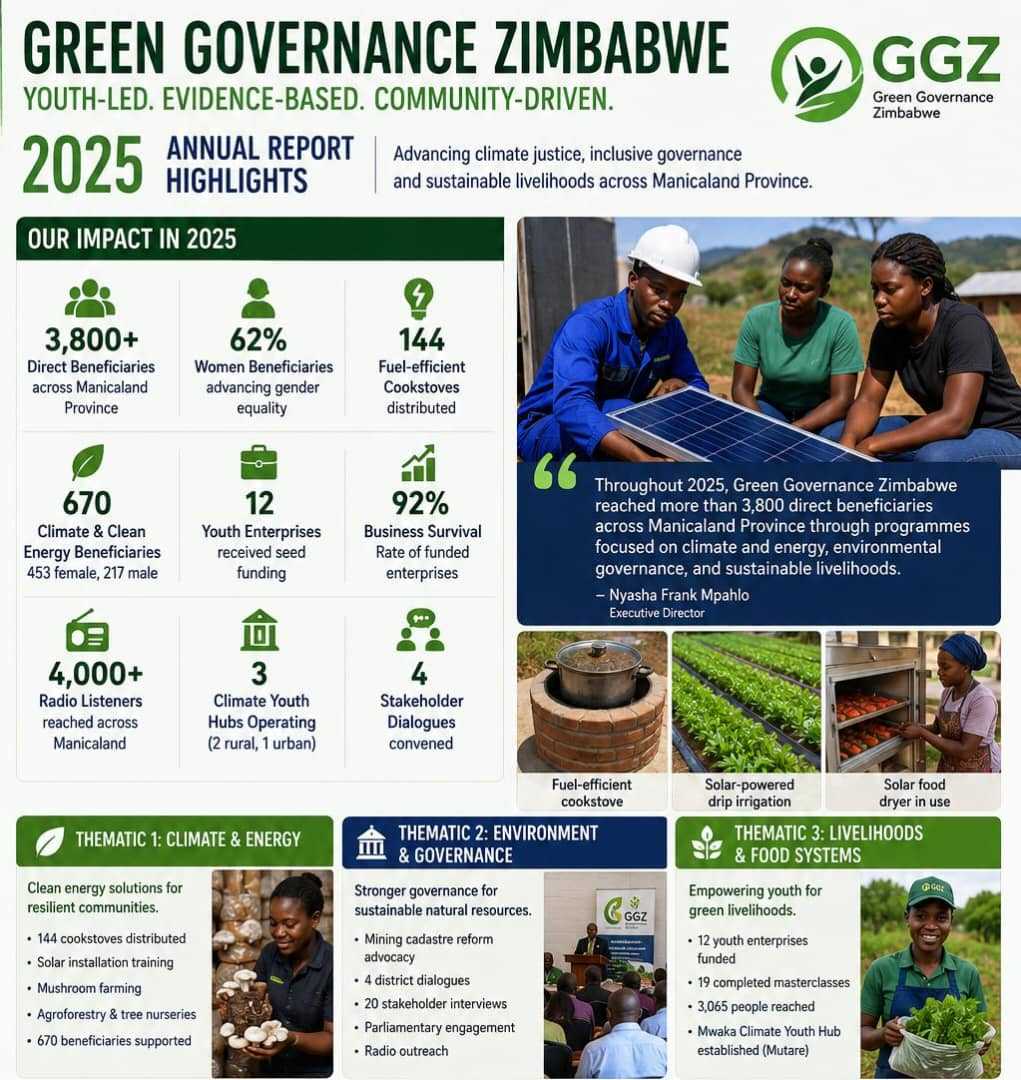
Climate advocacy by community organisations is beginning to influence national policy discussions in Zimbabwe, with Green Governance Zimbabwe revealing that its mining governance campaign triggered parliamentary scrutiny of the country's Computerised Mining Cadastre System while youth-led green businesses recorded a 92 percent survival rate despite the country's difficult economic environment.
The organisation's 2025 Annual Report suggests that small, community-driven interventions are increasingly moving beyond local environmental projects into influencing governance, transparency and economic resilience at a time when Zimbabwe faces mounting pressure from climate change, recurring droughts and disputes over natural resource management.
The report says Green Governance Zimbabwe engaged more than 120 community representatives through four district stakeholder dialogues and completed a provincial case study based on interviews with 20 stakeholders on the implementation of the Computerised Mining Cadastre System, with the findings later informing engagement with Members of Parliament.
"Engagement with MPs generated formal parliamentary scrutiny of mining governance practices," the report says, adding that the research documented "community perceptions and governance gaps" within the mining sector.
The development comes as mining continues to be one of Zimbabwe's fastest-growing economic sectors but also among its most contested, with communities frequently raising concerns over transparency, environmental degradation, displacement and benefit-sharing.
Executive Director Nyasha Frank Mpahlo said the organisation's approach was based on empowering communities to influence governance rather than simply participate in development programmes.
"As we marked the first year of implementing our 2025–2027 Strategic Plan, we remained committed to advancing climate justice, inclusive governance, and sustainable livelihoods through youth-led and community-driven approaches," Mpahlo said.
He said meaningful change remained possible "when communities are empowered, evidence informs action, and partnerships are nurtured."
Beyond policy advocacy, the report paints a picture of an organisation attempting to link climate adaptation directly with livelihoods.
Green Governance Zimbabwe says it reached more than 3,800 direct beneficiaries during 2025, distributed 144 fuel-efficient cookstoves, funded 12 youth enterprises and operated three Climate Youth Hubs across Manicaland Province.
Related Stories
Its most notable economic indicator was a reported 92 percent business survival rate among youth enterprises that received seed funding, with one quarter attracting additional external investment after initial support.
Among the beneficiaries was entrepreneur Tendai Manyeza, whose US$5,000 grant helped develop a solar-powered vegetable cooling system before later winning an additional US$15,000 innovation prize.
"Now I can manage banking tasks, request quotes, place online orders, and sign documents electronically. Entrepreneurship has brought a huge gain in productivity," Manyeza said.
For rural households, the report argues that relatively simple technologies are delivering measurable savings.
One beneficiary from Chimanimani, Rejoice, said the fuel-efficient stove distributed through the programme had dramatically reduced household expenditure on firewood.
"Before this stove, I spent a dollar every day on firewood. Now, one bundle lasts me two weeks. This stove has given me peace of mind. It has truly lightened my burden as a mother and wife," she said.
The organisation says 670 beneficiaries received clean energy support across Chimanimani and Chipinge, while solar-powered irrigation, agroforestry and food preservation technologies were introduced to strengthen climate resilience.
The report also reflects a broader shift among Zimbabwean civil society organisations from service delivery towards evidence-based policy engagement.
Green Governance Zimbabwe says it now works alongside organisations including the Zimbabwe Coalition on Debt and Development, ActionAid Zimbabwe, Zimbabwe Environmental Law Organisation, HIVOS and the City of Mutare to combine research, community mobilisation and parliamentary engagement.
Looking ahead, the organisation plans to expand solar training to more than 500 young people annually, establish Zimbabwe's first community-based carbon credit programme linked to cookstove distribution and reforestation, and scale its youth enterprise model to support 50 green businesses by 2027.
The report argues that Zimbabwe's climate response should increasingly be judged not only by the number of trees planted or cookstoves distributed, but by whether community-generated evidence can influence public policy and whether green enterprises can become sustainable sources of employment in an economy where youth unemployment remains persistently high.









Leave Comments