








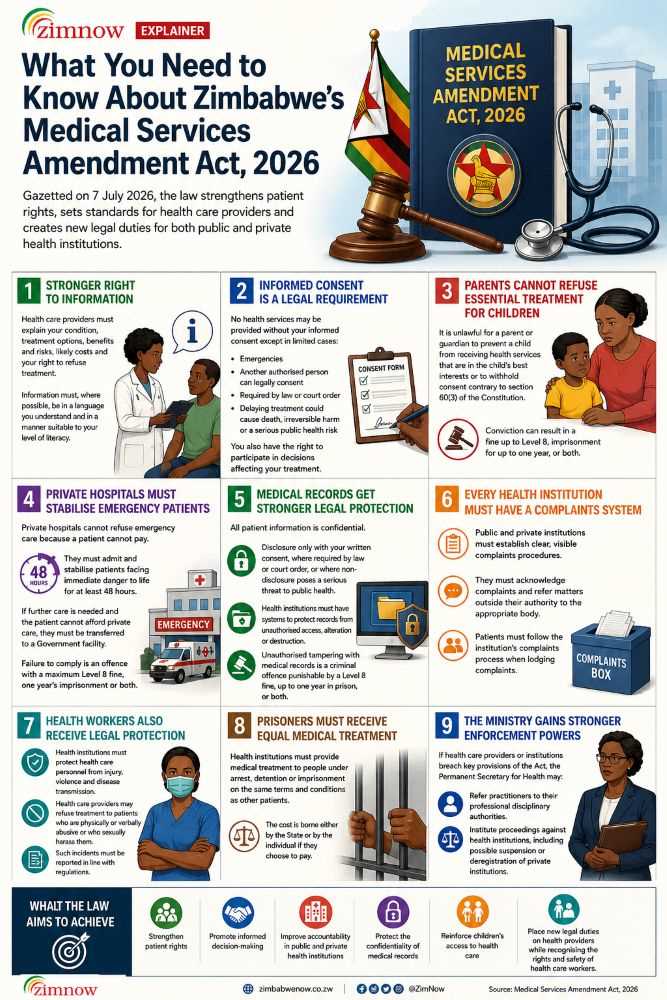
Zimbabwe's Medical Services Amendment Act, 2026 introduces significant changes to the country's healthcare system by strengthening patients' rights, setting minimum standards for health care providers and creating new legal obligations for both public and private health institutions. The law amends the Medical Services Act [Chapter 15:13] and was gazetted on July 7, 2026.
1. Patients now have stronger rights to information
Under the new law, health care providers must explain a patient's health condition, available treatment options, the benefits and risks of each option, the likely costs and the patient's right to refuse treatment. The information should, where possible, be given in a language the patient understands and in a manner appropriate to the patient's level of literacy.
2. Informed consent becomes a legal requirement
The Act provides that health services may not be provided without a patient's informed consent except in limited circumstances, including emergencies, where another authorised person can legally consent, where required by law or court order, or where delaying treatment could result in death, irreversible harm or a serious public health risk. Patients also have the right to participate in decisions affecting their treatment.
3. Parents cannot refuse essential treatment for children
One of the most significant provisions makes it unlawful for a parent or guardian to prevent a child from receiving health services that are in the child's best interests or to withhold consent contrary to section 60(3) of the Constitution. A person convicted of doing so may face a fine of up to Level 8, imprisonment for up to one year, or both.
4. Private hospitals must stabilise emergency patients
The Act prohibits private health institutions from refusing emergency medical treatment simply because a patient cannot immediately pay.
Private hospitals must admit patients facing an immediate danger to life for at least 48 hours to stabilise them before transferring them to a Government health institution capable of providing further treatment if they cannot afford private care. The Minister may also request private hospitals to provide specialist services during public emergencies, with agreements allowing recovery of treatment costs from the patient or the State. Failure to comply is an offence carrying a maximum Level 8 fine, one year's imprisonment or both.
5. Medical records receive stronger legal protection
Related Stories
The law makes all patient information confidential. Disclosure is generally only permitted with the patient's written consent, where required by law or a court order, or where non-disclosure would pose a serious threat to public health.
Health institutions must also introduce systems to protect patient records from unauthorised access, alteration or destruction. Unauthorised tampering with medical records becomes a criminal offence punishable by a Level 8 fine, imprisonment for up to one year, or both.
6. Every health institution must have a complaints system
Public and private health institutions are now required to establish visible complaints procedures, acknowledge complaints and refer matters outside their authority to the appropriate body. Patients must follow the institution's complaints process when lodging complaints.
7. Health workers also receive legal protection
The Act requires health institutions to protect health care personnel from injury, violence and disease transmission. It also allows health care providers to refuse treatment to patients who are physically or verbally abusive or who sexually harass them, subject to reporting requirements.
8. Prisoners must receive equal medical treatment
Health institutions must provide medical treatment to people under arrest, detention or imprisonment on the same terms and conditions as other patients. The cost is borne either by the State or by the individual if they choose to pay.
9. The Ministry gains stronger enforcement powers
Where health care providers or institutions breach key provisions of the Act, the Permanent Secretary for Health may refer practitioners to their professional disciplinary authorities or institute proceedings against health institutions, including possible suspension or deregistration of private institutions.
What the law aims to achieve
Overall, the Medical Services Amendment Act strengthens patient rights, promotes informed decision-making, improves accountability in both public and private health institutions, protects the confidentiality of medical records, reinforces children's access to health care, and places new legal duties on health providers while also recognising the rights and safety of health care workers.









Leave Comments