








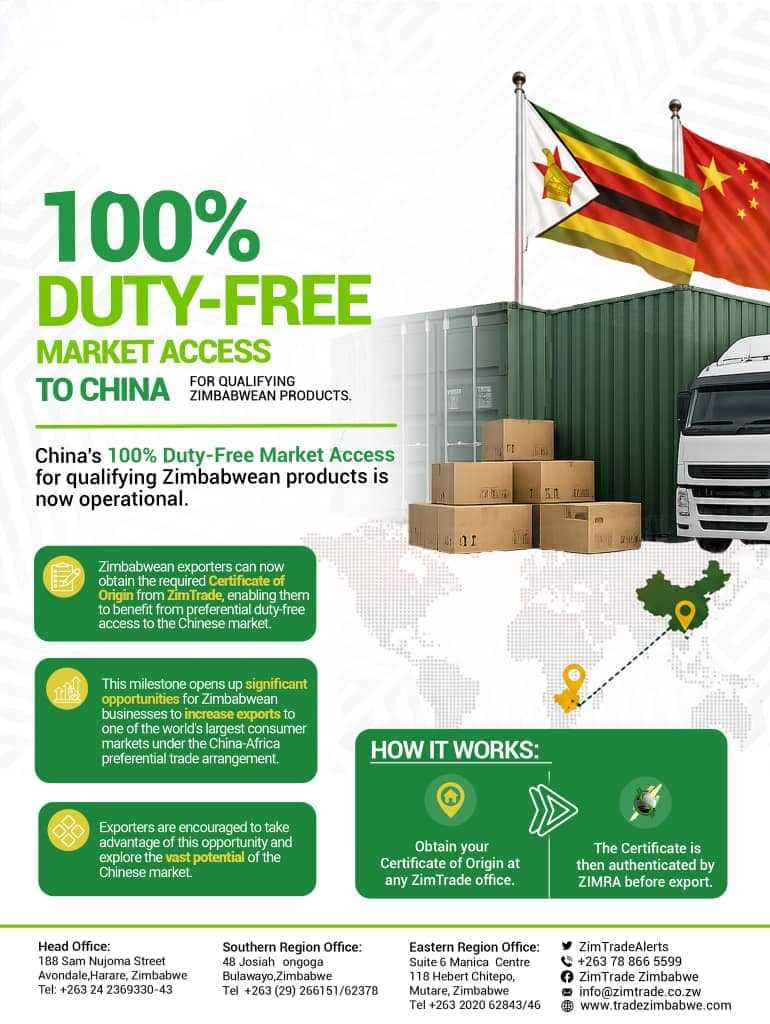
Zimbabwean exporters can now sell qualifying products into China without paying import duties after the country completed all requirements for Beijing's 100 percent duty-free market access programme, opening one of the world's largest consumer markets to local producers.
The development, confirmed by ZimTrade, represents one of Zimbabwe's biggest trade opportunities in recent years. Yet economists warn that the country's biggest obstacle may not be market access but its limited capacity to produce competitive, value-added exports.
"Zimbabwe has completed all processes required to unlock China's 100% Duty-Free Market Access for qualifying Zimbabwean products," ZimTrade announced.
The trade promotion agency said exporters can now obtain Certificates of Origin through ZimTrade before authentication by the Zimbabwe Revenue Authority, enabling them to benefit from preferential access under the China-Africa trade arrangement.
The programme removes tariffs on qualifying Zimbabwean goods entering China, significantly improving their price competitiveness against products from countries that do not enjoy similar preferences.
For a country seeking to grow exports and narrow its trade deficit, the announcement appears to be a major breakthrough. However, analysts argue that duty-free access alone does not guarantee increased exports.
Economist Persistence Gwanyanya has previously argued that Zimbabwe's long-term export growth depends on industrialisation and beneficiation rather than preferential market access alone.
"Market access is important, but competitiveness and value addition determine whether countries fully benefit from trade agreements," he has repeatedly argued in discussions on export performance.
That concern is reflected in Zimbabwe's export structure. Although exports have grown in recent years, they remain heavily concentrated in gold, platinum, lithium, tobacco and other primary commodities whose prices fluctuate on international markets.
Related Stories
According to the Zimbabwe National Statistics Agency, minerals continue to dominate export earnings, while manufactured exports account for a much smaller share despite Government's industrialisation agenda.
China is already Zimbabwe's largest single export destination and one of its biggest sources of imports. Much of Zimbabwe's exports to China consist of minerals, tobacco and other raw materials, raising questions about whether duty-free access will significantly diversify exports or simply reinforce existing trade patterns.
Government has repeatedly stated that beneficiation and value addition are central to economic development goals.
Presenting recent economic updates, Minister of Finance, Economic Development and Investment Promotion Professor Mthuli Ncube said agriculture and mining were the main drivers of Zimbabwe's 8.3 percent economic growth in 2025, underscoring the economy's continued reliance on primary sectors.
The challenge now is whether those sectors can move further up the value chain.
For example, Zimbabwe exports tobacco, but processed tobacco products command significantly higher values. Lithium exports remain dominated by concentrates despite the government's push for battery value chains.
Horticultural products, macadamia nuts, avocados, citrus fruits and processed foods could also become major beneficiaries if producers meet China's phytosanitary, quality and traceability requirements.
The World Bank and the African Development Bank have consistently argued that African countries derive greater economic benefits from exporting processed products than raw commodities because value addition creates more jobs, strengthens manufacturing and increases foreign currency earnings.
The opportunity also arrives as Zimbabwe seeks to sustain export-led growth amid moderating economic expansion. While the economy grew by 8.3 percent in 2025, Government projects growth will slow to 5 percent in 2026, making export diversification increasingly important.
For manufacturers, the removal of tariffs could improve competitiveness in a market of more than 1.4 billion consumers, however competing in China requires more than preferential access, with producers subjected to stringent food safety, packaging, certification and quality standards while ensuring reliable production volumes.










Leave Comments