







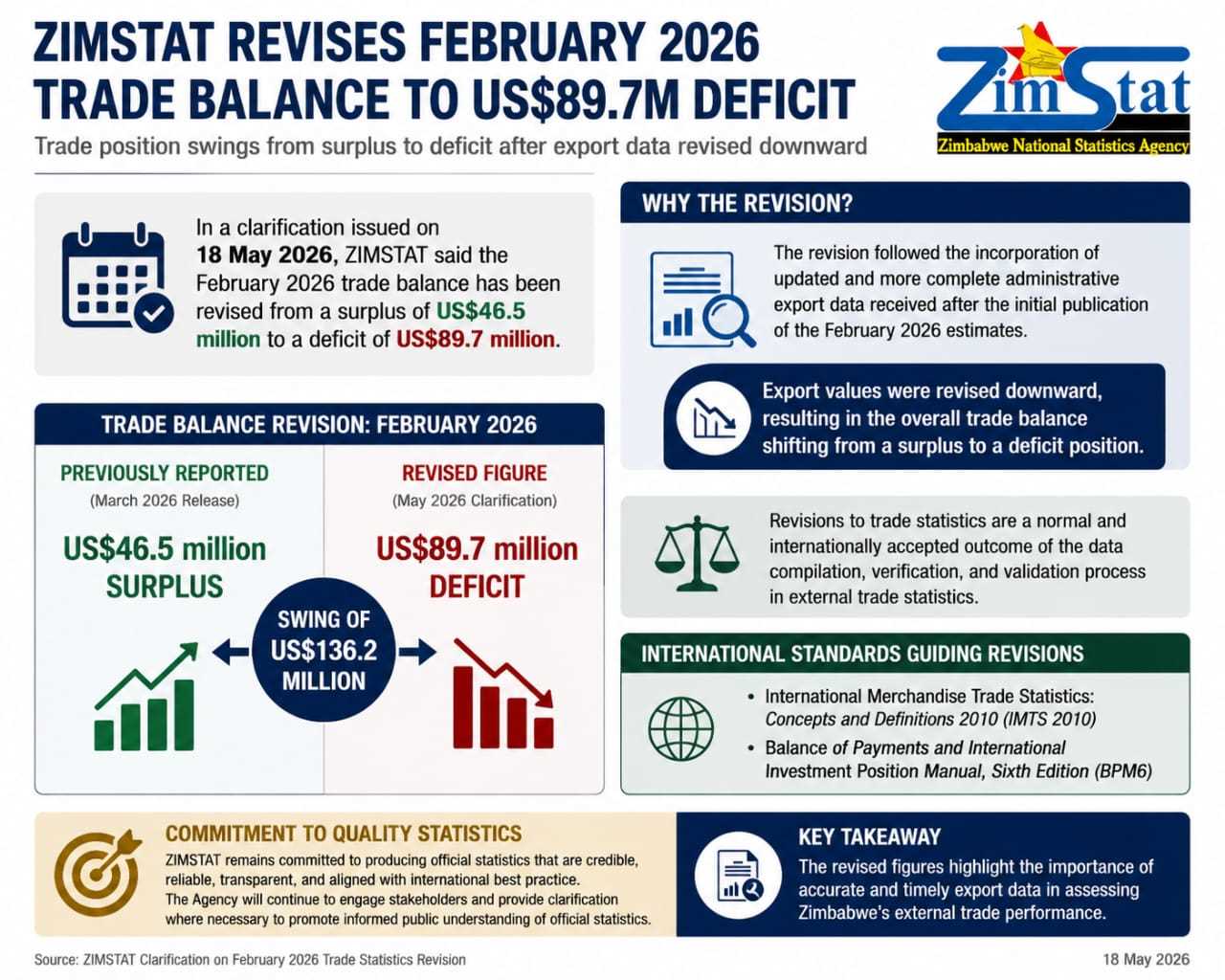
Zimbabwe’s trade balance for February 2026 has been sharply revised from a previously reported surplus of US$46.5 million to a deficit of US$89.7 million after updated export data showed lower export earnings than initially estimated.
In a clarification issued on May 18, the Zimbabwe National Statistics Agency said the revision followed the incorporation of “updated and more complete administrative export data received after the initial publication of the February 2026 estimates.”
“Consequently, export values were revised downward, resulting in the overall trade balance shifting from a surplus to a deficit position,” the agency said.
The adjustment represents a reversal of more than US$136 million from the earlier estimate and comes amid heightened scrutiny of Zimbabwe’s external trade performance, export reporting systems and foreign currency generation capacity.
Related Stories
ZIMSTAT said revisions to trade statistics are part of standard international statistical practice and occur as more complete source data becomes available through verification and validation processes.
“The revision of trade statistics is a normal and internationally accepted outcome of the data compilation, verification, and validation process in external trade statistics,” the agency said.
The statistics agency said the process is guided by international standards under the International Merchandise Trade Statistics: Concepts and Definitions 2010 (IMTS 2010) and the Balance of Payments and International Investment Position Manual, Sixth Edition.
“Such revisions are undertaken to enhance the accuracy, consistency, and reliability of official statistics,” ZIMSTAT added.
The clarification follows public debate after the revised March 2026 External Trade Statistics release showed a materially weaker trade position than initially reported for February.
Zimbabwe’s trade balance remains highly sensitive to movements in mineral exports, gold deliveries, fuel imports and global commodity prices, which continue influencing foreign currency inflows and exchange rate stability.










Leave Comments