








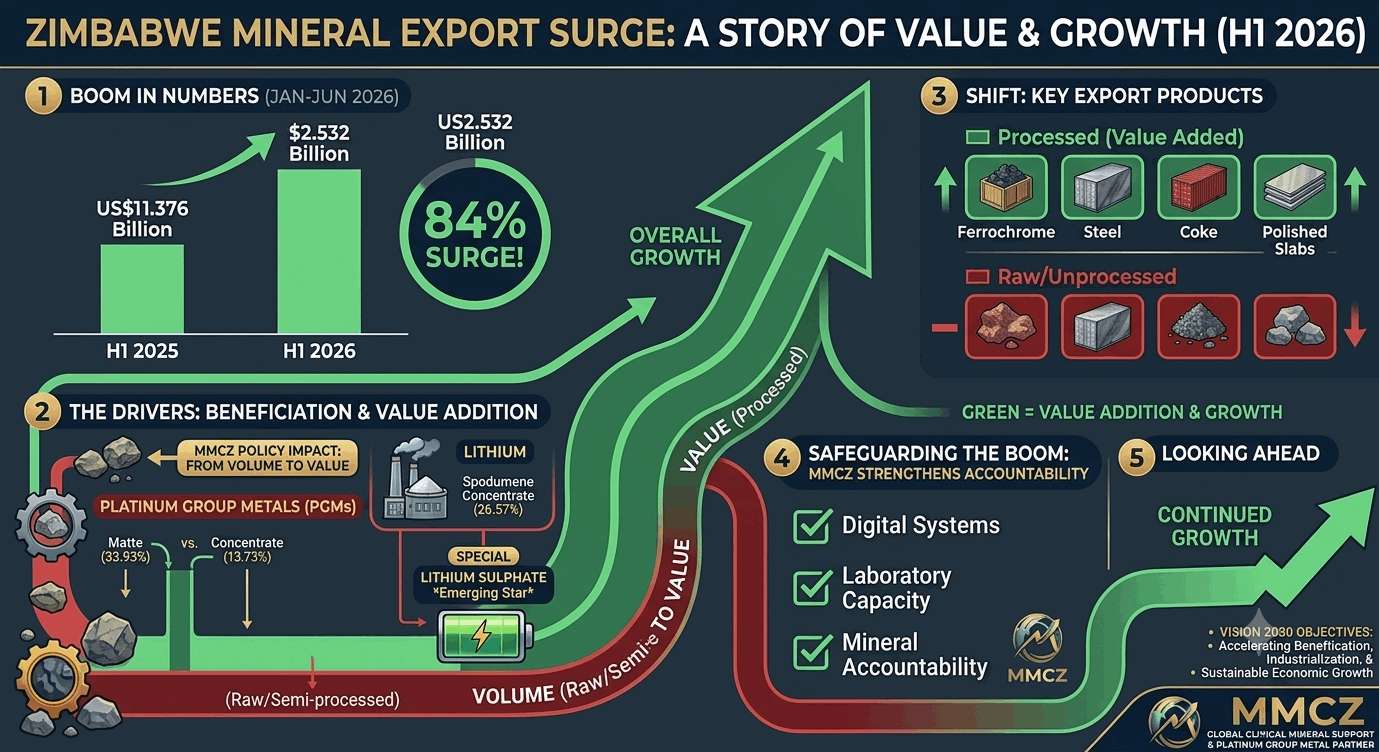
The massive 84.7 percent surge in Zimbabwe’s mineral export earnings during the first half of 2026 provides the strongest validation yet for the government’s controversial ban on raw mineral exports.
The data, released by the Minerals Marketing Corporation of Zimbabwe (MMCZ), indicates that the country generated US2.532billionbetweenJanuaryandJune,nearlydoublingtheUS1.376 billion recorded during the comparative period last year.
While market analysts acknowledge that stronger global demand and favorable commodity prices played a significant role, the underlying shift is structural. For years, regional economists have warned that Africa losing out on the electric vehicle boom by exporting unrefined lithium ores would be a historical mistake. The mid-year figures suggest that local processing infrastructure is finally coming online fast enough to alter the country's fiscal trajectory.
The breakdown of the export data reveals an aggressive concentration of value in commodities aligned with the global green energy transition.
Platinum Group Metal (PGM) matte led the charts, accounting for 33.93 percent of total export revenue, while spodumene concentrates followed closely at 26.57 percent, and PGM concentrates made up 13.73 percent.
Related Stories
Together, this trio yielded more than 74 percent of the country’s total mineral receipts, signaling a stark departure from past decades when gold and raw chrome dominated the balance sheets.
The true litmus test for the country's industrial policy, however, is the successful commercial export of locally processed lithium sulphate, which commenced early this year.
By converting spodumene into battery-grade chemical pre-cursors domestically, mining operations are drawing exponentially higher prices per ton. MMCZ General Manager Dr. Nomusa Jane Moyo noted that the shift proves national success is no longer tied strictly to extraction volumes, but rather to the complexity of the processing handled within borders.
The corporation has indicated that commodities like ferrochrome, refined steel, polished granite, and lithium sulphate are steadily replacing raw shipments, giving the country a firmer foot in the international battery supply chain.
However, the rapid influx of mineral revenue has placed renewed pressure on the state to tighten its oversight mechanisms. Industrialists point out that higher-value processed goods require far tighter supply chain auditing to prevent cross-border transfer pricing and resource smuggling. In response, the MMCZ confirmed it is expanding investments in digital tracking systems, contract monitoring, and localized laboratory networks to safeguard the revenues.









Leave Comments