









By Simbarashe Namusi
There is something deeply unsettling about the Lake Kariba tragedy that goes beyond why a boat capsized.
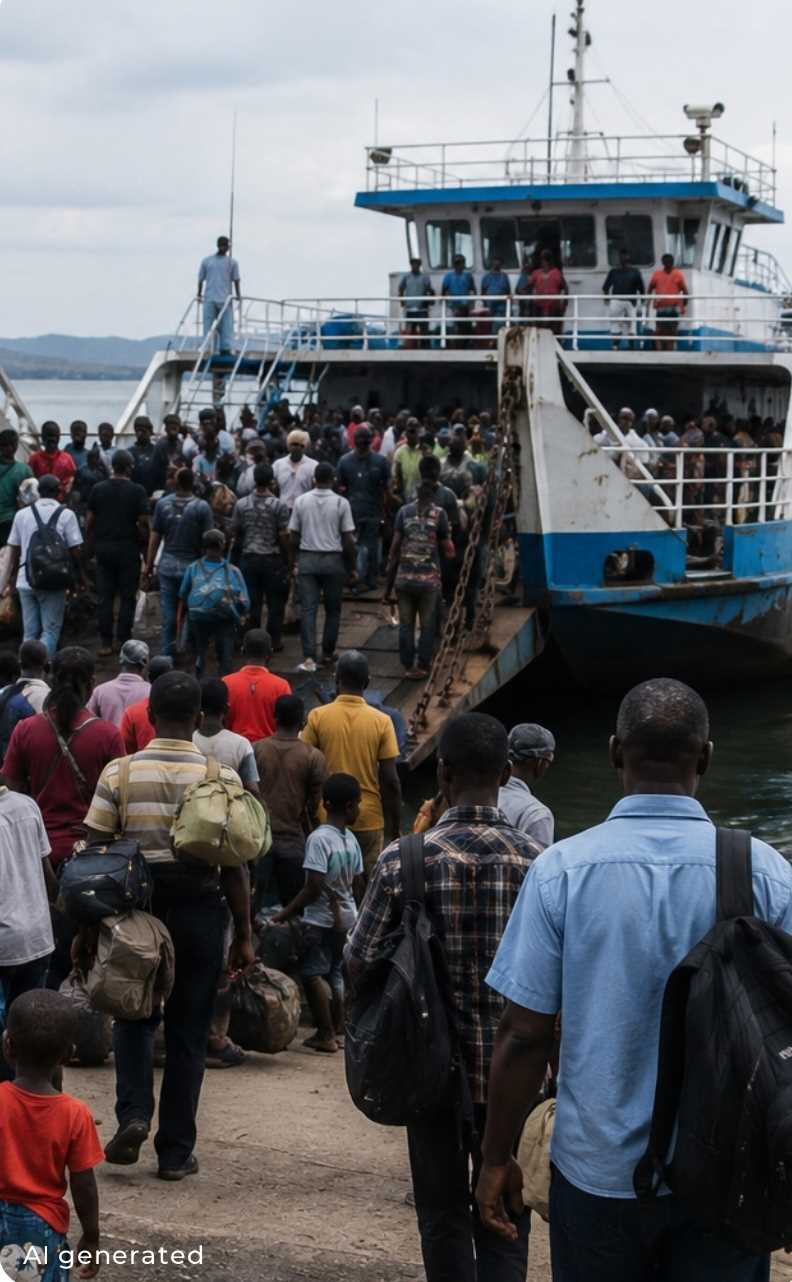
The Mbuya Nehanda was not carrying tourists on an excursion. It was serving communities in rural Nyaminyami that depend on the lake to reach Kariba urban. That places the tragedy in the territory of public infrastructure, institutional responsibility and development.
We do not yet know precisely what caused the ferry to capsize. That is for investigators to establish. But we already know enough to trouble Zimbabwe: 46 years after independence, communities in this part of the country still depend on a government ferry for basic connectivity.
The ferry belonged to the Rural Infrastructure Development Agency. It was therefore part of a public transport system on which citizens depended. Among those who used the ferry regularly were teachers crossing to Kariba urban for supplies and parents ferrying children to secondary school on the other side. For them, the ferry was not transport. It was the only door.
Reports that the vessel, with a stated capacity of 90, was carrying more than that number of adults make questions about safety, supervision, maintenance and accountability unavoidable.
But even those questions are not the whole story.
The more uncomfortable question is why so many people needed that ferry in the first place.
Kariba is one of Southern Africa's great infrastructure stories. The dam was built to generate electricity and transformed the Zambezi Valley. In the process, tens of thousands of Tonga people on both sides of the Zambezi were displaced from their ancestral lands. They paid a real price for a project whose benefits were national and regional.
The communities around Kariba did not simply choose to live on the wrong side of a lake. The lake was created around them by a development project of enormous national importance.
That development obligation appears to have quietly lapsed.
The Karoi-Binga road is an important link for Nyaminyami and the wider region. Government says rehabilitation is underway, but Parliament was told this year that only 62 kilometres of the 192-kilometre route is surfaced, with the remainder still gravel. That this remains a major infrastructure project more than four decades after independence tells us something about the uneven pace of development.
A ferry is not inherently a sign of failure. Water transport is legitimate infrastructure, particularly in Kariba. The problem is when an essential ferry becomes the practical lifeline for communities because the alternatives remain inadequate.
Related Stories
Good governance is not only about policies and projects. It is about whether institutions can keep public assets safe, maintain them properly, enforce standards and plan beyond the next crisis.
Zimbabwe has become too comfortable with things that are only temporarily functional. A road deteriorates, and people adjust. A public vehicle ages, and people keep using it. Eventually, the workaround becomes the system.
Then something goes wrong, and it becomes a tragedy.
Of course, it is a tragedy. But a tragedy can also expose a system that has been allowed to operate too close to the edge for too long.
This is why the Mbuya Nehanda should not become merely another occasion for condolences and an investigation that disappears from public memory once the grief subsides.
The investigation must establish what happened to the ferry. But Government should also examine the conditions that made it so indispensable.
Whether the vessel was properly maintained, whether safety requirements were enforced, and whether capacity limits were respected — these are the investigation's business. But adequate connectivity has remained a persistent problem in an area central to Zimbabwe's national development story, and that is Government's business.
Forty-six years is long enough for a country to ask whether the benefits of development have reached people who live farthest from its centres of power. Independence cannot be measured only by who occupies government offices.
It must also be measured by whether ordinary citizens can travel safely, reach hospitals, get children to school, take produce to market and connect with the economy without accepting unnecessary risks as part of everyday life.
The people of Nyaminyami have already paid a price for national development.
They should not have to keep paying for it through neglect.
That is why Lake Kariba should force a conversation bigger than one boat and one agency. We need to confront the institutional culture that allows infrastructure deficits to become permanent features of people's lives and then treats every disaster as an unfortunate interruption.
The dead deserve a proper investigation and the survivors answers. But the communities that remain deserve more than condolences.
They deserve a state that fixes the gap before people are forced to cross it at their own peril. Forty-six years after independence, the gap is still there, and so is the ferry.
Simbarashe Namusi is a media expert writing in his personal capacity.







Leave Comments