









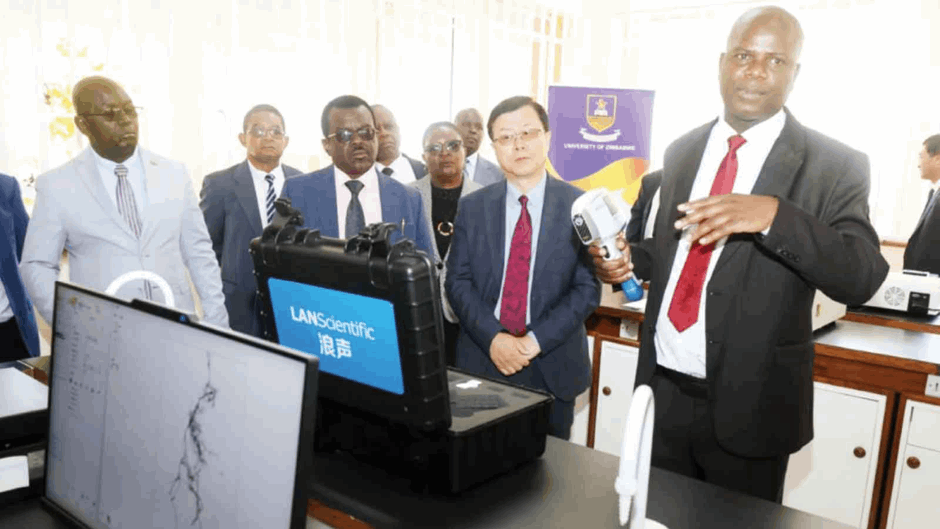
China and Zimbabwe commissioned the Belt and Road Joint Laboratory on Agriculture Ecology and Cash Crops at the University of Zimbabwe's Innovation Hub on Monday, alongside the inauguration of its Academic Committee and a first academic seminar.
Chinese Ambassador Zhou Ding said the facility marks a new phase in bilateral science, technology and education cooperation. It is one of 70 such joint laboratories China had established across 50 countries by the end of 2025, under the Belt and Road Science, Technology and Innovation Action Plan proposed by President Xi Jinping.
Higher Education Minister Frederick Shava, in remarks read on his behalf, tied the lab to government's Education 5.0 push to turn universities into drivers of industrialisation. The project is formally aligned with National Development Strategy 2 and Vision 2030, both of which prioritise ecological restoration, cash-crop upgrading and food security.
Built on an existing track record
The lab sits on top of cooperation already running on the ground.
Juncao technology, China's fast-growing grass used for mushroom cultivation, has been active in Zimbabwe since a 2021 partnership between the Ministry of Lands, Agriculture, Fisheries, Water and Rural Resettlement and the UN Department of Economic and Social Affairs. As of early 2026, over 50,000 seedlings had reached 65 households, with 187 demonstration households operating across five provinces. Equipment sent in 2024 is installed at Gwebi Agricultural College. The grass offers farmers an alternative to cotton waste, the traditional but increasingly scarce growing medium, yielding over 200 tonnes per hectare.
Related Stories
Zhou also credited the Zimbabwe Centre for High Performance Computing, built with Chinese grant funding, as the technical backbone for agro-ecological data analysis and smart agriculture research nationwide.
Trade underpins the cooperation: Zimbabwe-China trade hit US$3 billion in the first nine months of 2024 alone, up 25.6 percent year on year, driven by agriculture, minerals and machinery. ZimTrade has since run buyer missions targeting Chinese demand for Zimbabwean avocados and macadamias, product lines the new lab's cash-crop mandate directly touches.
The context the ceremony didn't dwell on
The commissioning comes as Zimbabwe is expecting another bad season while it still works through the fallout of the 2023/24 El Niño drought, which pushed food insecurity to 7.7 million people at its peak. WFP's 2026 monitoring shows partial recovery, but poor households in deficit-producing districts are still paying 34 to 57 US cents per kilogram for maize, and nearly half the population remains in extreme poverty. About 80 percent of Zimbabwean farming remains rain-fed, the exact vulnerability the lab's stated focus on climate-resilient varieties and soil management is meant to address.
Academic research on China's earlier Agricultural Technology Demonstration Centres in the region, including in Zimbabwe, has noted these facilities have functioned partly as showcases of Chinese farming technology, alongside their research role.
Zhou said the lab would help Zimbabwe leverage China's zero-tariff policy to move research output toward commercial and industrial application, a link between the laboratory and the export market ZimTrade is already courting.









Leave Comments