









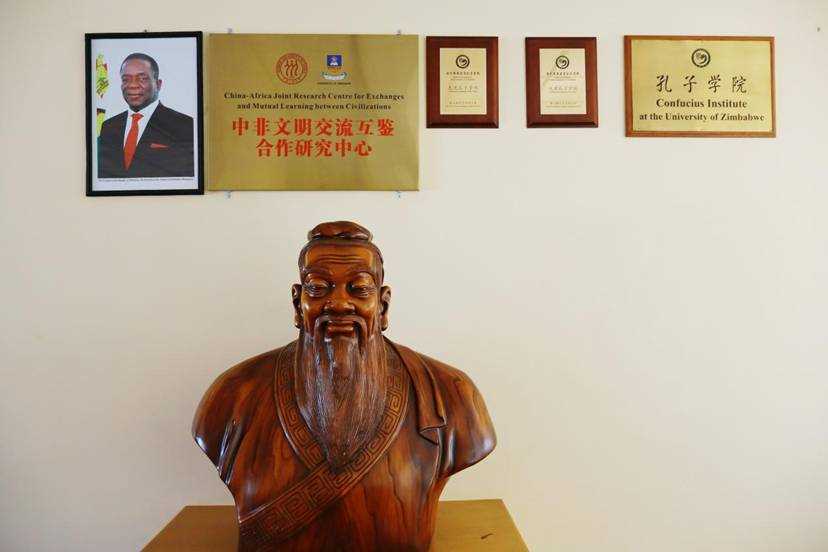
Li Liqin- Correspondent
Last year, while visiting a secondary school in Bulawayo with my colleagues to survey Chinese-language teaching, the principal greeted us warmly, then paused and asked, "What exactly is this ‘Confucius’ in ‘Confucius Institute’ all about?" He hesitated, then added with a smile, "The name is puzzling—it sounds like Confucius, Confused." The room erupted in laughter. I laughed too, but the question stayed with me.
In Africa, unfamiliarity with Confucius runs far deeper than the pronunciation of a name. Who was this Eastern philosopher who lived over 2,500 years ago? What did he do to inspire a civilization to name its language institutes after him? And what cultural tradition transformed "Confucius" into a byword for wisdom?
To answer this, we must return to the source of Chinese civilization. Confucius's greatest contribution lies in his role as the first scholar to systematically compile the "Six Classics"—the Book of Poetry, Book of Documents, Book of Rites, Book of Music, Book of Changes, and Spring and Autumn Annals. He was not their author; he was their compiler, interpreter, and transmitter. He broke the aristocratic monopoly on knowledge, recruited students, founded private education, and established the Confucian school.
During the reign of Emperor Wu of Han, the ruling class recognized the value of Confucian thought for maintaining social stability and governance. The emperor adopted the policy of "dismissing the hundred schools and exclusively venerating Confucianism," established the Imperial Academy, and appointed "Erudites of the Five Classics." Henceforth, mastery of Confucian classics became a gateway to officialdom. Confucius's thought was elevated to state orthodoxy, dominating politics, education, and culture. This was no mere academic preference; it was a profound civilizational foundation.
Around nine hundred years ago, the Neo-Confucian philosopher Zhu Xi extracted the Great Learning and Doctrine of the Mean from the Book of Rites, combining them with the Analects and Mencius to form the "Four Books." Together with the "Five Classics," they became the core canon of Chinese culture. These texts are not merely historical records; together they are a canon—scriptures that regulate worldview, truth, and values, serving as the standard and measure for judging right and wrong.
Between 1591 and 1594, the Italian Jesuit Matteo Ricci translated the Confucian Four Books into Latin, entitling the work Four Books of China for the use of subsequent missionaries to China. It was during this translation process that Ricci took the sound of "Kǒng Fūzǐ"(孔夫子) and, following Latin orthographic conventions, Latinized it as Confucius. In 1687, European missionaries published Confucius Sinarum Philosophus in Paris, formally introducing the Latinized name "Confucius" to the West. Over the following three centuries, Confucian thought entered Western academic discourse through translation. From Leibniz to Voltaire, the name of this Eastern philosopher was cited, interpreted, and debated. And in this process, the work of one British missionary proved particularly pivotal.
He was James Legge—a Scot who spent thirty years in Hong Kong and twenty-one years as Professor of Chinese at Oxford University. Between 1861 and 1872, he published in Hong Kong his five-volume The Chinese Classics, systematically introducing the Four Books and Five Classics to the English-speaking world. His translations remain standard textbooks in Sinology departments across Britain and America to this day.
Related Stories
Legge's translations are distinguished by a notable feature: he employed a method of "using the classics to annotate the classics," drawing heavily on Chinese scholars' commentaries, while simultaneously bringing the perspective of Biblical hermeneutics into his understanding of Chinese classics as a missionary. This cross-cultural "scriptural reasoning" made his annotations a classic case of Eastern and Western "sacred books" illuminating each other.
Take, for example, the line xián xián yì sè (贤贤易色) meaning value virtue above beauty in the Analects. Chinese commentators have long debated its meaning: does it mean "changing one's countenance to show respect," or "changing one's lustful heart"? Legge translated it as: "If a man withdraws his mind from the love of beauty, and applies it as sincerely to the love of the virtuous." Choosing "withdraw" rather than simply "change," and drawing on the Biblical tradition where "withdraw" commonly expresses turning away from temptation or recalling one's schemes, Legge supplied a particular nuance of meaning while remaining faithful to the Confucian tradition.
Of course, Legge's translations also raised sharp controversies. He questioned Confucius's integrity, suggesting that the Master's conduct in certain instances showed "insincerity." He also criticized Confucius's ethic of "requiting injury with uprightness" as falling short of the Christian standard of benevolence. These controversies elicited responses from Chinese scholars and revealed the complexity of cross-cultural interpretation: classics are never neutral, and every interpretation is shaped by the cultural perspective through which it is viewed.
Yet it is precisely this collision that gives classics their enduring vitality. When a British missionary reads the Analects through the eyes of an outsider or the other, and when Chinese readers, in turn, examined his ‘misreadings’ and ‘insights’ in turn, the classic gained new life through this mutual gaze and dialogue. Just so, the Zimbabwean principal's question—"Confucius, Confused?"—seemed like a linguistic joke, but in fact opened a door to civilizational dialogue.
“Confucius is not ‘Confused." He was a towering intellectual who compiled classics, founded a school of thought, and shaped a civilization. The name "Confucius Institute" is itself an expression of the enduring reverence for Confucius and the Confucian school in Chinese cultural tradition. And the China-Africa Joint Research Centre for Exchanges and Mutual Learning between Civilizations, established in Harare in 2024, together with the three subsequent sessions of the "China-Africa Civilization Forum," provides us with an important platform for cultural exchange.
Understanding Confucius is perhaps the first step in understanding Chinese culture. And for Zimbabwean and African academia, these century-spanning debates and dialogues may inspire a more universal reflection: when Shona traditional classics encounter Confucian texts, when Africa's oral wisdom enters into dialogue with the East's written civilization, might a similar "scriptural reasoning" be possible? Who knows—perhaps the Sinologists of tomorrow are sitting in today's Zimbabwean classrooms.
Editor's note: LI Liqin, Associate Professor of International School (Suzhou Research Institute), Renmin University of China; Co-Director of Confucius Institute at the University of Zimbabwe; Director of the China-Africa Joint Research Centre for Exchanges and Mutual Learning between Civilizations








Leave Comments