





Our nation invests heavily in empowering girls and women. The arguments are valid: decades of disadvantages, structural gender inequality, unequal opportunities, disproportional burdens.
But is it time to also consider the other 48% of the Zimbabwe human race? Because while we work towards uplifting women, we are neglecting young men — ignoring their crises, their vulnerabilities, their identity confusion, their silent losses.
What if today’s empowerment programs, by omission, are seeding tomorrow’s dysfunction and discontent?
This is the uncomfortable truth we must confront today.
🔹 What the data — and the silence — show
- According to a 2025 youth-employment snapshot, Zimbabwe faces a severe unemployment and underemployment challenge among youth, male and female.
- The education system continues to lose large numbers of students: in 2024 alone ~50,000 children reportedly dropped out of school and the rates are almost the same for boys and girls.
Yet almost all gender-focused empowerment programs remain directed at girls: scholarships, mentoring, life-skills, financial support.
In plain language: a large portion of boys and young men — many of them educated, or partially educated — are entering adulthood unemployed, underprepared, unsupported and largely invisible to these programs.
We are neglecting boys — psychologically, socially, culturally and yes, economically.
Alienation & resentment as fertile ground for toxicity
When society invests only in girls, boys grow up watching. They see scholarships, support networks, campaigns, funding — but nothing for them.
They feel abandoned, undervalued, unprotected. The same society that preaches equality gives them no route to positive masculinity.
Without spaces for honest conversation, mentorship, emotional support — boys often search for identity in dangerous places: hyper-masculinity, misogyny, addiction, violence, extremist ideas.
They become vulnerable to narratives that tell them ‘real men’ must dominate, control, punish — because that’s all that seems to give them a sense of power or purpose.
That’s how models like “gender-war content creators” emerge, offering warped certainty in a world that ignored them.
Related Stories
Relationship dysfunction & cycles of violence
Women may have empowerment — education, income, confidence — but relationships require two people.
If the male half is broken — unemployed, frustrated, socially isolated — the imbalance can lead to domestic violence, abuse, resentment, and emotional collapse.
Empowerment without inclusion breeds instability.
A generation where women and men are socialised on different tracks — girls lifted up, boys left behind — becomes a society where genders inhabit parallel universes.
Understanding, empathy, shared responsibility — the foundations of healthy social relations — erode.
Why current empowerment programming is failing the “leave no one behind” test
- Most initiatives target only girls/women. That’s often justified by statistics on female disadvantages — but disadvantages are not frozen in time. Young men are suffering too — in different ways.
- There are few structured spaces for boys/young men: no mentorship, no emotional-health programming, no life-skills inclusive of their realities.
- There is little data collection or public discussion about male youth crises — dropout, unemployment, mental health, social marginalisation, but they have a higher suicide rate that their female counterparts, which is a huge red flag.
- The assumption persists that uplifting women solves gender inequality — but gender equality requires both sides, equally supported.
What genuine, inclusive empowerment must look like
If we truly want equality — not just symbols — we must create:
- Youth programmes that include young men and women equally — addressing unemployment, life skills, mental health, skills training, mentorship.
- Safe spaces for boys and young men to discuss identity, masculinity, frustration, fear — before they spiral into resentment or violence.
- Mixed-gender community programs that build empathy, collaboration and shared understanding — not competition or division.
- Data collection, research and transparency about youth dropout, unemployment, mental health across genders — so policy responds to reality, not assumptions.
- Long-term support — not only during school, but through post-school transitions, early adulthood, career building, family formation.
The brutal truth we cannot dodge
We cannot fight gender-based violence, inequality or societal fragility by lifting only half the population.
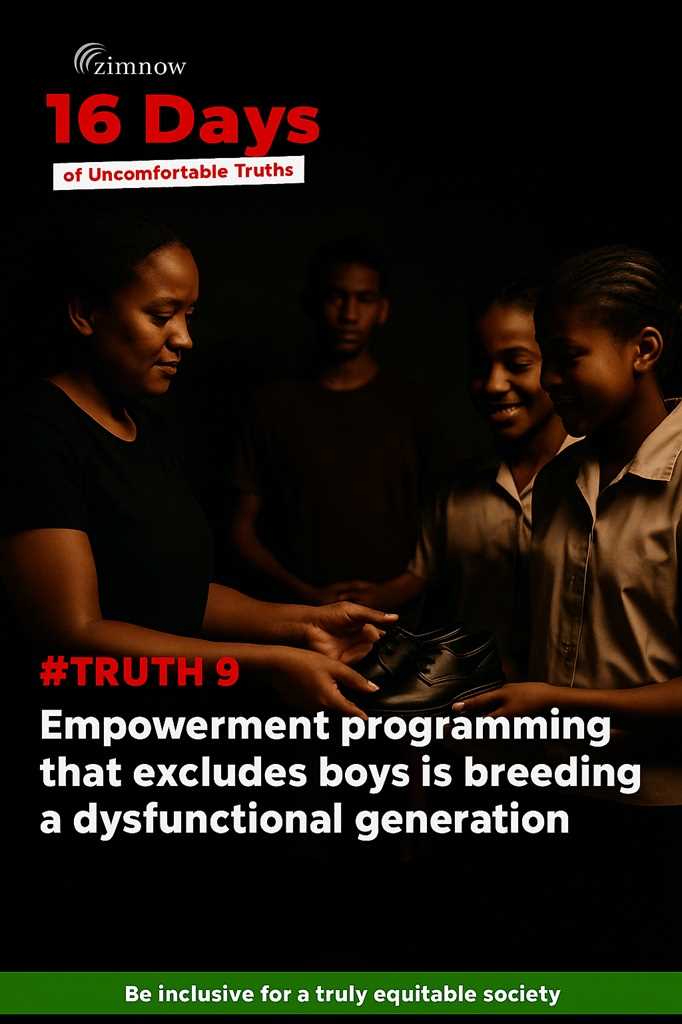
When empowerment programmes systematically exclude boys — or treat them as “the norm” that doesn’t need support — we are building a generation of resentful, unsupported, socially lost young men.
We are building generation that creates its own narratives, often toxic, that undermines the very progress we celebrate by punishing the women being uplifted.
If we care about equality, social justice, peace and sustainable progress — we must leave no one behind.
A society that truly respects women must also protect men. A generation that empowers women must also nurture men. Because progress without inclusion is just another form of exclusion.







Leave Comments