







Government has introduced new regulations restricting foreign participation in sectors designated for local control, following the gazetting of Statutory Instrument 215 of 2025 under the Indigenisation and Economic Empowerment (Foreign Participation in Reserved Sectors) Regulations.
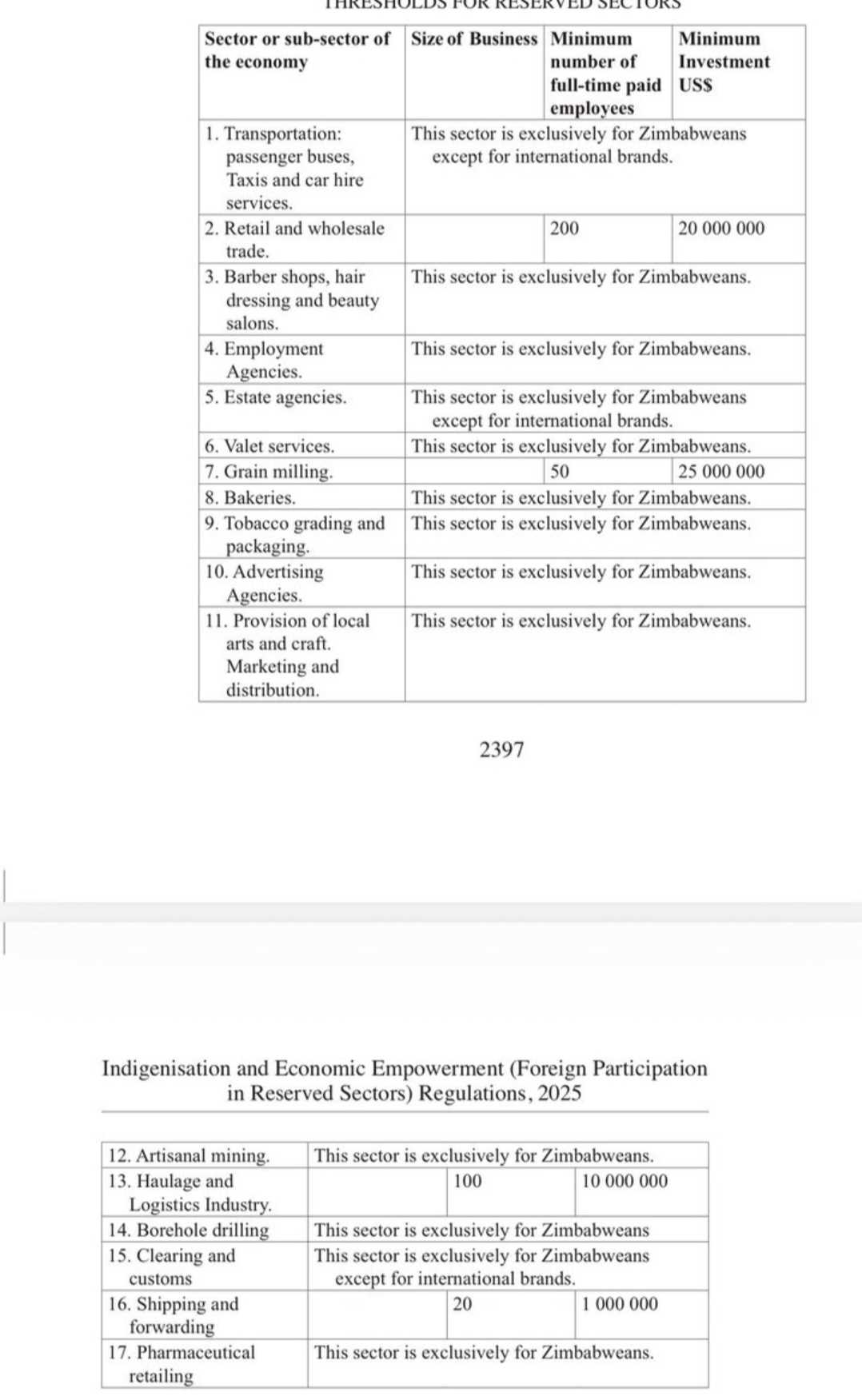
The rules outline 17 sectors that are either fully reserved for Zimbabweans or open to foreign investors only under strict conditions.
Businesses such as artisanal mining, bakeries, tobacco grading, employment agencies, barber shops, hair salons, advertising, and the marketing and distribution of local arts and crafts are now exclusively for Zimbabwean citizens.
Other sectors permit foreign participation but require significant capital commitments and job creation. In retail and wholesale trade, foreign investors must put in a minimum of US$20 million and employ at least 200 full-time workers.
Related Stories
In the haulage and logistics sector, the minimum investment is US$10 million, with a requirement to employ at least 100 workers.
Grain milling remains open to foreign investment only for entities investing at least US$25 million and hiring a minimum of 50 employees. Shipping and forwarding requires foreign investors to commit at least US$1 million and employ at least 20 staff.
Some sectors — including passenger transport services such as buses, taxis, car hire, and clearing and customs — remain fully reserved for locals, although exemptions may be granted for established international brands.
Foreign-owned businesses currently operating in the restricted sectors must restructure their ownership within three years. They are required to sell 75% of their shareholding to Zimbabwean citizens, divesting 25% each year under the transition framework.
The regulations do not affect foreign control in other strategic sectors of the economy, including large-scale mining, banking and broader commercial operations.
Authorities say the measures aim to boost local participation in key industries while continuing to accommodate foreign investment in capital-intensive sectors.









Leave Comments