








Zimbabwe’s agriculture sector has emerged as a central pillar in the Zimbabwe Investment and Development Agency’s 2025 project pipeline, with export-oriented citrus and livestock developments positioned to drive foreign currency inflows, rural employment and value-chain industrialisation.
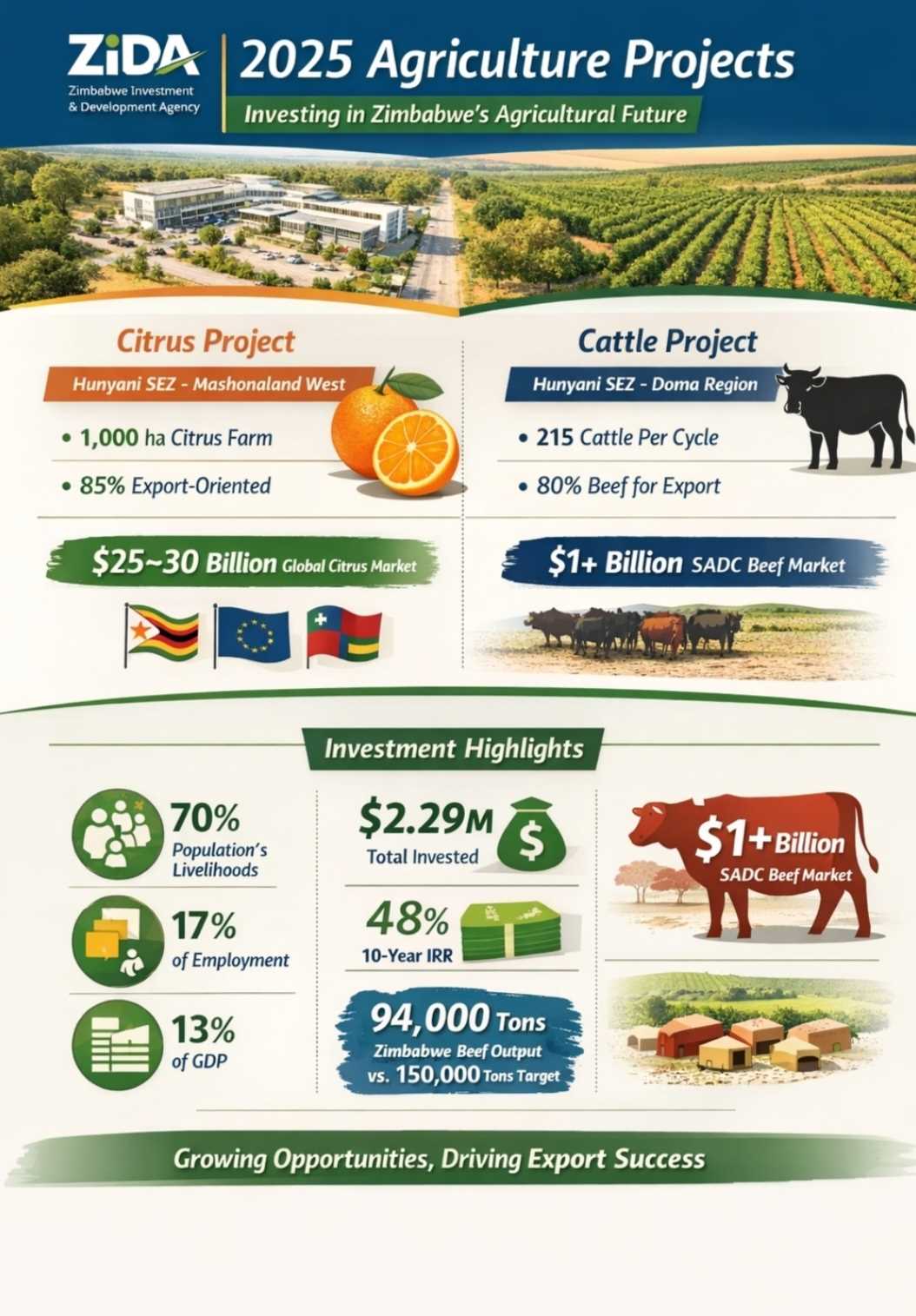
According to ZIDA, agriculture remains “a cornerstone of Zimbabwe’s economy,” supporting the livelihoods of about 70 percent of the population while contributing 17 percent of formal employment and 13 percent to national gross domestic product.
The agency notes that the sector’s resilience and scalability continue to attract investor interest, particularly within Special Economic Zones designed to accelerate agro-industrial growth.
One of the flagship projects outlined in the 2025 portfolio is the Hunyani Agro-Industrial Special Economic Zone Citrus Project in Mashonaland West, owned by DuroCurry (Private) Limited. The project is anchored on 1,000 hectares of citrus production, with 85 percent of output earmarked for export markets and revenues denominated in United States dollars.
ZIDA states that the project benefits from “legally secured land and water rights, including a 99-year lease and Lake Manyame as a secure water source,” a structure aimed at reducing investor risk while supporting long-term production planning. The agency highlights that the global citrus market, valued between US$25 billion and US$30 billion, is growing at an annual rate of five to seven percent, driven by rising demand for fresh fruit, juices, concentrates and essential oils.
Export destinations for the HAISEZ citrus project include regional supermarket chains, as well as private sector buyers in Europe, particularly the Netherlands and Germany, alongside Asia and the Middle East. ZIDA says Zimbabwe’s proximity to Harare’s logistics infrastructure creates “budget-friendly, scalable production operations,” enhancing competitiveness in EU, Middle East and AfCFTA markets.
Alongside horticulture, ZIDA has also placed strong emphasis on livestock development through the HAISEZ Cattle Project, located within the Hunyani Estate in the Doma–Chinhoyi district, about 65 kilometres west of Harare.
Related Stories
The project, owned by DawnCiry (Private) Limited, is positioned as a green-field, provincially enabled investment aligned with Zimbabwe’s livestock transformation agenda.
“The Ministry of Agriculture has allocated approximately 1,000 hectares of ranch land for the project, with the land set as proposed Livestock/Agro-Industrial use only,” ZIDA notes in the project description. The cattle project is export-oriented, with 80 percent of production targeted for external markets, tapping into a Southern African Development Community beef market valued at over US$1 billion.
ZIDA’s analysis highlights a structural supply gap in Zimbabwe’s beef industry, with national output currently estimated at 94,000 tonnes per annum against a target of 150,000 tonnes, representing a shortfall of about 62 percent. The Hunyani cattle project is designed to help close this gap through improved livestock genetics, expanded pastures and investment in processing infrastructure.
Operating initially on 12.5 hectares, the project will breed, fatten and process 215 beef cattle per cycle using a rotational paddock system. ZIDA says the development will “generate significant employment for local communities” while integrating smallholder farmers through structured out-grower schemes and supply linkages.
The total investment required for the cattle project is US$2.29 million, covering infrastructure upgrades, breeding stock acquisition and working capital. ZIDA projects a 10-year internal rate of return of 48 percent, a net present value of US$1.79 million, and a payback period of three years, positioning the project as a high-return opportunity for private sector partners.
Beyond individual projects, ZIDA notes that Zimbabwe’s broader agricultural competitiveness is underpinned by “abundant arable land and water, a temperate climate suitable for year-round production, and preferential market access to global markets.”
The agency also points to low labour costs and harmonised customs and certification systems as key export advantages.
Through the 2025 agriculture project pipeline, ZIDA says it is seeking to attract strategic investors who can support value addition, agro-processing and export growth, while strengthening rural incomes and food systems resilience.









Leave Comments