








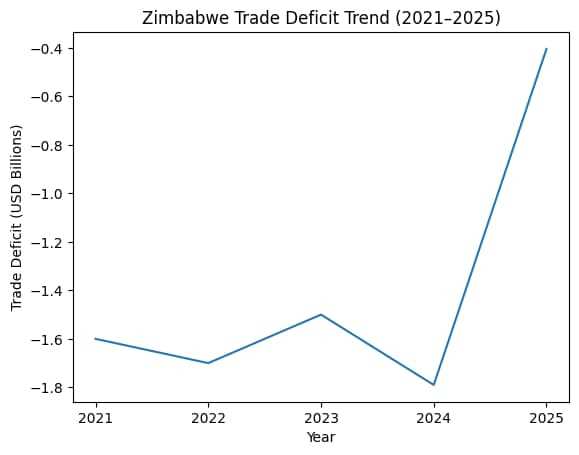
Zimbabwe’s annual trade deficit narrowed sharply to US$404 million in 2025, the lowest level in five years, after a strong second-half export surge offset heavy import pressures in the first half of the year.
The improvement marks a dramatic shift from the US$1.79 billion deficit recorded in 2024 and from average annual gaps exceeding US$1.6 billion between 2021 and 2024.
Total exports rose to US$9.71 billion in 2025, up from US$6.06 billion in 2021, reflecting stronger mining output, improved agricultural performance and a fast-growing horticulture sector. Imports climbed to US$10.11 billion from US$7.37 billion in 2021, driven largely by fuel and food-related purchases.
Buy Zimbabwe, in its 2025 Export and Import Trade Analysis Report, said: “The sharper rise in exports, supported by higher production and favourable commodity prices, enabled the deficit to shrink markedly, signalling improved external resilience.”
Related Stories
The turnaround was largely driven by a second-half surplus of about US$423 million, which reversed a US$824 million deficit accumulated between January and June.
December alone posted a US$245 million surplus, with exports reaching US$1.21 billion against imports of US$963 million.
Semi-manufactures dominated exports at 47 percent, followed by nickel mattes at 15 percent and Virginia flue-cured tobacco at 13 percent. Gold exports reached US$4.64 billion, underpinned by record output of 46.7 tonnes.
Horticulture also recorded strong growth, with blueberry exports exceeding US$120 million in 2025, up from under US$10 million five years ago. Citrus, macadamia nuts, peas and cut flowers continued to expand, collectively contributing hundreds of millions of dollars and positioning horticulture as one of the fastest-growing non-traditional export segments.
However, imports remain heavily concentrated in energy and agricultural inputs. Diesel imports alone exceeded US$1.17 billion, while maize imports stood at US$443 million, alongside significant fertilizer and machinery purchases.
While the narrowing deficit signals improved external stability, the narrow export base and heavy reliance on fuel and food imports continue to expose the economy to global price volatility.









Leave Comments