







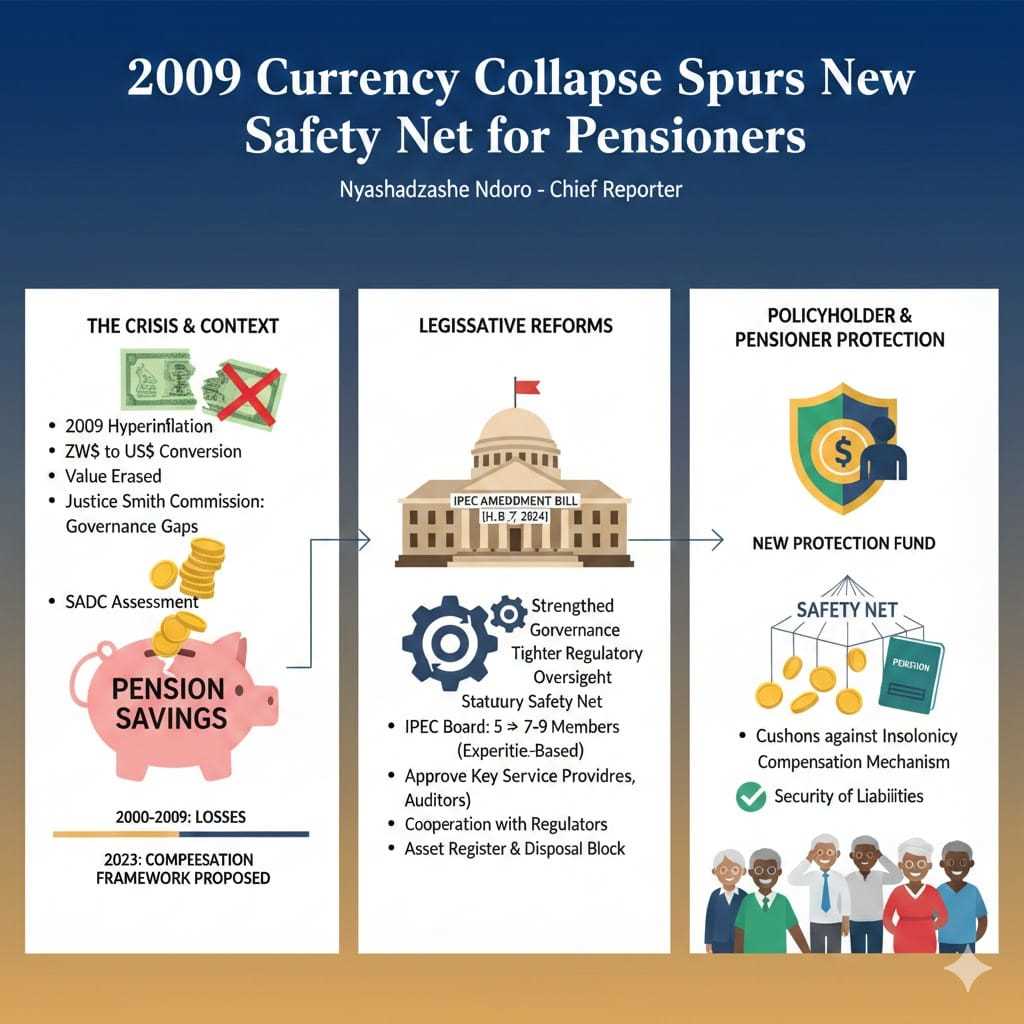
Justice Minister Ziyambi Ziyambi has tabled sweeping amendments to the Insurance and Pensions Commission Act, anchoring the proposed reforms on long-standing governance weaknesses and the unresolved fallout from Zimbabwe’s 2009 currency collapse that wiped out pension savings.
Presenting the Second Reading of the Insurance and Pensions Commission Amendment Bill [H.B. 7, 2024] in the National Assembly, Ziyambi said the legislation seeks to strengthen corporate governance at IPEC, tighten regulatory oversight and introduce a statutory safety net for policyholders and pension fund members.
The Bill comes against the backdrop of government efforts to address losses suffered by pensioners during the hyperinflation era, when the abandonment of the Zimbabwe dollar in favour of the US dollar erased the value of Zimbabwe dollar-denominated savings.
In 2023, IPEC announced a compensation framework requiring pension funds and insurers to quantify losses and propose payouts to eligible members who lost value between 2000 and February 2009.
IPEC commissioner Grace Muradzikwa said at the time it was “right, fair, proper and desirable” for affected pensioners to receive compensation from pension funds, insurers and the state, arguing that the industry had the capacity to compensate members “to the fullest extent practicable”.
However, the proposal drew resistance from sections of the industry. Asset managers, including Harare-based Imara Asset Management, warned that the compensation demand could destabilise the sector if implemented in an accelerated manner.
Executives at the firm argued that the framework appeared to exclude the National Social Security Authority, raising concerns about uneven treatment between private pension schemes and the national statutory fund.
Related Stories
It is within this context of historical loss, industry tension and regulatory gaps that the new amendment Bill has been introduced.
Ziyambi told Parliament that the legislation seeks to harmonise the Insurance and Pensions Commission Act with the Insurance Act and the Pensions and Provident Fund Act to eliminate regulatory arbitrage and ensure consistent supervision.
He said Zimbabwe’s regulatory framework has lagged behind rapid changes in financial markets and technological innovation, creating oversight weaknesses.
The minister also cited findings of the Justice Smith Commission of Inquiry, which investigated the 2009 conversion of insurance and pension values. The commission identified serious corporate governance deficiencies and recommended strengthening IPEC’s legal and supervisory powers.
Further impetus for reform came from an assessment by the Southern African Development Community Secretariat, which benchmarked Zimbabwe’s compliance with standards set by the International Association of Insurance Supervisors and the International Organisation of Pension Supervisors.
Among the key proposals is the expansion of IPEC’s board from five members to between seven and nine, in line with the Public Entities Corporate Governance Act. Board appointments will be based on expertise in insurance, pensions, actuarial science, law, finance, ICT and related fields, while stricter conflict-of-interest provisions will disqualify individuals with significant interests in regulated entities.
The Bill also empowers IPEC to approve key service providers such as actuaries, auditors and asset managers, enhancing front-line regulatory assurance. It strengthens provisions for cooperation with domestic and foreign supervisory authorities and clarifies governance structures within the Commission.
Significantly, the amendments provide for the establishment of a Policyholder and Pensions and Provident Fund Members Protection Fund, a statutory compensation mechanism designed to cushion policyholders and pension contributors in the event of the insolvency of an insurer or pension fund. The absence of such a safety net was highlighted by the Justice Smith Commission, which warned that no institution is immune to failure.
The Commission will also be empowered to maintain a register of assets held by regulated entities and may block disposals that threaten the security of policyholder and pension liabilities, a move aimed at preventing asset stripping or value erosion that previously left contributors exposed.







Leave Comments