





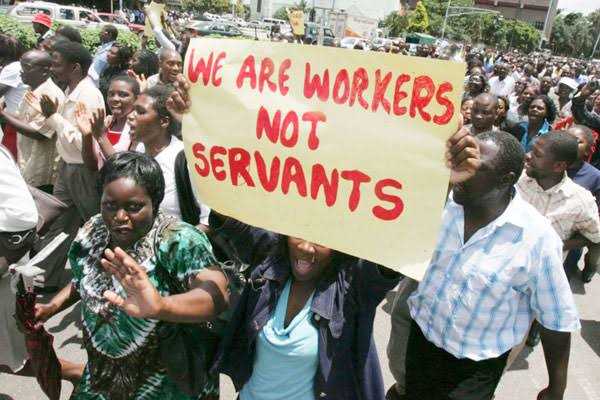
Zimbabwe’s tax regime is facing renewed scrutiny after legislators warned that the current Pay-As-You-Earn structure is placing an increasingly heavy burden on low- and middle-income workers, effectively turning ordinary salaries into one of the State’s most dependable revenue sources.
Debate in Parliament this week highlighted how statutory deductions are eroding workers’ disposable income long before households meet basic living costs, raising concerns that the tax system is disproportionately targeting formal employees.
At the centre of the controversy is the tax-free threshold, which remains fixed at just US$100 per month. Lawmakers argued that the threshold captures workers too early in the income scale, exposing even modest earners to immediate taxation.
Gokwe-Kabuyuni legislator Spencer Tshuma, who moved the motion in the National Assembly, described the structure as fundamentally unfair.
“The tax brackets in Zimbabwe are punitive to low-income earners. The tax-free threshold is too low — anyone earning US$100.01 is subjected to these painful taxes,” he said.
Under the current framework, workers earning between US$100 and US$300 are taxed at 20%, while those earning up to US$1,000 face a 25% rate, before additional statutory deductions are applied.
Beyond PAYE, employees contribute 4.5% towards the National Social Security Authority (NSSA) pension scheme, while a 3% AIDS levy is charged on the tax itself, compounding the overall deduction burden.
Parliamentary examples illustrated the practical impact on workers’ incomes. A salary of US$300 leaves a worker with approximately US$233.79 after deductions. A construction worker earning US$396.56 loses more than US$79 to statutory obligations, while a mining employee earning US$899.12 forfeits over US$225 — more than a quarter of total earnings.
Legislators noted that these deductions occur before workers encounter indirect taxes such as Value Added Tax (VAT), effectively subjecting employees to multiple layers of taxation on already reduced income.
Taxing poverty
Members of Parliament argued that the PAYE structure no longer reflects Zimbabwe’s cost-of-living realities. The poverty datum line, estimated at about US$250 per month for a family of five based on food requirements alone, already approaches or exceeds many workers’ post-tax earnings.
Tshuma warned that the existing tax bands risk deepening inequality rather than promoting fairness.
Related Stories
“The current tax brackets do not reflect the cost-of-living realities, thereby exacerbating inequality and poverty levels,” he said.
Critics say this effectively results in taxation of income that falls close to, or below, subsistence levels, raising broader questions about whether PAYE in Zimbabwe functions as a progressive tax or a regressive extraction mechanism.
Lawmakers further argued that structural imbalances allow higher-income earners greater flexibility to reduce effective tax exposure through deductions and financial planning, while salaried workers remain fully visible to tax authorities and taxed at source.
The motion noted that lower-income employees bear the most consistent tax burden, while wealthier individuals often benefit from exemptions or optimisation opportunities unavailable to ordinary workers.
Regional comparison exposes disparity
Comparisons with regional and international peers underscore Zimbabwe’s unusually low tax-free threshold.
South Africa maintains a tax-free threshold of about US$6,450 per year, Mauritius US$9,350, Botswana US$2,900, and the United States roughly US$12,000 annually.
Zimbabwe’s equivalent — approximately US$1,200 per year — places taxation deep into low-income earnings, widening the tax net far below regional norms.
Reliance on formal workers
Although not explicitly framed in those terms during debate, legislators suggested that PAYE has become one of government’s most reliable revenue streams because it is easily collected from formally employed workers who have limited avenues for avoidance.
Tshuma warned the structure could produce unintended economic consequences, including incentives for under-declaration of salaries, informal employment arrangements and tax avoidance behaviour between employers and employees.
Lawmakers are now pushing for wide-ranging reforms, including raising the tax-free threshold to at least US$500 per month, introducing inflation-indexed tax bands, easing rates for lower-income earners and tightening loopholes benefiting high-income taxpayers.
Proponents argue that reform is necessary not only to ease pressure on workers but also to rebuild confidence in Zimbabwe’s tax system and strengthen long-term compliance.







Leave Comments