





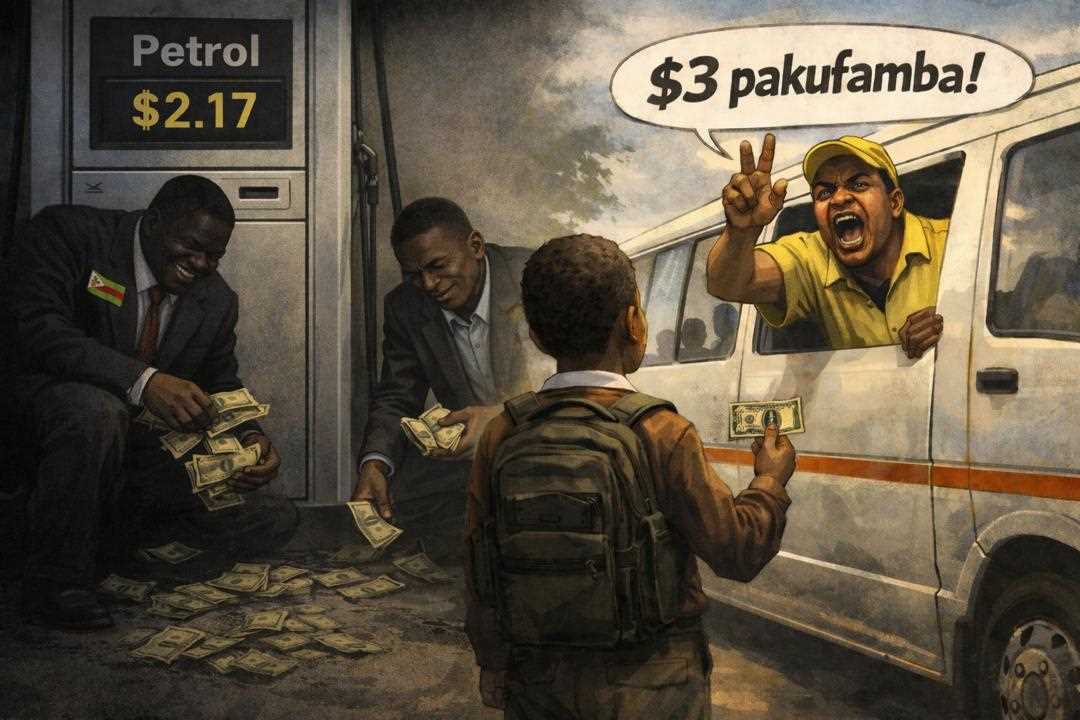
Eleven days after President Emmerson Mnangagwa directed government to review taxes blamed for Zimbabwe’s high fuel prices, motorists are still paying US$2.17 per litre of petrol and US$2.06 for diesel — with no visible relief at the pump.
The delay raises a fundamental question: who exactly are Zimbabweans paying for every litre of fuel?
Current pricing structures show that up to 86 cents of every litre of petrol consists of taxes and statutory levies. The figure, derived from the fuel pricing framework circulating within the industry, has not been disputed by the Zimbabwe Energy Regulatory Authority, which maintains that levy components are determined within the national fiscal framework and implemented through the regulated pricing model.
The implication is clear. Zimbabwe’s fuel price problem begins less with international oil markets and more with domestic policy choices.
Across Southern Africa, countries are exposed to the same global crude oil environment. The Free on Board (FOB) cost — the international benchmark price of refined fuel — remains broadly similar across the region. Government itself has acknowledged this reality.
Where prices begin to diverge is in what governments add after fuel lands.
Regional comparisons illustrate the gap. Around mid-March 2026, Malawi recorded petrol prices near US$2.85 per litre, the highest in the Southern African Development Community. Zimbabwe followed at US$2.17, while neighbouring Zambia — also landlocked — sold petrol at roughly US$1.37. Most other regional markets cluster between US$1.05 and US$1.30.
Malawi’s pricing reflects structural constraint. The country lacks pipeline infrastructure and depends heavily on long-distance road transportation, making logistics expensive and supply chains vulnerable to disruption.
Zambia tells a different story. Pipeline access combined with a more competitive procurement framework has opened the supply chain to multiple importers. Recent reforms reduced concentration in fuel procurement, allowing efficiencies to filter into pump prices.
A March 2026 price adjustment even moved downward, reflecting currency stability and improved purchasing dynamics.
Related Stories
Zimbabwe, by contrast, possesses structural advantages that should theoretically translate into lower prices. The Beira–Feruka–Harare pipeline reduces transport costs, ensures stable supply, and positions the country as a regional fuel transit corridor.
Yet Zimbabwe’s prices remain far closer to Malawi’s than Zambia’s.
The divergence begins with market structure. Zimbabwe’s fuel supply chain remains highly concentrated, limiting competitive pressure that typically forces prices down. With few dominant players controlling procurement and distribution, cost efficiencies struggle to reach consumers — leaving motorists effectively exposed to a tightly controlled market.
Policy choices deepen the imbalance.
Zimbabwe mandates ethanol blending using locally produced ethanol supplied primarily by Green Fuel at approximately US$1.10 per litre. At the same time, ethanol produced domestically at Triangle is exported into regional markets, including Zambia, at prices closer to US$0.68 per litre.
The result is a pricing paradox: a domestic product costs Zimbabwean consumers significantly more than buyers in neighbouring countries pay for the same commodity.
Finance Minister Mthuli Ncube has argued that government interventions have already prevented steeper fuel price increases, saying adjustments to levies and taxes effectively cushioned consumers.
However, motorists have yet to see measurable relief.
Despite a presidential directive, repeated signals of an impending review, and sustained public concern over regional price disparities, pump prices remain unchanged nearly two weeks later.
For now, Zimbabweans continue to pay one of the highest fuel prices in Southern Africa — with the bulk of the cost constructed not abroad, but at home.





Leave Comments