






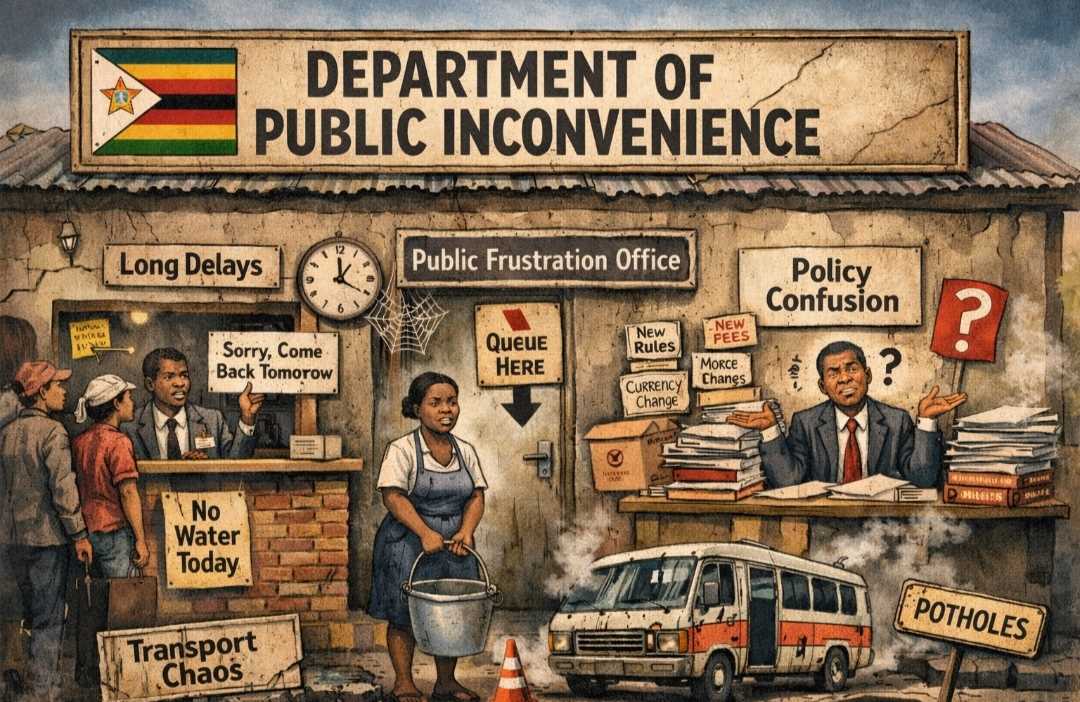
If Zimbabwe were to formalise the lived experiences of its citizens into a government structure, it might well establish a new ministry: the Department of Public Inconvenience.
It would require neither a budget announcement nor parliamentary debate to justify its existence. Its mandate is already embedded in everyday life.
From erratic service delivery to unpredictable policy shifts, Zimbabweans navigate systems that often feel designed less for efficiency than for endurance. The question is no longer whether inconvenience exists — it is whether it has effectively become institutionalised.
Take utilities. The daily struggle is no longer defined solely by absence, but by the frustration of systems that fail even when citizens are ready to comply. In the case of electricity, the problem extends beyond load shedding. Increasingly, Zimbabweans encounter breakdowns in prepaid vending platforms themselves. One may have the money, the intention and the need — yet still fail to access power because the purchasing system is down, delayed or unreliable. The simple act of buying electricity becomes an unpredictable exercise, layering inconvenience upon scarcity.
Water presents an even starker paradox. In many areas, residents are expected to prepay for a service that is inconsistently available — or at times absent altogether. The infrastructure to collect payment exists, but the infrastructure to deliver water does not always follow. It is a contradiction that captures the essence of Zimbabwe’s public service dilemma: systems function well enough to demand compliance, but not reliably enough to guarantee delivery.
Infrastructure challenges, however, are only one layer of the inconvenience matrix.
Policy inconsistency arguably inflicts deeper and more systemic disruption. Monetary policy, for instance, has oscillated with such frequency that confidence struggles to take root. Businesses price defensively, consumers spend cautiously, and long-term planning becomes speculative. Announcements intended to stabilise often generate fresh uncertainty. In such an environment, the citizen becomes both participant and casualty in an economic guessing game.
Transport provides another chapter in this unofficial department’s portfolio. The daily commute — particularly in Harare — has evolved into a test of patience and resilience. Informal ranks emerge overnight, traffic management appears reactive, and enforcement remains uneven. The result is a system in which time, perhaps the most finite resource, is routinely lost.
What makes these inconveniences particularly corrosive is not merely their frequency, but their normalisation. Zimbabweans have become adept at coping. They plan around outages, budget for volatility and lower expectations of service delivery. Resilience, often celebrated as a national virtue, begins to mask a more troubling reality: adaptation to dysfunction.
Related Stories
This normalisation carries risks. When inconvenience becomes the baseline, accountability weakens. Service delivery failures no longer provoke outrage; they elicit resignation. Citizens recalibrate expectations downward, and institutions face diminishing pressure to improve.
Yet it would be simplistic — and unfair — to attribute all inconvenience solely to state failure. A societal dimension also demands reflection. The proliferation of illegal vending, disregard for designated public spaces and the erosion of civic norms contribute to urban disorder. When a commuter rank spontaneously appears at a busy intersection, it reflects both regulatory gaps and citizen complicity.
In this sense, the “Department of Public Inconvenience” is not housed exclusively within government offices. It is co-produced through policy missteps, institutional weaknesses and everyday choices by citizens themselves.
Still, responsibility cannot be evenly distributed. The state retains the primary obligation to provide order, consistency and reliable services. Where systems are predictable and fairly enforced, citizen behaviour tends to align. Where they are not, improvisation fills the vacuum.
Encouragingly, there are glimpses — though inconsistent — of what reversal might look like. Targeted infrastructure investments, clearer policy communication and the strategic use of technology in service delivery have, in isolated cases, improved outcomes. These examples suggest inconvenience is not inevitable; it is largely a consequence of policy and governance choices.
The path forward requires a shift from a culture of coping to a culture of fixing.
For policymakers, this means prioritising consistency over experimentation and execution over announcement. For local authorities, it means restoring urban order through fair and sustained enforcement. For citizens, it means resisting quiet resignation while also respecting the rules that allow systems to function.
Zimbabwe does not need a Department of Public Inconvenience. It already has one — informal, pervasive and costly. What the country needs instead is the deliberate dismantling of the structures, habits and decisions that sustain it.
Until then, inconvenience will remain the country’s most efficient — and least acknowledged — public service.
Simbarashe Namusi is a peace, leadership and governance scholar and media expert writing in his personal capacity.










Leave Comments