







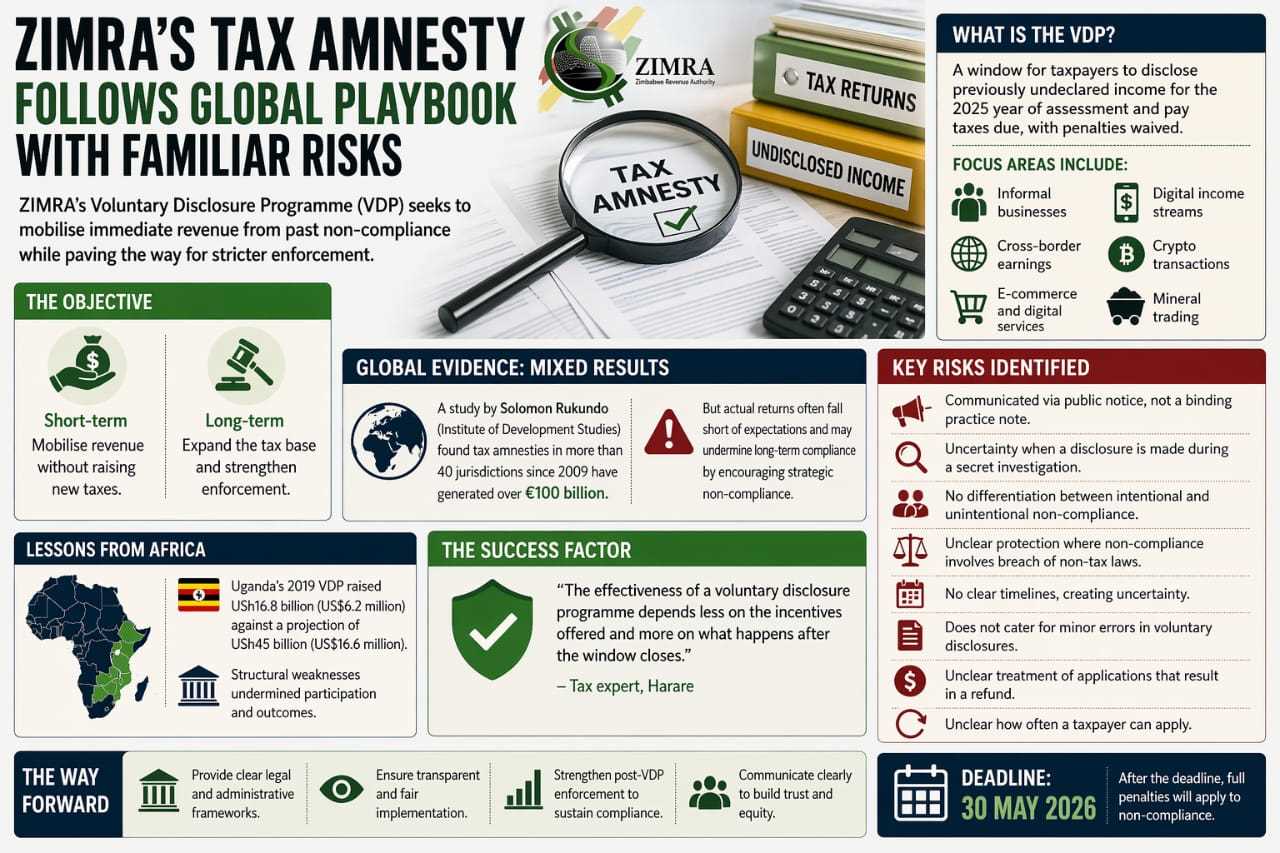
The Zimbabwe Revenue Authority’s newly announced Voluntary Disclosure Programme reflects a well-established global fiscal strategy — securing immediate revenue from past tax non-compliance while preparing the ground for tighter enforcement going forward.
The programme invites taxpayers to voluntarily declare previously undisclosed income for the 2025 year of assessment in exchange for waived penalties, though the underlying tax liability remains payable. It arrives as tax authorities broaden scrutiny to traditionally hard-to-tax areas, including informal enterprises, digital income streams, cryptocurrency transactions and cross-border earnings.
Although presented as a compliance initiative, analysts say the structure and timing suggest broader fiscal objectives. Governments frequently deploy tax amnesties when under pressure to boost revenue collection without introducing new taxes, generating short-term inflows while expanding the future tax base.
Global evidence, however, shows mixed results.
Research by Solomon Rukundo published through the Institute of Development Studies indicates that tax amnesty programmes implemented across more than 40 jurisdictions have collectively raised over €100 billion since 2009. Yet the same study cautions that outcomes often fall below expectations and may weaken long-term compliance incentives.
“Despite their global popularity, the efficacy of tax amnesties as a tax compliance tool remains in doubt,” Rukundo observed, adding that revenue generated is frequently lower than projected and could sometimes be achieved through stronger routine enforcement.
The research highlights a recurring policy dilemma: while voluntary disclosure programmes can unlock immediate revenue, they may encourage strategic non-compliance if taxpayers begin delaying payments in anticipation of future amnesties.
Related Stories
This concern carries particular relevance in Zimbabwe, where the informal economy accounts for a significant share of economic activity and compliance gaps remain persistent.
By waiving penalties but maintaining tax obligations, ZIMRA appears to be attempting a balance between encouraging disclosure and protecting the credibility of the tax system.
Zimbabwe’s VDP mirrors similar initiatives across Africa, including Uganda’s 2019 programme, which underperformed relative to revenue projections despite offering favourable participation terms.
According to Rukundo’s findings, unclear administrative procedures, limited legal certainty and weak enforcement frameworks often undermine participation rates.
Some of these risks are emerging locally. ZIMRA’s programme has been communicated primarily through a public notice, with limited detail on how disclosures will be treated where investigations are ongoing or how repeat disclosures may be handled. Questions also remain regarding the interaction between tax disclosures and potential non-tax financial offences.
At the same time, ZIMRA’s assurance that voluntary disclosures will not automatically trigger audits or prosecution reflects a common international design feature aimed at lowering psychological barriers to compliance.
“The effectiveness of a voluntary disclosure programme depends less on the incentives offered and more on what happens after the window closes,” a Harare-based tax expert said. “If enforcement does not intensify, the programme risks being viewed as a recurring opportunity rather than a once-off compliance reset.”
The authority has warned that non-compliance detected after the May 30, 2026 deadline will attract full penalties, signalling an intended transition toward stricter enforcement — a pattern widely observed globally, where amnesties serve as a bridge from weak compliance environments to more data-driven tax administration systems.
ZIMRA’s inclusion of sectors such as cryptocurrency trading, e-commerce activities and mineral transactions further points to evolving enforcement capacity, as tax administrations increasingly rely on financial data analytics, third-party reporting and cross-border information exchange to identify discrepancies and widen the tax net.







Leave Comments