








Global commodity market pressures combined with domestic operational challenges weighed heavily on Ariston Holdings Limited’s financial performance for the year ended September 30, 2025, as weak international tea prices and subdued macadamia markets constrained earnings despite efforts to stabilise operations.
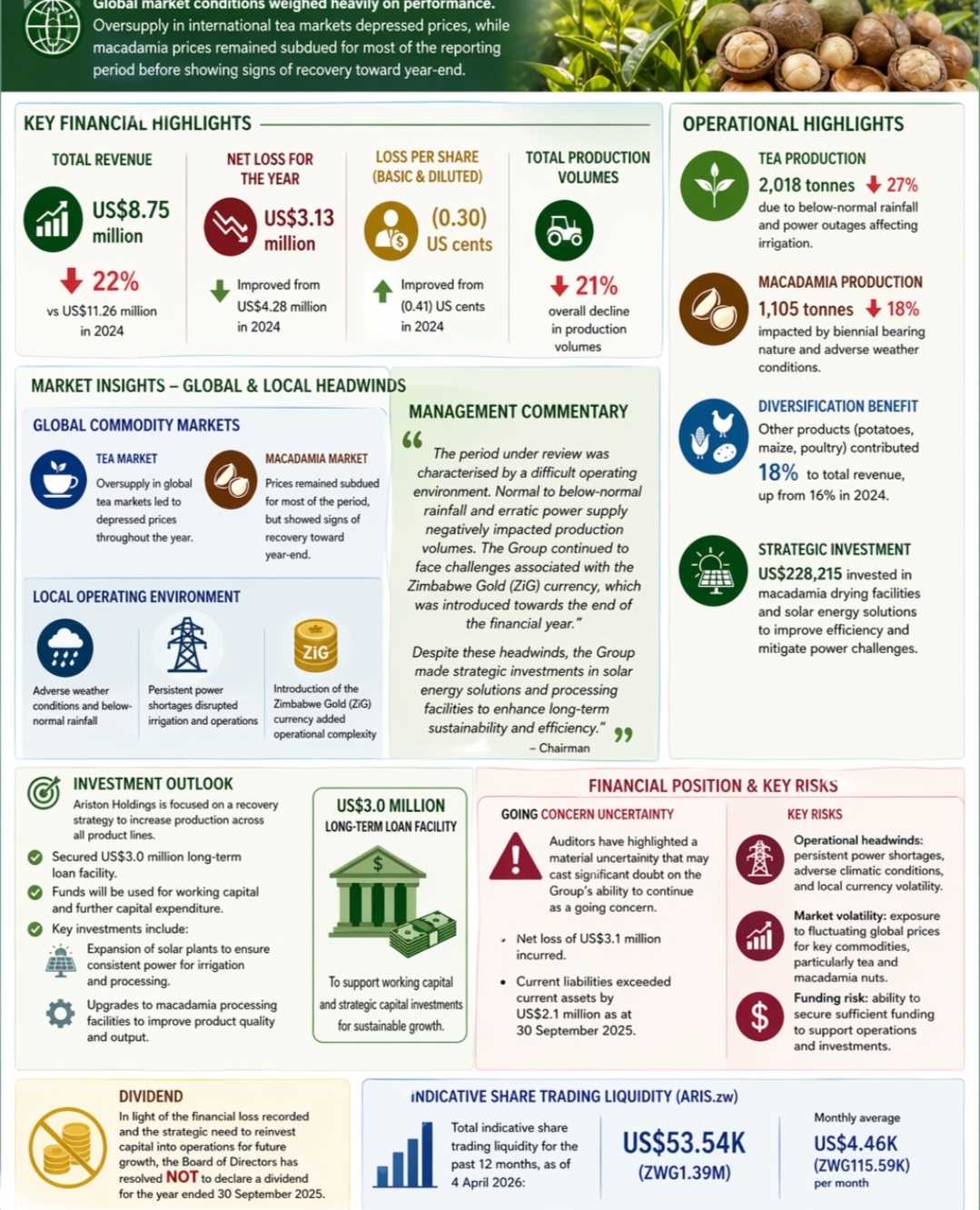
The agro-industrial group reported that an oversupply in global tea markets significantly depressed prices during the period under review, directly affecting revenue generation from one of its core export crops. At the same time, macadamia prices remained soft for most of the financial year, only beginning to recover toward the close of the reporting period.
These external market dynamics coincided with adverse weather conditions and persistent electricity shortages locally, resulting in reduced production volumes and overall revenue decline.
Revenue for the year fell 22 percent to US$8.75 million from US$11.26 million recorded in 2024, reflecting both lower output and weaker commodity pricing. However, management’s cost containment measures helped narrow the group’s net loss to US$3.13 million from US$4.28 million previously.
Commenting on the results, the company’s chairman said the business operated under exceptionally difficult conditions.
“The period under review was characterised by a difficult operating environment. Normal to below-normal rainfall and erratic power supply negatively impacted production volumes,” he said.
He added that the introduction of the Zimbabwe Gold (ZiG) currency toward the end of the financial year created additional operational complexities for the group.
Related Stories
Operationally, overall production volumes declined by 21 percent. Tea production dropped 27 percent to 2,018 tonnes as irrigation systems were disrupted by power outages and insufficient rainfall. Macadamia output fell 18 percent to 1,105 tonnes, affected by adverse climatic conditions as well as the crop’s natural biennial bearing cycle.
Despite these setbacks, Ariston’s diversification strategy provided a degree of resilience. Other agricultural activities, including potatoes, maize and poultry, increased their contribution to total revenue to 18 percent, up from 16 percent in the prior year, helping cushion the impact of weak export commodity performance.
The group continued investing in operational efficiency and energy security during the year, directing US$228,215 toward macadamia drying facilities and solar energy projects aimed at mitigating unreliable grid electricity.
“Despite these headwinds, the Group made strategic investments in solar energy solutions and processing facilities to enhance long-term sustainability and efficiency,” the chairman said.
Ariston Holdings is positioning itself for recovery as global macadamia prices begin to firm and internal productivity initiatives take effect. The company secured a US$3 million long-term loan facility to strengthen working capital and finance capital expenditure programmes, including expansion of solar plants to support irrigation and processing operations.
However, auditors flagged a material uncertainty regarding the group’s ability to continue as a going concern, noting that current liabilities exceeded current assets by US$2.1 million at year end.
The company’s future performance remains dependent on successful funding arrangements and improved operating conditions.
Management acknowledged that ongoing risks include climate variability, electricity supply disruptions, currency instability and fluctuating global commodity prices, particularly in tea and macadamia markets.










Leave Comments