









Why Africa needs innovation, not just beneficiation
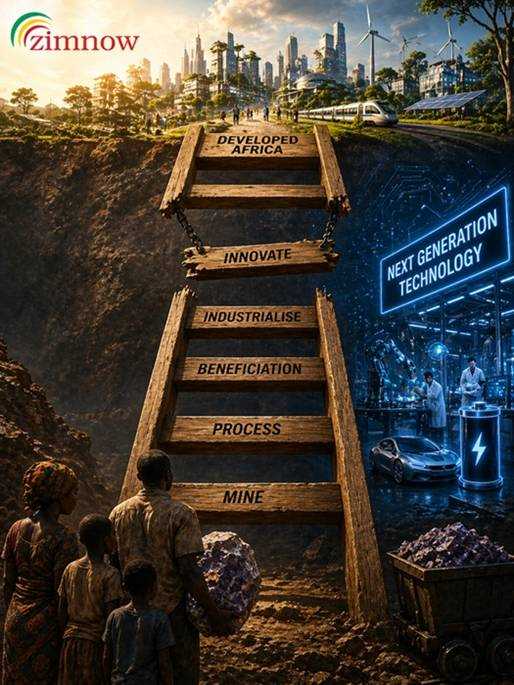
Before the world decided it needed lithium, Zimbabwe's deposits were of no value. Then the electric vehicle revolution came, and suddenly that rock became a critical mineral, a sovereign asset, a diplomatic bargaining chip, and the centrepiece of Zimbabwe's Vision 2030 industrialisation narrative. But what happens when the world decides it no longer needs that rock?
The diamond debacle
Africa has been here before, holding a resource the world desperately wanted, and failing to translate that want into durable industrial capacity before the window closed.
Diamonds once made Botswana's fortune and propped up Zimbabwe at a dire moment. Then lab-grown diamonds emerged. Chemically identical, ethically uncomplicated and increasingly cheap to produce, they altered the economics with startling speed. Natural diamond markets began a long, irreversible slide, reminding us that no extractive boom retains leverage forever.
Lithium could face a variation of the same pressure. The mechanism is different, but the logic is similar: technology is racing to reduce dependence on any single material that can be controlled, disrupted or weaponised by another country.
Lithium is already on a slippery slope
China is the world’s largest buyer of African lithium, and Zimbabwe's primary partner in the beneficiation ambition is simultaneously engineering itself out of lithium dependence.
CATL, the world's dominant battery manufacturer, launched its Naxtra sodium-ion battery at scale in 2025. BYD is building a massive sodium-ion production facility. Chinese authorities have formally designated sodium-ion development a national strategic priority, positioned explicitly as an alternative that reduces reliance on lithium.
Sodium is not rare. It is not concentrated in six countries. It is abundant, in salt lakes, in seawater, in deposits so vast that one lake in Qinghai Province alone is estimated to hold sodium reserves many times global lithium reserves.
While Zimbabwe focuses on beneficiation, the dominant buyer is actively engineering alternatives. Can the planned beneficiation bring the expected revenue and sustained development?
Indonesia offers a sobering lesson. Jakarta banned raw nickel exports years ago, attracted billions in downstream investment, built smelters and created industrial parks. By many measures, it worked.
And yet researchers examining the results found that Indonesia built an industrial enclave, not an industrial economy. The battery components sector lagged. EV exports in 2024 were a fraction of Thailand’s and Vietnam’s. The deeper problem was that while foreign investors processed nickel on Indonesian soil, the technology, intellectual property and value chain architecture remained largely elsewhere.
Downstreaming moved the factory. It did not move the brain.
Beneficiation is necessary, but not sufficient
Beneficiation, processing raw materials domestically rather than exporting them unrefined, is sound policy. While the manner of implementation may be debated, few dispute Zimbabwe was right to demand accountability. The question is not whether to beneficiate, but rather: then what?
The Indonesian lesson, the diamond lesson and the emerging sodium-ion lesson all point to the same structural gap. When a country builds industrialisation around a resource it owns but does not understand at the scientific frontier, it remains vulnerable to those who do.
You can own the mine. You cannot own the future of the product if you have outsourced the thinking.
Related Stories
Technology transfer has limits. Contracts expire. Core intellectual property stays with the owner. Imported equipment may make you a user, but not a maker. None of these, alone or together, produces the capacity to innovate when circumstances shift. And in technology-driven industries, circumstances always shift.
The real asset is not underground
Africa’s long-term competitive position in the industrial transition will not be secured by what lies in the ground. It will be secured by what exists in the classroom, the laboratory and the research institute.
That requires sustained investment in scientific education and local research capacity. Not imported PhDs on consultancy contracts. Not token research centres carrying someone else’s IP agenda. But domestic, publicly supported R&D capable, over time, of developing the next battery chemistry, the next materials innovation, the next application the world does not yet know it needs.
Africa has raw material proximity. It increasingly has the vocabulary of resource sovereignty. What it has not yet built at scale is the innovation infrastructure that allows it to move from owning the input to defining the output.
Africa as Design Brief
The R&D brief does not need to be commissioned. It already exists. It is 1.5 billion people, most under 25, living in conditions often underserved by products designed elsewhere.
Consider what Africa imports as aspiration. Fashion designed for European winters. Vehicles engineered for other road realities. Financial products built around other credit cultures. That is all industrial opportunity.
A battery designed for African grid instability and high temperatures is a different product from one designed for a German household. A motorcycle engineered for African roads and fuel economics is not the same machine sold in Moscow. A skincare line formulated for African climates at African price points is not simply imported cosmetics with darker faces in the advertising.
These are distinct products. They require distinct research.
This is the innovation African governments should be funding and African universities should be pursuing, not racing to replicate what already exists in Munich or Seoul, but solving for conditions Munich and Seoul have never had to think about.
When African R&D produces technologies optimised for African realities, those solutions may serve far beyond Africa. That is export potential imitation alone does not generate. The young population is the specification document.
The Clock
Lithium in the ground was just rock. With the right knowledge, it became a battery cell, a grid-storage system, an energy sovereignty strategy. Much of what we possess still waits someone to define its value.
We are going into a phase where those who innovate are moving towards viewing our resources as indispensable and treating substitutes as strategic. Africa's resource nationalism is a demand for leverage. But leverage over a material is not leverage over the idea that replaces it.
Have we thought of where we will be when technology nationalism answers our resource nationalism?
Monica Cheru is the founder of Mabwe Waves Media and managing editor of Zim Now. This is the first in a four-part series on Africa's resource moment and whether the continent is thinking strategically. Coming next: China is not Africa’s keeper.









Leave Comments