


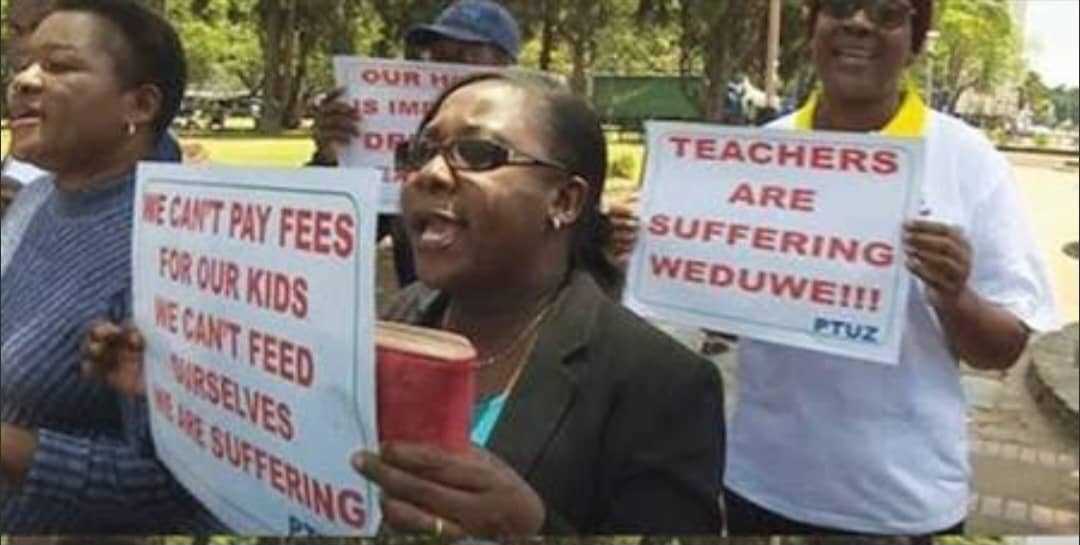





Zimbabwe’s education sector is facing renewed tension after teachers, represented by the Educators’ Union of Zimbabwe, rejected the current salary structure and grading system, warning they could stop reporting for duty within 14 days if their concerns are not addressed.
Educators’ Union of Zimbabwe Secretary General Tapedza Zhou said consultations carried out across the country revealed deep frustration among teachers, with many saying their earnings no longer reflect the cost of living or their professional standing.
He said the current arrangement has created wage compression, where a uniform United States dollar component is applied across all grades, effectively removing distinctions based on experience and qualifications.
Zhou said this has “eliminated meaningful differentiation, trivialised seniority and responsibility and undermined morale and professionalism” within schools.
He added that the structure has also shifted currency risk onto teachers, exposing their salaries to erosion.
“The current structure unfairly transfers exchange rate risk to teachers, exposes their salaries to erosion through ZiG volatility and disconnects earnings from real market conditions,” Zhou said.
He said many teachers had rejected the recent salary review, arguing that the US$320 base across all grades does not amount to a meaningful adjustment in real terms.
Zhou also said the removal of qualification-based progression has discouraged further studies and weakened the overall quality of teaching.
“The removal of qualification-based progression discourages further education, undermines quality of teaching and contradicts international education standards,” he said.
On career growth, he said the elimination of graded roles such as Senior Teacher and Head of Department has stalled progression within schools.
Related Stories
“The elimination of roles such as Senior Teacher and HOD as graded positions creates stagnation, limits advancement opportunities and weakens institutional growth within schools,” Zhou said.
He also criticised the manner in which the new grading system was introduced, saying it was imposed without proper consultation or adherence to labour procedures.“The new grading system has been imposed contumaciously without respect to labour laws and practices,” he said, adding that teachers were moved into a new framework without due process.
Zhou said the union is demanding a significant increase in the United States dollar component, differentiated by grade, and full payment of the US$80 teaching allowance in foreign currency.
He added that teachers also want the restoration of the previous grading system while negotiations continue, as well as the reinstatement of transport, housing and rural allowances.
Zhou warned that failure to respond within 14 days would trigger incapacitation.
“If no satisfactory response is received and no redress is made regarding salary reviews within 14 days, members have vowed that they shall not be reporting for duty due to employer induced incapacitation,” he said.
He added that the union is prepared to take legal action if the issues remain unresolved.
“In the absence to address the issues within 14 days by the employer, the Union shall challenge the imposed grading system and unilateral changes to conditions of service,” Zhou said.
Zhou said the current situation is already affecting the education sector, warning that declining morale among teachers could undermine learning outcomes.
“The current arrangement incapacitates teachers, weakens morale and discourages professional growth,” he said.
He said a profession that is not valued cannot deliver quality education, urging authorities to urgently engage and resolve the matter before it escalates into a full-blown crisis.







Leave Comments