








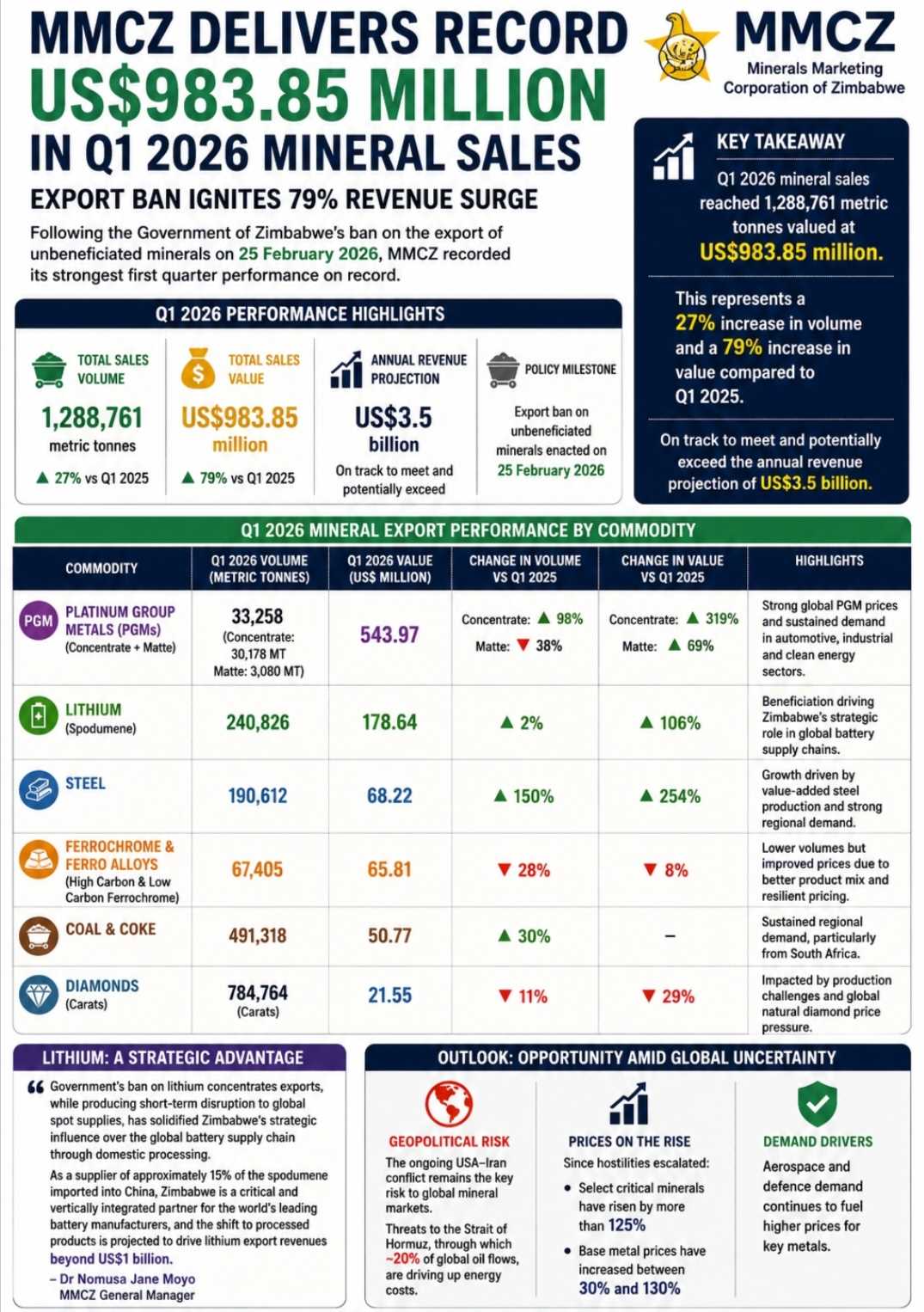
Zimbabwe’s mineral marketing authority, the Minerals Marketing Corporation of Zimbabwe, delivered a record-breaking first quarter performance for 2026, posting mineral sales valued at US$983.85 million, a sharp 79% increase in revenue compared to the same period last year, following the government’s ban on exports of unbeneficiated minerals.
Total mineral volumes reached 1,288,761 metric tonnes, representing a 27% rise year-on-year, placing the corporation firmly on course to meet — and potentially exceed — its US$3.5 billion annual revenue projection.
The strong results came barely weeks after the government implemented the export restriction on February 25, a policy shift aimed at forcing local beneficiation and value addition within Zimbabwe’s mining sector.
MMCZ said the export ban marked a turning point in mineral governance, with immediate measurable outcomes reflected in export earnings.
Improved global commodity prices supported revenue growth across most minerals, although rough diamonds remained under pressure due to structural shifts in the global gemstone market.
Platinum Group Metals emerged as the largest contributor to export revenue during the quarter, generating US$543.97 million from concentrate and matte exports combined.
PGM concentrate sales surged dramatically to 30,178 metric tonnes valued at US$191.73 million, representing a 98% increase in volume and an exceptional 319% jump in value compared to Q1 2025 — the strongest year-on-year value growth across all commodities.
Meanwhile, PGM matte sales reached 3,080 metric tonnes worth US$352.24 million. Although volumes declined by 38%, export value rose 69%, reflecting stronger international prices driven by demand from automotive manufacturing, industrial production and clean energy technologies.
Lithium recorded one of the most significant gains, reinforcing Zimbabwe’s growing strategic importance in global battery supply chains.
Sales reached 240,826 metric tonnes valued at US$178.64 million, translating to a 106% increase in value despite only a modest 2% growth in volumes.
MMCZ General Manager Dr Nomusa Jane Moyo said Zimbabwe’s beneficiation policy is reshaping global supply dynamics.
“Government's ban on lithium concentrates exports, while producing short-term disruption to global spot supplies, has solidified Zimbabwe's strategic influence over the global battery supply chain through domestic processing,” she said.
Related Stories
“As a supplier of approximately 15% of the spodumene imported into China, Zimbabwe is a critical and vertically integrated partner for the world’s leading battery manufacturers, and the shift to processed products is projected to drive lithium export revenues beyond US$1 billion.”
Steel exports delivered one of the standout performances of the quarter, with sales reaching 190,612 metric tonnes valued at US$68.22 million.
This represented a 150% increase in volumes and a 254% surge in value, largely attributed to expanded production of value-added steel products and growing regional demand — a development MMCZ described as tangible evidence of beneficiation policy success.
Combined high and low carbon ferrochrome exports totalled 67,405 metric tonnes worth US$65.81 million, reflecting declines of 28% in volume and 8% in value compared to last year.
Despite lower output, average realised prices improved due to a stronger product mix and resilient international pricing.
Coal and coke exports posted solid gains, reaching 491,318 metric tonnes valued at US$50.77 million, a 30% increase in volumes, driven mainly by sustained regional demand, particularly from South Africa.
The performance reaffirmed Zimbabwe’s competitiveness as a regional energy supplier.
Diamond exports continued to struggle, with sales falling to 784,764 carats valued at US$21.55 million, reflecting declines of 11% in volume and 29% in value.
MMCZ attributed the downturn to production challenges and growing competition from lab-grown diamonds, which continue to reshape global jewellery markets.
MMCZ warned that global commodity markets are entering a period of heightened volatility.
The ongoing geopolitical tensions between the United States and Iran have emerged as a major risk factor, particularly due to threats to the Strait of Hormuz — a critical oil transit route accounting for roughly 20% of global oil flows.
Rising energy costs have already pushed production expenses higher for energy-intensive metals, while prices for some critical minerals have surged by more than 125%, with base metals rising between 30% and 130% amid strong aerospace and defence demand.
The Q1 results suggest Zimbabwe’s beneficiation push is beginning to translate into measurable export value growth rather than purely volume-driven mining.
With lithium, PGMs and steel leading earnings expansion, MMCZ’s near-billion-dollar quarterly performance signals a structural shift in how Zimbabwe participates in global mineral markets — moving from raw exporter to value-added supplier.






Leave Comments