



Civil society organisations across four continents have launched a Global Week of Action calling on governments to hold tobacco companies financially accountable for the health and environmental harm linked to their products.
The campaign, dubbed "Make Big Tobacco Pay", is bringing together advocacy groups from Africa, Asia, Europe and the Americas to push governments to recover healthcare costs and environmental clean-up expenses associated with tobacco use and tobacco-related pollution.
Organisers say while tobacco companies generate enormous profits from cigarette and nicotine product sales, governments and taxpayers are left to shoulder the costs of treating tobacco-related diseases and managing environmental damage.
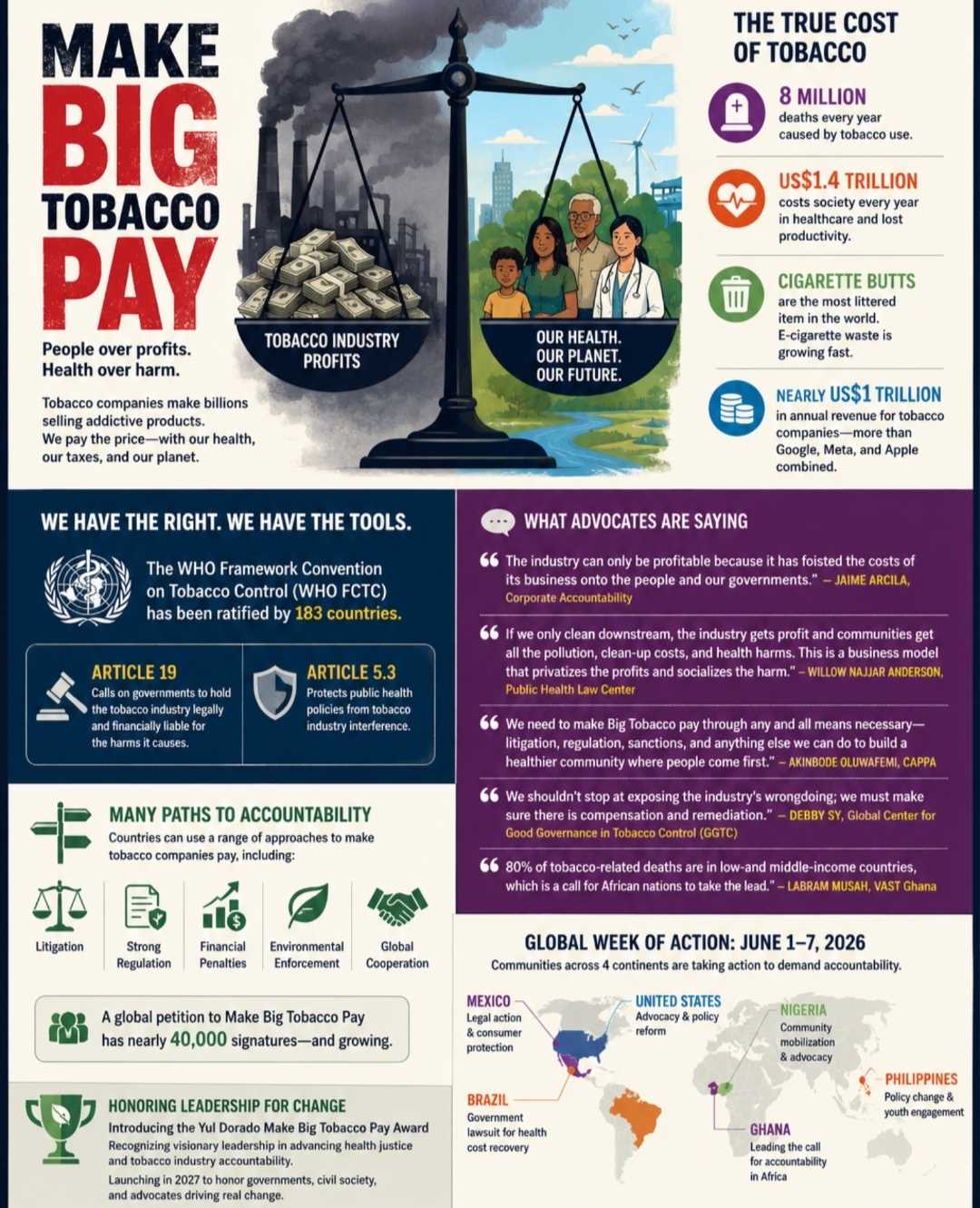
According to campaign organisers, tobacco use contributes to approximately eight million deaths annually worldwide and is a major risk factor for diseases such as cancer, heart disease, stroke and diabetes.
Daniel Dorado, Tobacco Campaign Director at Corporate Accountability and organiser of the Make Big Tobacco Pay coalition, said the campaign seeks to challenge what he described as an unfair burden placed on communities and governments.
"No matter where we live or what we look like, everyone deserves to lead a healthy life. But the tobacco industry sells dangerous and deadly products at huge profits. Meanwhile, we all pay — with our lives, our taxes, and our environment," said Dorado.
Advocates estimate that tobacco-related illnesses and environmental pollution cost society more than US$1.4 trillion annually, while tobacco corporations generate nearly US$1 trillion in revenue each year.
Corporate Accountability senior researcher Jaime Arcila said the industry's profitability is sustained by transferring the true costs of its operations onto the public.
"Tobacco corporations cheat us financially — whether we use their products or not. The industry can only be profitable because it has foisted the costs of its business onto the people and our governments," said Arcila.
He added that governments already possess a legal mechanism to pursue accountability through the World Health Organization Framework Convention on Tobacco Control (WHO FCTC).
"Fortunately, we have a powerful tool to make Big Tobacco pay for its harms: the global tobacco treaty," he said.
The WHO FCTC has been ratified by 183 countries and encourages governments to pursue legal and financial liability measures against the tobacco industry while protecting public health policies from industry interference.
Campaign organisers argue that liability can take many forms beyond large-scale litigation, including regulatory action, sanctions and environmental enforcement measures.
Related Stories
Akinbode Oluwafemi of Corporate Accountability and Public Participation Africa said governments should use every available tool to hold tobacco companies accountable.
"We need to make Big Tobacco pay through any and all means necessary litigation, regulation, sanctions, and anything else we can do to build a healthier community where people come first," he said.
Environmental concerns are also central to the campaign. Advocates point to cigarette butts as the world's most littered item and warn that growing volumes of e-cigarette waste are introducing toxic chemicals into soil and water systems.
Willow Najjar Anderson of the Public Health Law Center said current approaches often leave communities paying the price for pollution generated by tobacco products.
"If we only clean downstream, the industry gets profit and communities get all the pollution, clean-up costs, and health harms. This is not an accident; it's a business model – one that privatizes the profits and socializes the harm," she said.
The week-long campaign includes online and in-person events in Mexico, Brazil, the United States, the Philippines, Nigeria and Ghana, alongside a global petition that has already attracted nearly 40,000 signatures.
Advocates say momentum is growing internationally, particularly following recent discussions on industry liability during meetings of parties to the WHO tobacco control treaty.
"We've made a lot of progress on liability at the last two global tobacco treaty meetings and this Global Week of Action is so important in keeping the momentum going before the next one," said Kelsey Romeo-Stuppy of Action on Smoking and Health.
In Africa, campaigners say stronger action is needed as low- and middle-income countries continue to bear the greatest burden of tobacco-related deaths.
"80% of tobacco-related deaths are in low-and middle-income countries, which I think is a call for Ghana and other African nations to take the lead in changing this trajectory," said Labram Musah of Vision for Accelerated Sustainable Development in Ghana.
The campaign also announced the creation of the Yul Dorado Make Big Tobacco Pay Award, which will recognise governments, civil society organisations and advocates making significant contributions to tobacco industry accountability and health justice.
Organisers say the ultimate goal is not only to expose industry wrongdoing, but to ensure tobacco companies bear the full cost of the harm their products cause to people, public health systems and the environment.




Leave Comments