








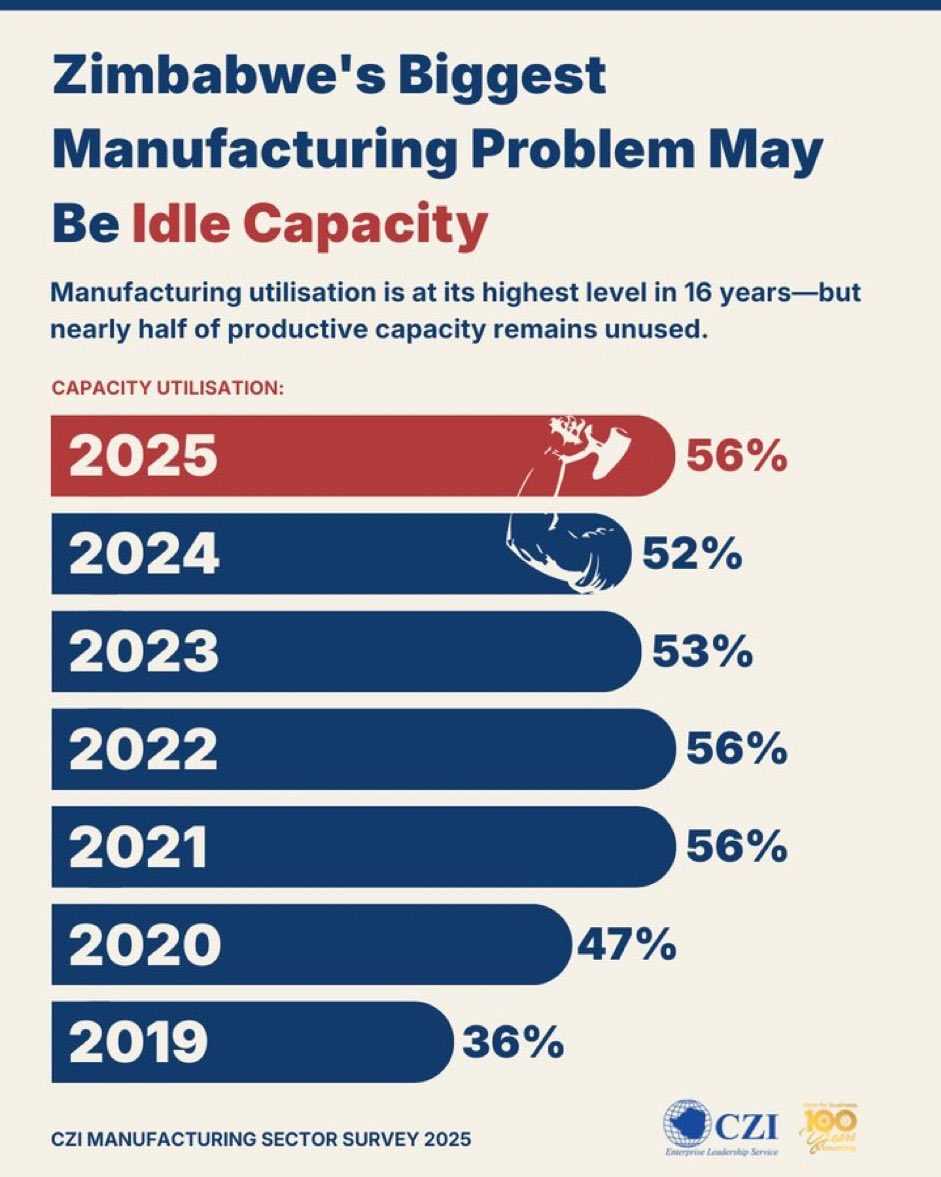
Zimbabwe's manufacturing sector recorded its highest capacity utilisation in 16 years in 2025, with factories operating at 56 percent of installed capacity, according to the Confederation of Zimbabwe Industries Manufacturing Sector Survey. The figure represents an improvement from 52 percent in 2024 and 36 percent in 2019, signalling a gradual recovery in industrial activity.
But beneath the encouraging headline lies a more significant economic story: 44 percent of Zimbabwe's manufacturing capacity remains idle.
The figures suggest the country's industrial challenge is no longer primarily about attracting new factories or expanding installed capacity. Instead, it is about removing the structural bottlenecks preventing existing factories from producing at their full potential.
Economists and industry leaders say unlocking that idle capacity could generate faster industrial growth, create thousands of jobs, increase exports and expand Government revenues without the huge capital costs associated with building new factories.
The CZI survey found that manufacturers continue to grapple with high production costs, expensive financing, foreign currency shortages, electricity supply challenges, policy uncertainty, obsolete technology, competition from imports and subdued domestic demand.
These constraints have left billions of dollars' worth of industrial infrastructure underutilised at a time Zimbabwe is pursuing an upper-middle-income economy through industrialisation and value addition.
CZI Senior Economist Carren Pindiriri said the country should view idle capacity as an opportunity rather than merely a weakness.
"The persistence of unused capacity should be viewed not only as a constraint but also as a major opportunity for industrial growth, employment creation and fiscal expansion," Pindiriri said.
"With existing plant and machinery already in place, firms can raise output significantly without incurring the full costs of new investment, provided the operating environment continues to improve."
She said improving the operating environment would allow manufacturers to produce more competitively while reducing production costs.
"Lower costs improve competitiveness, enable firms to price products more attractively and stimulate demand in both domestic and export markets. As output rises, fixed costs such as rent, maintenance, depreciation and insurance are spread over a larger production base, reinforcing economies of scale and further lowering unit costs," she said.
Her analysis comes as the manufacturing sector continues to recover from years of macroeconomic instability, although production remains well below potential.
Economist Gift Mugano said Zimbabwe's industrial recovery ultimately depends on increasing production rather than relying solely on monetary reforms.
"The challenge in Zimbabwe is not currency. The challenge in Zimbabwe is production. We need to address production and anchor the currency with production so that we substitute imports," Mugano said during the Buy Zimbabwe Summit.
He argued that Zimbabwe continues to import products because local production remains inadequate.
"We are importing because we don't have enough items that we are producing. We need to be producing locally," he said.
Mugano has also warned that structural weaknesses continue to undermine the competitiveness of local manufacturers.
"Some of the factors making Zimbabwean products very expensive are liquidity challenges, poor infrastructure, outdated equipment and management inertia," he said in earlier remarks.
"Zimbabwe is a cash-trapped economy... resulting in high cost of financing that goes into industry."
Related Stories
His observations closely mirror the findings of the latest CZI survey, which identifies high borrowing costs, policy uncertainty and infrastructure deficits as some of the biggest barriers preventing manufacturers from utilising existing capacity.
The impact extends beyond individual companies.
According to CZI Chief Executive Officer Sekai Kuvarika, idle factory capacity significantly increases production costs because companies spread fixed expenses over fewer products.
"Fixed costs are spread on smaller output produced from 55 percent capacity instead of 100 percent," Kuvarika said during the Zimbabwe International Trade Fair International Business Conference.
"With a linear output-capacity utilisation relationship, a 45 percent unutilised capacity in our manufacturing sector increases the fixed cost per unit by at least 80 percent."
She said reducing idle capacity would improve economies of scale while making Zimbabwean products more competitive both locally and internationally.
"Reducing unutilised capacity will reduce the overall cost of production and increase economies of scale."
"This will improve the competitiveness of our exports and, in turn, increase the demand for our products in foreign markets. For many firms, a significant portion of the idle capacity was installed for the export market.
Hence, there is an opportunity to increase the production of exportable goods through the utilisation of excess capacity," Kuvarika said.
She added that increasing capacity utilisation would generate benefits extending beyond factory floors.
"Improving the competitiveness of manufacturing firms is not only crucial for improving the export revenue of the country, but is also critical for preserving jobs when implementing the African Continental Free Trade Area."
The latest survey suggests there is considerable room for such expansion.
Food processing emerged as the strongest-performing manufacturing subsector in 2025, recording 16 percent employment growth, alongside an 18 percent increase in output and a 19 percent rise in revenue.
Pharmaceutical manufacturers, chemicals producers and cement companies have also announced capacity expansion and equipment upgrades to meet growing domestic and regional demand.
However, other industries—including textiles, clothing, leather products and engineering, continue to struggle with obsolete equipment, limited access to affordable finance and growing competition from imported products.
Government has introduced several industrial support measures under the Zimbabwe Industrial Reconstruction and Growth Plan and the National Development Strategy, while manufacturers continue calling for lower compliance costs, stable exchange rates, affordable electricity and improved access to long-term financing.
CZI argues that further improvements in capacity utilisation will require more than company-level efficiency measures.
The organisation is calling for targeted regulatory reforms, lower production costs, stable macroeconomic conditions and reliable electricity supplies to enable firms to maximise the use of existing industrial assets.
Regional experience suggests the approach could deliver substantial gains.
Countries such as Ethiopia, Morocco and Rwanda have improved manufacturing performance by combining industrial financing, export promotion, infrastructure development and policy stability with efforts to improve factory productivity rather than relying solely on new industrial investments.










Leave Comments