









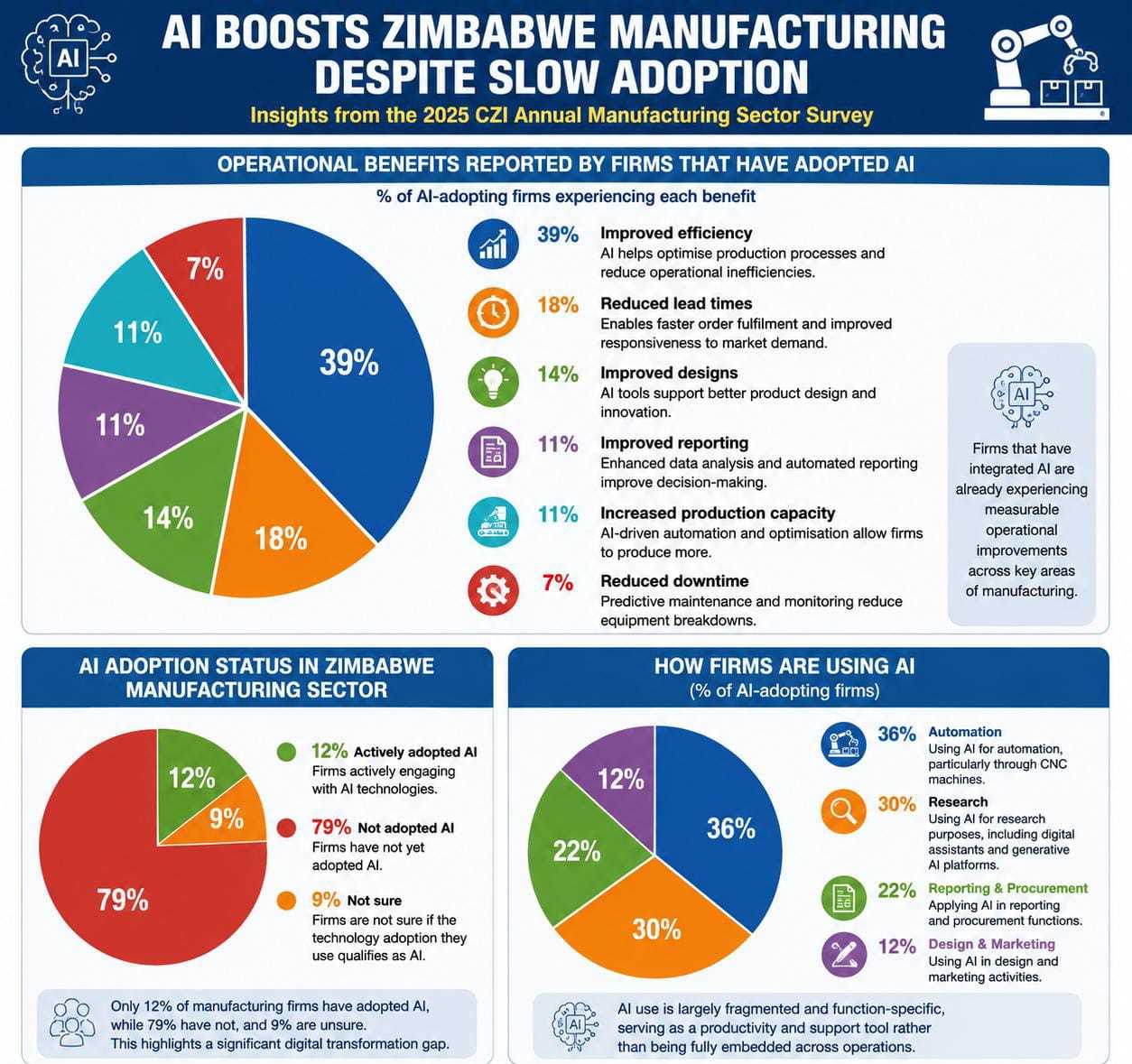
Manufacturers in Zimbabwe that have embraced Artificial Intelligence (AI) are already reporting noticeable improvements in productivity, efficiency and business performance, demonstrating the technology's potential to transform industrial operations.
Although AI adoption remains limited across the sector, companies that have integrated the technology into parts of their operations are beginning to realise tangible benefits that are helping them become more competitive.
According to the 2025 Confederation of Zimbabwe Industries (CZI) Annual Manufacturing Sector Survey, firms that have adopted AI are experiencing measurable operational improvements across several aspects of manufacturing.
Improved operational efficiency
The most significant benefit reported by manufacturers using AI is improved operational efficiency. 39 percent of firms that have adopted AI reported greater efficiency, highlighting the technology's ability to optimise production processes, automate repetitive tasks and minimise operational inefficiencies. By making better use of machinery, labour and raw materials, manufacturers are able to improve productivity while reducing operating costs.
Reduced lead times
18 percent of AI-adopting firms have reduced lead times. AI enables manufacturers to improve production planning, monitor workflows in real time and respond more quickly to customer orders. Faster production cycles allow businesses to fulfil orders more efficiently and remain responsive to changing market demand.
Improved product design
According to the survey, 14 percent of manufacturers using AI have improved their product design processes. AI-powered design tools enable firms to analyse product concepts, refine specifications and accelerate product development, allowing manufacturers to respond more effectively to customer preferences and changing market trends.
Enhanced reporting
11 percent of AI adopters have improved their reporting systems. AI allows businesses to automatically collect, analyse and present operational data, providing management with timely information that supports faster and more informed decision-making.
Increased production capacity
Another 11 percent of firms reported increased production capacity after adopting AI technologies. Automation and intelligent production management systems enable manufacturers to maximise equipment utilisation, improve workflow coordination and increase output without proportionately increasing operating costs.
Reduced equipment downtime
7 percent of manufacturers have reduced equipment downtime through AI adoption. Intelligent monitoring systems can identify potential machinery faults before they result in breakdowns, enabling predictive maintenance that minimises production interruptions and improves equipment reliability.
AI adoption remains low
Related Stories
Despite these encouraging outcomes, AI adoption across Zimbabwe's manufacturing sector remains relatively limited.
According to the 2025 CZI Annual Manufacturing Sector Survey, 79 percent of manufacturing firms have not yet adopted AI, while a further 9 percent are uncertain whether the technologies they currently use qualify as AI.
This means that only 12 percent of manufacturing firms are actively engaging with AI technologies.
The low adoption rate reflects a significant digital transformation gap driven by limited awareness, inadequate investment and insufficient technical capacity within the manufacturing sector.
AI use remains fragmented
Among the 12 percent of firms that have adopted AI, usage is largely fragmented and concentrated in specific business functions rather than fully integrated across manufacturing operations.
36 percent of AI adopters are using the technology for automation, particularly through Computer Numerical Control (CNC) machines, making automation the most advanced AI application currently being deployed within the sector.
Another 30 percent of AI-adopting firms are using the technology for research purposes, including digital assistants and generative AI platforms.
Meanwhile, 22 percent are applying AI in reporting and procurement functions, while 12 percent are using AI in design and marketing.
AI in Zimbabwe is still largely being used as a productivity and support tool rather than as a transformative technology capable of driving end-to-end manufacturing processes.
Industry 4.0 presents an opportunity
According to the CZI survey, AI sits at the core of Industry 4.0, where manufacturing systems are becoming increasingly digitised, automated and interconnected.
The report notes that leading industrial economies are leveraging AI across production systems through predictive maintenance, robotics, quality control, supply chain optimisation and demand forecasting. These technologies are delivering significant productivity gains, cost reductions and operational efficiencies, making AI no longer a futuristic concept but a strategic necessity for modern manufacturing.
For Zimbabwe, where manufacturers continue to grapple with high production costs, infrastructure constraints and intense import competition, the report says AI presents a unique opportunity to leapfrog traditional industrialisation pathways, improve operational efficiency and strengthen competitiveness in both domestic and export markets.
Although adoption remains at an early stage, the experience of early adopters suggests that AI can deliver measurable business value.
The survey noted that these firms provide practical examples of the technology's benefits, creating an opportunity for wider adoption as awareness grows, investment increases and digital capabilities improve across the manufacturing sector.










Leave Comments