








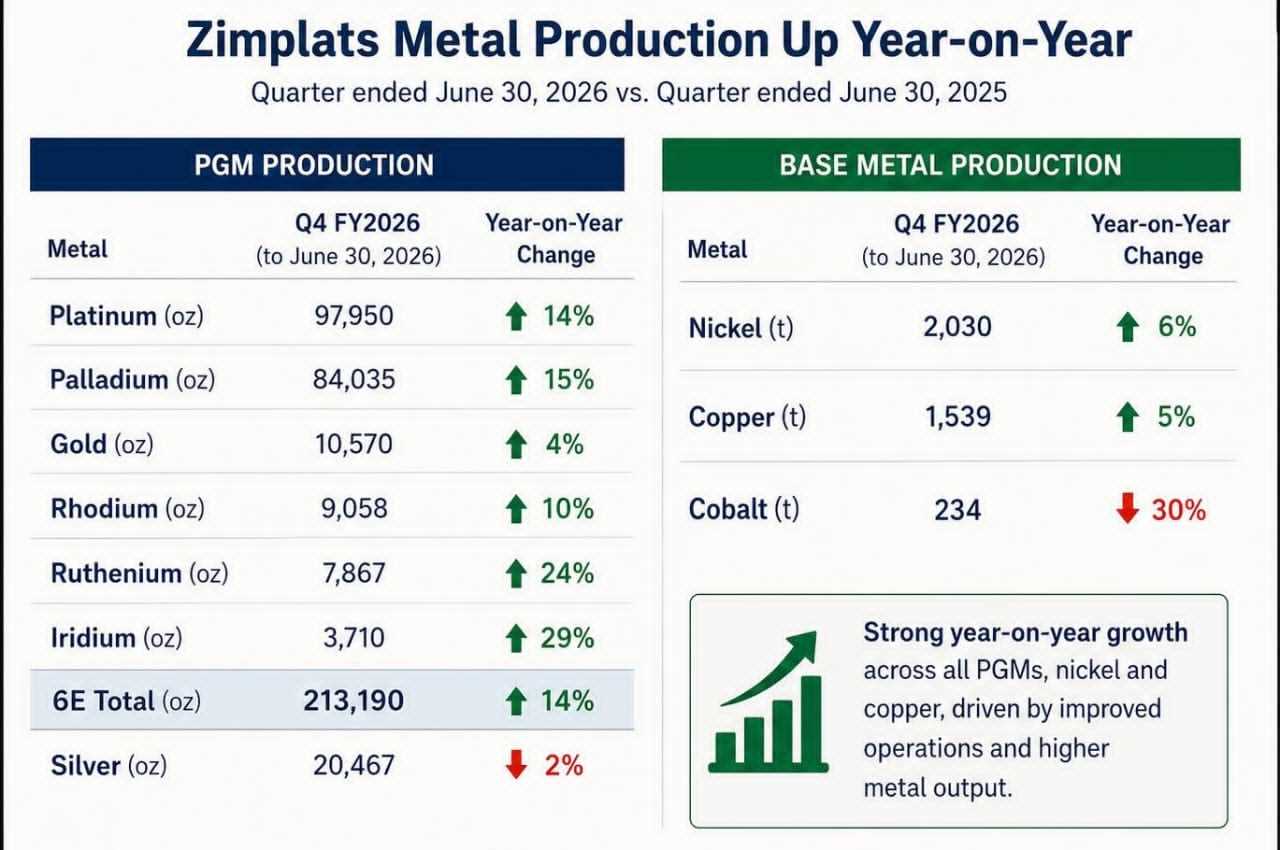
Zimplats has delivered a broad-based production rebound, with platinum-group metals output rising 14% year-on-year in the quarter ended June 2026, strengthening Zimbabwe’s position in a global platinum market still facing tight supply.
The country’s largest PGM producer produced 213,190 ounces of 6E metals during the quarter, up from the comparable period last year. Platinum increased 14% to 97,950 ounces, palladium rose 15% to 84,035 ounces, while ruthenium and iridium jumped 24% and 29%, respectively.
“Nickel and copper production also increased, by 6% to 2,030 tonnes and 5% to 1,539 tonnes, respectively,” Zimplats said in its update.
The figures are significant because they mark a sharp recovery from the disruption that hit Zimbabwe’s platinum industry earlier this year. In the first quarter, national platinum output fell 26% year-on-year to 84,000 ounces, its lowest quarterly level in a decade, largely because of furnace maintenance at Zimplats. The World Platinum Investment Council said the maintenance delayed the processing of 29,000 ounces of semi-finished material into the following quarter.
The June-quarter numbers therefore point to more than ordinary production growth: they show Zimplats recovering volumes that had been constrained by processing disruptions.
That recovery is particularly important because Zimplats has become increasingly central to Zimbabwe’s strategy of capturing more value from its platinum resources.
The company commissioned its expanded Selous smelter in 2025, tripling processing capacity to about 380,000 tonnes of concentrate a year. The expansion has helped shift Zimbabwe further away from exporting raw PGM concentrates towards higher-value matte.
The change is already visible in national export patterns. PGM concentrate exports fell 52% in volume in 2025, while PGM matte export value jumped 71% to about US$1.5 billion, according to industry data reported by Equity Axis.
Related Stories
This makes Zimplats’ latest production performance important beyond the company itself.
Zimbabwe is the world’s second-largest platinum producer and holds the second-largest platinum reserves after South Africa, with most of its resources concentrated along the Great Dyke. The World Platinum Investment Council expects Zimbabwean platinum production to recover in 2026 after a 2% decline in 2025.
The global market is also providing a favourable backdrop. WPIC expects the platinum market to remain in deficit in 2026, following a third consecutive annual deficit in 2025, although the projected shortfall is expected to narrow to about 240,000 ounces.
That creates an opportunity for Zimbabwe: higher production into a structurally tight market potentially means stronger export earnings, provided the country can maintain output and continue moving up the value chain.
The industry is already projecting substantial returns. Platinum Producers Association chairman Alex Mhembere said the sector could generate about US$2 billion in export earnings in 2027, supported by stronger prices, expanding operations and global demand.
But Zimplats’ performance also exposes the vulnerability of relying heavily on a small number of large producers.
The sharp fall in national output during the furnace maintenance episode demonstrated how a single major operational disruption can materially affect Zimbabwe’s platinum production.
That makes investment in processing capacity, reliable power and operational resilience critical if Zimbabwe is to turn its geological advantage into sustained export growth.
Zimplats itself describes its business as the production of platinum-group and associated metals from the Great Dyke, where its Ngezi mines and Selous processing operations form an integrated mining and processing complex.







Leave Comments