









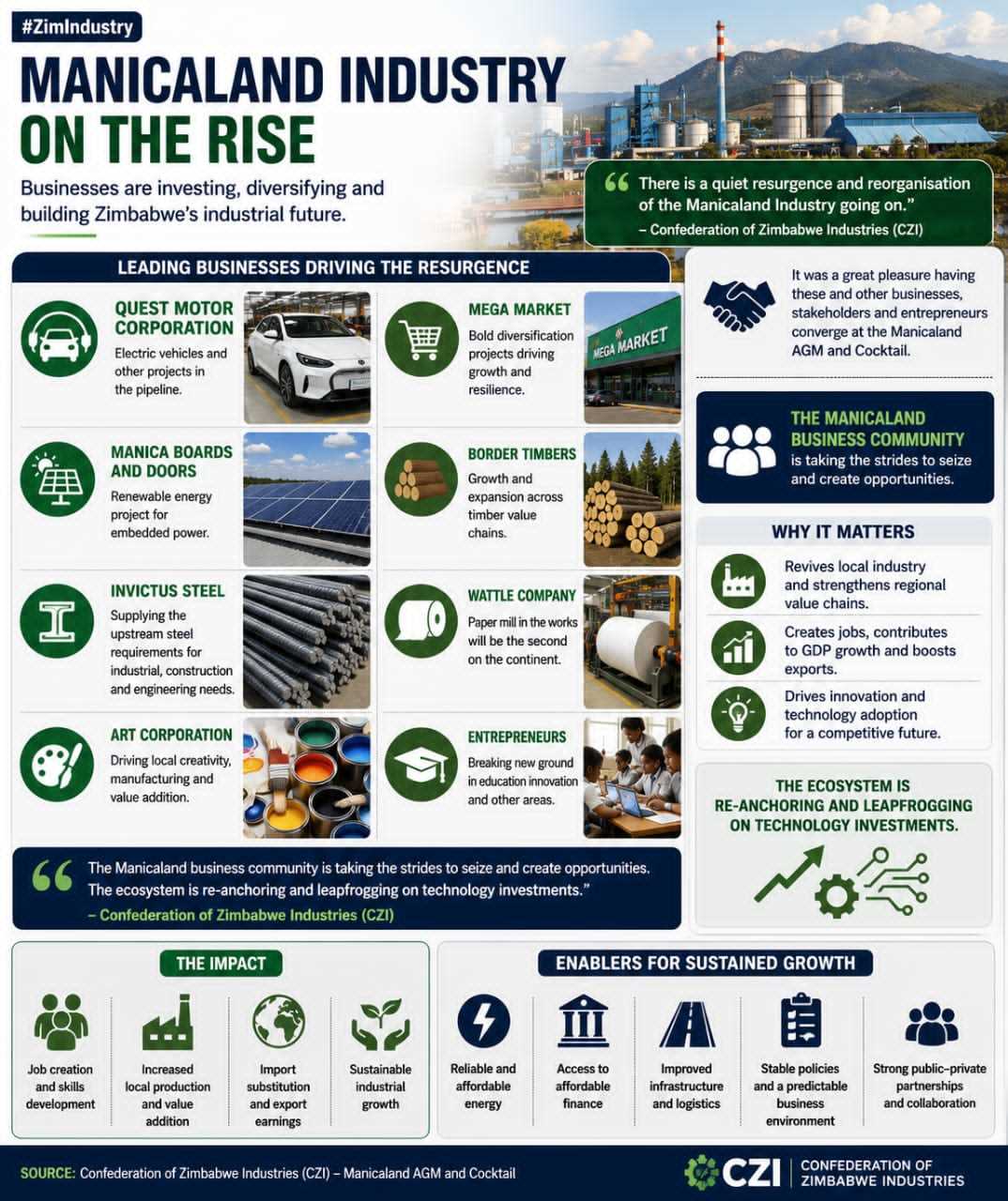
Zimbabwe's manufacturing sector may be showing early signs of recovery in Manicaland Province, where established industries and emerging businesses are expanding production, investing in new technologies and diversifying operations despite a challenging operating environment.
Speaking at the Confederation of Zimbabwe Industries Manicaland Annual General Meeting, business leaders pointed to a wave of investments spanning electric vehicle assembly, steel production, renewable energy, timber processing, paper manufacturing and education innovation.
The Confederation of Zimbabwe Industries said there was "a quiet resurgence and reorganisation of the Manicaland Industry", highlighting expansion by Quest Motor Corporation, Mega Market, Manica Boards and Doors, Border Timbers, Invictus Steel, Wattle Company and Art Corporation, alongside entrepreneurs investing in new sectors.
According to the organisation, "The Manicaland business community is taking the strides to seize and create opportunities. The ecosystem is re-anchoring and leapfrogging on technology investments."
The investments come at a time when Zimbabwe is seeking to reverse decades of industrial decline.
According to the Confederation of Zimbabwe Industries' 2025 Manufacturing Sector Survey, average manufacturing capacity utilisation has been improving but remains below levels needed to drive broad-based industrial growth. Manufacturers continue to identify the high cost of capital, electricity shortages, exchange rate uncertainty and limited access to affordable long-term finance as major constraints to expansion.
Against that backdrop, the projects announced in Manicaland represent more than isolated business investments. They point to a shift towards value addition, import substitution and industrial diversification.
Related Stories
Quest Motor Corporation's plans to expand electric vehicle production align with Zimbabwe's ambition to develop greener transport technologies, while Invictus Steel's investment could reduce dependence on imported steel products by supplying inputs for construction, engineering and manufacturing.
Particularly significant is Wattle Company's proposed paper mill, which the Confederation of Zimbabwe Industries says would become only the second facility of its kind on the African continent. If realised, the project could reduce imports of paper products while creating new forestry and manufacturing value chains.
The renewable energy investment by Manica Boards and Doors also reflects a growing trend among Zimbabwean manufacturers to generate their own electricity as persistent power shortages continue to disrupt production.
Embedded power generation has become less of a competitive advantage and more of a business survival strategy as industries seek to reduce downtime and improve productivity.
The African Development Bank has repeatedly identified unreliable electricity supplies as one of the biggest barriers to industrialisation across Africa, while the World Bank says improving energy reliability is essential for increasing manufacturing competitiveness and attracting investment.
The emphasis on technology investment is equally important.
Productivity gains in manufacturing increasingly depend on automation, digital technologies and modern production systems. Companies that invest in new technologies are generally better positioned to improve quality, reduce production costs and compete in regional export markets under the African Continental Free Trade Area.
Manufacturers continue to call for lower borrowing costs, improved infrastructure, predictable economic policies and reliable electricity supplies.










Leave Comments