






President Emmerson Mnangagwa’s call for provinces and districts to identify local economic opportunities has placed fresh emphasis on a policy that Zimbabwe has been pursuing since the adoption of the 2013 Constitution, but whose implementation remains constrained by the pace of fiscal transfers and the unfinished institutional framework for devolution.
“National development cannot be the responsibility of Government alone. This requires a Whole-of-Government-and-Society Approach. Each Province and District must, therefore, identify its opportunities and challenges and develop practical solutions suited to its circumstances,” Mnangagwa said.
He said provinces should develop economies around their local resources, with provincial development contributing to national prosperity.
The Constitution already provides for this approach. Chapter 14 requires government powers and responsibilities to be devolved to provincial and metropolitan councils and local authorities where they are competent to exercise them. It also provides for the transfer of responsibilities and resources from national government to give lower tiers of government a sound financial base. Provincial and metropolitan councils are specifically mandated to plan and implement social and economic development in their areas, manage natural resources and promote tourism.
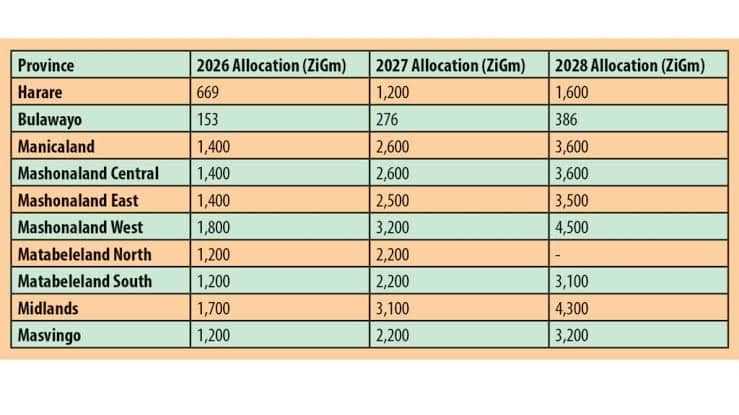
Government has since established a fiscal transfer mechanism to support this constitutional framework. The 2026 National Budget allocated ZiG14.4 billion for development initiatives in provinces and local authorities and said Government would strengthen fiscal administration to allow lower tiers of government to respond directly to community needs. Treasury also said the finalisation and enactment of a Devolution Act would facilitate the “full operationalisation and entrenchment” of devolution.
That admission is significant because it shows that the policy has moved beyond the question of whether money should be allocated to provinces and councils to whether the institutional system needed for them to exercise meaningful authority is fully in place.
The funding record also exposes a gap between budgetary allocations and actual transfers. Finance Minister Mthuli Ncube told Parliament that only 23% of the budgeted devolution funds were disbursed in 2023, while 26% of the ZiG4.1 billion budgeted in 2024 was released. He attributed the delays partly to Treasury’s cash-flow position and partly to the readiness of projects and local authorities to absorb the funds.
Related Stories
The 2025 figures point to the same constraint. Parliamentary records show that against national revenue of about ZiG223 billion, devolution-related disbursements were about ZiG1.9 billion, equivalent to roughly 1% of revenue, below the constitutional minimum of 5%.
The problem not simply the size of the allocations announced in national budgets but whether provincial and local institutions receive predictable resources with enough autonomy and certainty to plan their economies.
The experience of Matobo Rural District Council illustrates the consequences. The council applied for ZiG104 million for legacy projects but received ZiG14.48 million in March 2026, forcing it to reduce the scope of its priorities. Council chief executive Alvis Sibanda said the authority had to prioritise projects after receiving less than it had budgeted for.
Zimbabwe Open University academic Tobias Guzura has argued that the absence of predictable transfers and functioning provincial structures has limited the practical implementation of devolution. He said the inter-governmental fiscal transfer system lacked clear timelines and questioned the limited activity of provincial and metropolitan councils elected in 2023.
Guzura also argued that constitutional provisions require supporting legislation to make devolution operational.
Government itself acknowledged this legislative gap in the 2026 Budget by identifying the Devolution Act as part of the work required to complete the framework.
There is evidence that devolved funding can produce tangible local benefits when money reaches councils and projects are ready for implementation. In Mvuma, an early childhood development centre was constructed using devolution and council funds after the local authority identified the need to protect children who had been crossing major highways to attend school. Mvuma RDC chief executive Lovemore Chatikobo credited the timely release of funds for enabling the project.





Leave Comments