








As the legal battle over access to abortion services for minors returns to the High Court, health and reproductive health rights advocates say the needs of girls facing unwanted pregnancies cannot be put on hold while the court reconsiders the law.
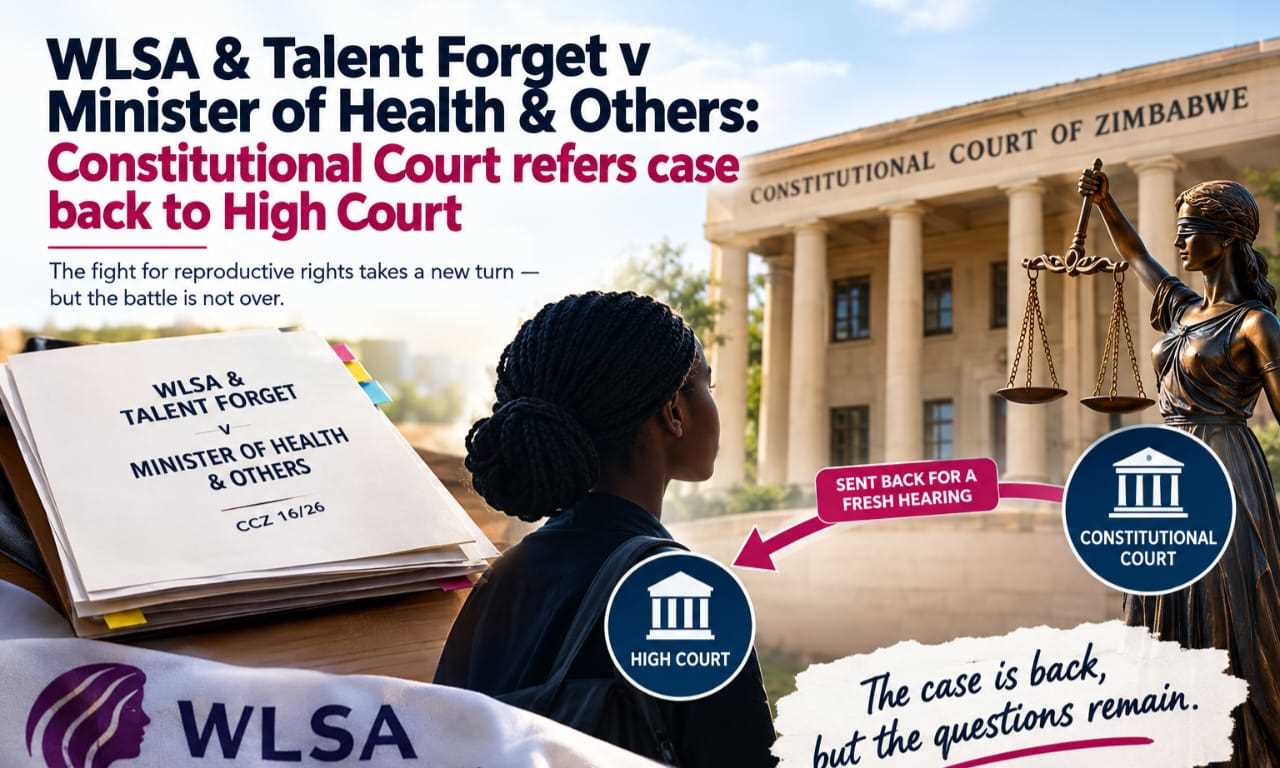
On 29 July 2026, the Constitutional Court of Zimbabwe set aside the 2024 High Court ruling in Women and Law in Southern Africa & Talent Forget v Minister of Health & Others (CCZ 16/26) and remitted the matter to the High Court for a fresh hearing (de novo).
The High Court had declared parts of sections 2(1) and 4 of the Termination of Pregnancy Act unconstitutional for excluding pregnancies resulting from sexual intercourse with minors and marital rape from the definition of “unlawful intercourse” for legal abortion purposes. The ruling recognised the need to protect children from sexual exploitation and child marriage.
The Constitutional Court did not determine the constitutional merits of the exclusions but found that the proceedings were procedurally flawed because the respondents, including the Ministry of Health and the Attorney General, had failed to meaningfully participate in the High Court proceedings, arguments concerning marital rape were introduced only during confirmation proceedings, and the entire provision was declared invalid despite only part of it being challenged.
The High Court judgment was therefore set aside, delaying potential legal reforms that could expand access to lawful abortion for girls under 18 and survivors of marital rape. The matter is still awaiting a fresh hearing in the High Court, and the existing legal barriers remain in place.
What it means
Bianca Mahere, WLSA senior legal officer, explained that the matter was referred back to the High Court for a fresh trial. This means the Constitutional Court could not reach a decision based on the evidence presented during the initial High Court proceedings, so it directed the parties to restart the proceedings in the High Court.
“This means that, following the setting aside of the 2024 judgment, the law has reverted to where it was before that judgment, which means legal termination is not open to marital rape victims and children below 18.
“If the girl has been raped, she can access legal termination when she reports the rape case. However, if it is consensual intercourse, the girl does not qualify under the Termination of Pregnancy Act to get a lawful termination,” she said.
Tinashe Mundawarara, board chairperson of the Health Law and Policy Consortium, said denying pregnant minors access to abortion can conflict with their constitutional rights, health and best interests. He added that the legal framework should recognise the particular vulnerability and health risks faced by girls who become pregnant following sexual exploitation.
Girls' health cannot wait for the court process
Mundawarara highlighted the medical risks associated with adolescent pregnancy, including increased risks of eclampsia, pre-eclampsia, haemorrhage, preterm birth, low birth weight and severe neonatal outcomes. He also noted that pregnancy and childbirth complications are a leading cause of death among girls aged 15–19 globally, with younger adolescents facing even greater risks.
He frames access as a constitutional right
Related Stories
He linked access to abortion with the constitutional right to health, arguing that denying access can violate reproductive health rights. He also connected the issue to equality and non-discrimination, arguing that denying minors access to abortion can perpetuate inequality.
Best interests of the child
Mundawarara pointed to the Constitution's protection of the best interests of the child, as well as the Medical Services Amendment Act's requirements concerning the best interests of children in healthcare.
He argued that forcing a pregnant child to continue a pregnancy despite the heightened medical risks may not be consistent with the best-interests principle.
Mundawarara’s arguments address the issue that, while the WLSA & Talent Forget case awaits a fresh hearing, there is already a crisis that cannot wait for a court hearing.
Hamida Ismail-Mauto, operations manager at SRHR Africa Trust, said pregnancies do not pause for court processes. A girl who is pregnant today must still be supported through existing systems.
“That means ensuring she receives accurate information, counselling, post-abortion care if needed, referral to child-protection services and, if she meets the legal criteria under the Termination of Pregnancy Act, clear, non-delayed access to lawful services as provided for in the Comprehensive Abortion Care Guidelines.
“Three immediate steps within the current law while we wait for the court are to clarify and standardise procedures and documentation for legally permissible services to avoid inconsistent application. Second, strengthen facility readiness through trained providers, essential commodities and functional referral pathways, with priority given to underserved provinces.
"Third, ensure the integration of post-abortion counselling, contraception and child-protection referrals so that no girl leaves a facility without the care and support she needs,” she said.
Mauto emphasised that her main concern was the gap between the law and access.
She said Health Facility Assessment (HHFA) 2023/24 data shows that only 5–6% of facilities provide legal abortion services and only 5% have staff trained in comprehensive abortion care.
The concern is that uncertainty and inconsistent administrative requirements will further delay timely care for legally eligible women and girls, increasing the risk of unsafe abortion complications.
Ultimately, the fresh hearing at the High Court will be crucial in determining the next step. Until the court makes a determination, questions remain about access to lawful abortion services for these vulnerable groups, leaving reproductive rights advocates concerned about the impact of continued legal uncertainty on those seeking care.







Leave Comments