






Zimbabwe’s emergence as Africa’s 14th-largest economy, with gross domestic product projected to reach US$65.92 billion in 2026, has raised questions among analysts about whether the headline figure accurately reflects the size of the country’s underlying economy.
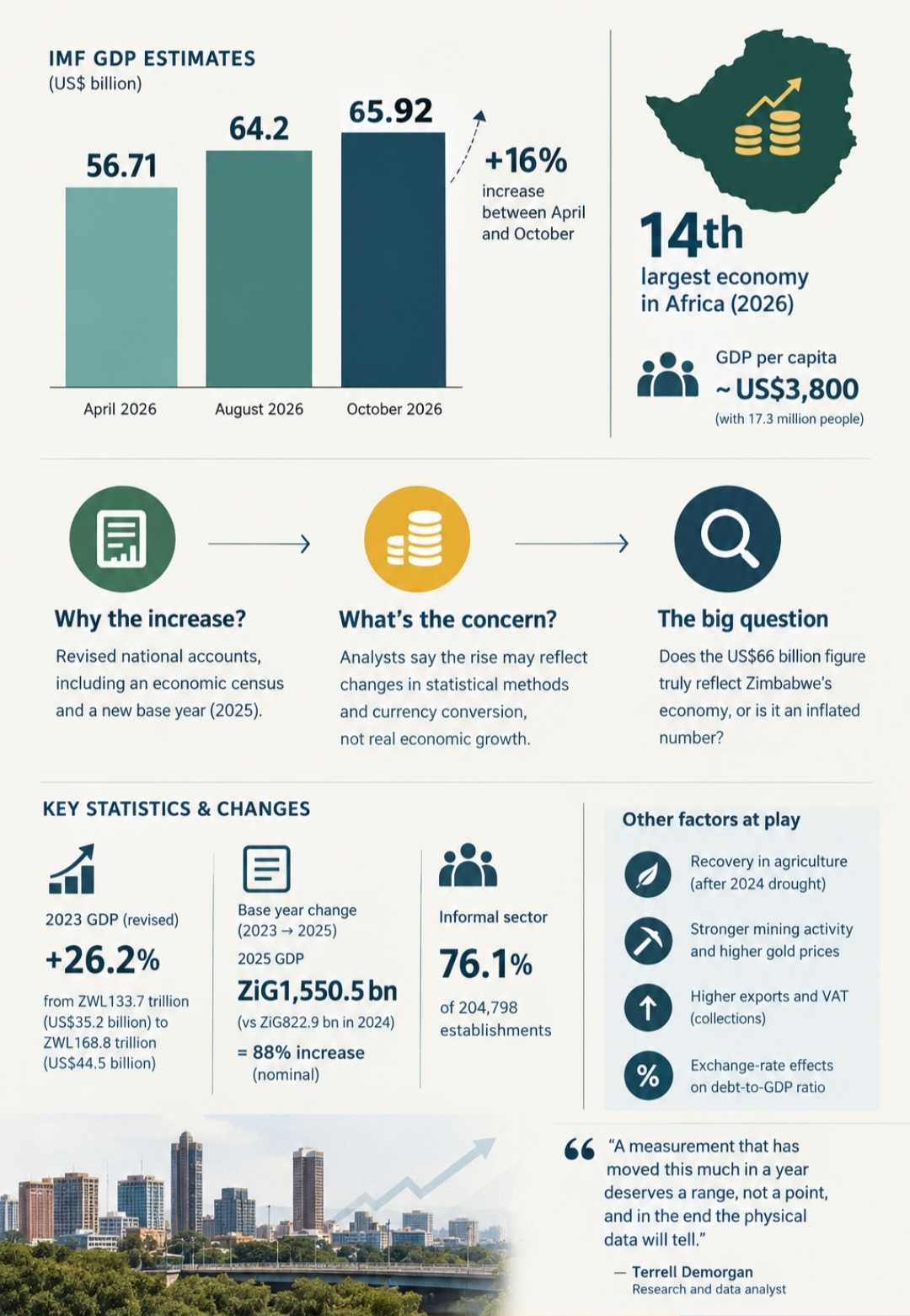
The International Monetary Fund’s October 2026 World Economic Outlook puts Zimbabwe’s economy at US$65.92 billion, up from US$56.71 billion in its April projections and US$64.2 billion in its August staff report, despite maintaining its real economic growth forecast for 2026 at approximately 5%.
The successive revisions represent an increase of about 16% between April and October, raising questions about how much of the expansion reflects actual economic activity and how much stems from changes in national accounting methods and the conversion of Zimbabwe’s output into US dollars.
Terrell Demorgan, a research and data analyst and country contributor for the Economist Intelligence Unit, has questioned the credibility of the US$66 billion estimate, arguing that the figures require greater scrutiny before being interpreted as evidence of a substantially larger economy.
“I am not convinced Zimbabwe is a US$66 billion economy. I cannot prove it is not, at least not comprehensively, due to limited information, and I will set out where I could be wrong, but I think the number deserves more scrutiny than it has received,” Demorgan said.
He noted that the IMF’s April estimate put Zimbabwe’s 2026 GDP at US$56.7 billion, before it rose to US$64.2 billion in August and US$65.9 billion in October.
Demorgan attributed much of the increase to the incorporation of Zimbabwe’s revised national accounts following statistical changes by the Zimbabwe National Statistics Agency (ZIMSTAT), rather than a comparable increase in projected real economic growth.
His concerns centre on two major statistical developments: the revision of historical GDP figures following an economic census and the subsequent rebasing of national accounts.
In June 2025, ZIMSTAT increased its estimate of Zimbabwe’s 2023 GDP by 26.2%, from ZWL133.7 trillion, equivalent to US$35.2 billion, to ZWL168.8 trillion, or approximately US$44.5 billion.
The revision reflected efforts to account for economic activity that had previously been missed or inadequately captured in official statistics.
A further change came in June 2026, when ZIMSTAT moved the national accounts base year from 2023 to 2025.
The revised figures put 2025 GDP at ZiG1,550.5 billion, compared with ZiG822.9 billion in 2024, representing an 88% nominal increase.
However, Demorgan noted that this increase should not be interpreted as real economic growth, which ZIMSTAT estimated at 8.29% for 2025.
He argued that inflation and changes in statistical measurement account for much of the difference between nominal GDP figures, raising questions about how the revised numbers should be interpreted when assessing the economy’s underlying performance.
The informal economy is another major point of contention.
The economic census identified 204,798 establishments, of which 76.1% were informal, highlighting the scale of economic activity outside the formal sector.
Demorgan said incorporating previously unrecorded businesses was a legitimate reason to revise GDP upwards but questioned the assumptions used to estimate their contribution to national output.
He argued that the methodology, as he understands it, applies an uplift of approximately 35% to formal gross output to account for informal activity, while relying on intermediate-consumption ratios derived from earlier supply-and-use tables to calculate value added.
He said those assumptions warranted examination, particularly because informal businesses can have different productivity levels and operating costs from registered companies.
“Frozen cost ratios also overstate value added when input costs rise faster than revenue, which has happened repeatedly since 2019,” he said.
Related Stories
Chartered accountant and former group chief financial officer Chris Sambaza also questioned the revised estimate, arguing that the treatment of informal-sector activity could create a risk of double counting if transactions involving goods already included in formal-sector output were not properly distinguished.
“The bigger risk is double counting: informal traders mostly resell goods already counted in formal trade,” Sambaza said.
He also questioned whether the headline GDP figure adequately reflected Zimbabwe’s economic circumstances.
“With about 17.3 million people, that is about US$3,800 per person. That is double Zambia, well above Kenya and above Ghana, which is hard to match with jobs and power supply on the ground,” he said.
Sambaza acknowledged that previous GDP estimates may have omitted economic activity but maintained that the revised figure could still overstate the economy’s underlying size.
Operations and data analyst Antony Magaya agreed that the US$66 billion estimate deserved scrutiny, although he challenged some of Demorgan’s arguments.
Magaya said Zimbabwe’s strong economic growth in 2025 could be explained by the recovery from the previous year’s drought, alongside stronger mining activity and favourable international mineral prices.
In 2024, the drought constrained agricultural production, particularly maize, forcing the country to import substantial quantities of grain.
The subsequent recovery in agricultural output, combined with higher gold prices, could generate rapid economic growth without a proportionate increase in new investment, he argued.
Magaya also questioned the use of rising exports and value-added tax collections as evidence of a larger underlying economy, noting that higher prices can increase both indicators without corresponding increases in physical output.
He added that the decline in Zimbabwe’s debt-to-GDP ratio cited in Demorgan’s analysis appeared to be driven largely by differences in the exchange rates used to convert GDP figures for 2024, rather than rebasing alone.
The debate also raises questions about Zimbabwe’s public debt and how its economic performance is measured.
Demorgan said the IMF’s figures showed public debt increasing marginally from US$22.5 billion to US$22.7 billion, while the debt-to-GDP ratio fell from 70.4% to 38%.
He argued that an increase in the GDP denominator can lower the debt ratio without any corresponding repayment of debt.
However, Magaya’s criticism suggests that the exchange-rate methodology also needs to be examined before attributing the decline to statistical revisions.
Demorgan acknowledged evidence of a stronger economy, including increased merchandise exports and higher VAT collections, and said the revisions could reflect a more accurate measurement of previously unrecorded activity.
Nevertheless, he argued that the available evidence did not conclusively establish that Zimbabwe’s economy was worth US$66 billion.
“If I had to anchor a range, I would start there and treat US$66 billion as the top of it,” he said, referring to the IMF’s April projection of US$56.7 billion for 2026.
“A measurement that has moved this much in a year deserves a range, not a point, and in the end the physical data will tell.”
The IMF projects Zimbabwe’s economy to grow by 5% in 2026, following estimated growth of 8.3% in 2025, supported by recovering agricultural production, mining activity and favourable gold prices.
Zimbabwe’s improved continental ranking reflects the estimated dollar value of its economic output. However, GDP alone does not show how much wealth reaches households, the strength of employment or the purchasing power of ordinary citizens.
The central question, analysts argue, is whether the revised figures provide a sufficiently reliable picture of the economy to guide public policy, fiscal planning and assessments of the country’s economic progress.









Leave Comments