





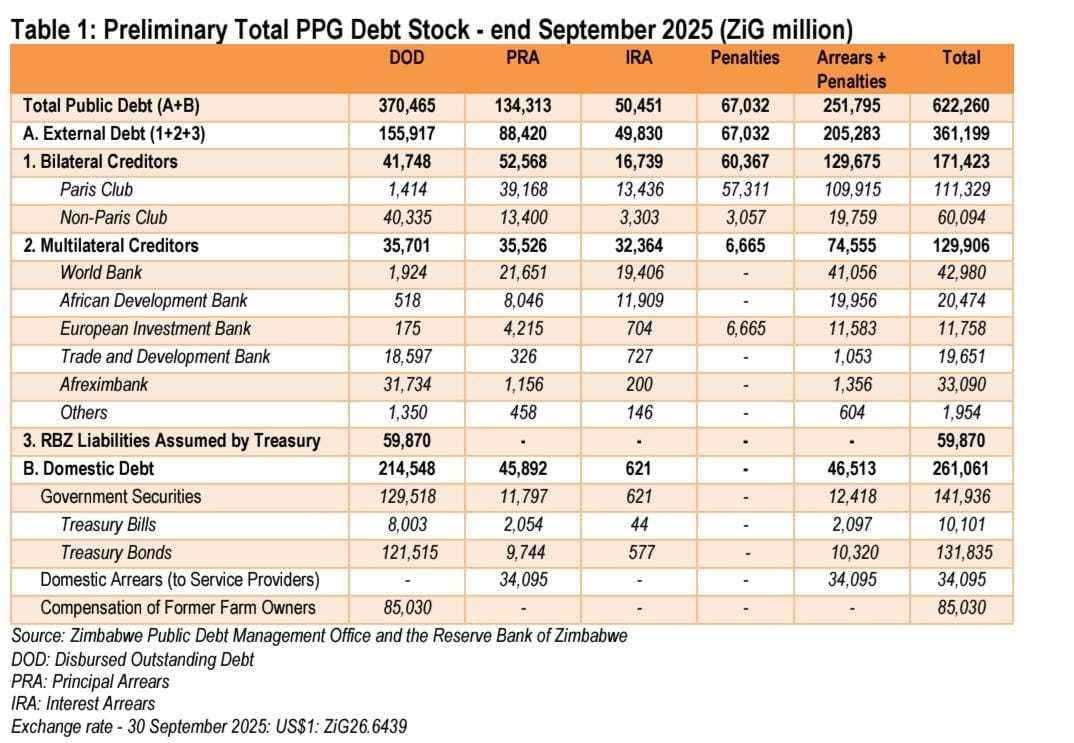
Zimbabwe’s total public and publicly guaranteed debt reached ZiG622.3 billion (US$23.4 billion) as of September 2025, an 8.5% increase from ZiG555.3 billion (US$21.5 billion) recorded in December 2024.
The increase is largely attributed to unvalidated domestic expenditure arrears, which climbed to US$1.3 billion.
External and Domestic Debt Structure
External debt continues to dominate Zimbabwe’s debt profile, accounting for 58.1% of total PPG debt, or ZiG361.2 billion (US$13.6 billion). This includes:
Bilateral creditors – US$6.4 billion (47.5%)
• Paris Club: US$4.2bn, led by Germany (US$1.05bn), France (US$877m), the UK (US$472m), Japan (US$381m), Finland (US$122m), Belgium (US$180m), and Italy (US$169m). About 98% of these obligations are in arrears.
• Non-Paris Club: US$2.3bn, mainly China (US$2.1bn), India (US$92m), Zambia ex-CAPCO (US$57m), South Africa (US$24m), and Kuwait (US$3m).
Multilateral creditors – US$4.9 billion (36%)
Major exposures include the World Bank (US$1.6bn), Afreximbank (US$1.2bn), AfDB (US$768m), EIB (US$441m), TDB (US$738m), and smaller commitments to BADEA, NDF, OFID, and IFAD.
RBZ liabilities assumed by Treasury – US$2.2 billion (16.6%)
Domestic debt accounts for 41.9% of total debt, standing at ZiG261.1 billion (US$9.8bn). It comprises:
• Government securities – ZiG141.9bn (US$5.3bn), mainly Treasury bonds (ZiG131.8bn) and Treasury bills (ZiG10.1bn), largely held by banks.
• Former farm owners’ compensation – ZiG85bn (US$3.2bn) under the Global Compensation Deed.
• Service provider arrears – ZiG34.1bn (US$1.3bn), consisting of unvalidated claims still under Treasury audit.
Debt Servicing Trends
Between January and September 2025, Zimbabwe paid US$220.25 million towards external debt servicing. This included:
• US$188.57m for active loans, mostly Afreximbank (US$147.22m)
• US$28.86m on legacy debts
• US$2.81m in token payments
An additional US$86.6 million is expected to be paid by year-end.
Domestic debt servicing reached ZiG11.2bn (US$420m) — comprising ZiG9.1bn in principal and ZiG2.1bn in interest payments. A further ZiG4.8bn is projected for Q4 2025.
Budget Financing Measures
From January to September 2025, Treasury mobilised ZiG7.4bn in budget financing. Of this:
Related Stories
• ZiG7.3bn was raised domestically through Treasury securities with interest rates between 14.5% and 16%.
• ZiG52m came from external sources.
Total borrowings for 2025 are projected at ZiG9.1bn.
Contingent Liabilities and Arrears Management
In September 2025, government issued a US$210 million guarantee to ZETDC for electricity imports and energy services, valid until October 2029. Its guarantee portfolio currently consists of:
• US$8.68m in fully performing guarantees
• US$73.6m in non-performing guarantees, mainly legacy agriculture guarantees — including US$40.28m for the 2020/21 maize season
• ZiG5.63m in local-currency commitments
Preliminary expenditure arrears stood at US$1.7bn (ZiG45.6bn) at the end of 2024. These arrears stem mainly from:
• Capital projects – 55%, including about US$700m for dam construction
• Social benefits – 33%
• Employee compensation – 7%
Government has outlined a five-year arrears clearance plan, combining non-tradable securities, reverse auctions prioritising key services, and phased revenue-linked allocations — starting at 0.6% of revenue in 2026, rising to 7% by 2030.
Borrowing Outlook for 2026
Government plans to borrow ZiG14.8bn (US$555m) in 2026, structured as follows:
• ZiG12.7bn domestic borrowing — 53% from banks and 47% from non-bank investors, including pension funds (mandated 20% participation).
• ZiG2.1bn external financing — US$68m in sovereign loans and US$238m in on-lent facilities to state-owned enterprises.
After projected repayments of ZiG11.5bn and interest payments of ZiG8.5bn, net financing will amount to ZiG3.2bn.
Borrowing will remain capped at 5.25% of GDP.
Government says it will prioritise concessional external borrowing, anticipating arrears clearance with international financial institutions by 2027 through the IMF Staff-Monitored Programme and the G20 framework. Domestically, Treasury plans to lengthen maturities so that long-term instruments make up 40% of the debt portfolio by 2030.
Transparency Improvements
The 2025 Public Debt Report — presented to Parliament on November 27 by Finance Minister Mthuli Ncube — also notes improved debt transparency assessments by the World Bank, reflecting progress in public reporting and disclosure.






Leave Comments