








Zimbabwe is often described as a country trapped in a never-ending election cycle. The phrase is familiar, almost comforting in its simplicity. But it is also imprecise.
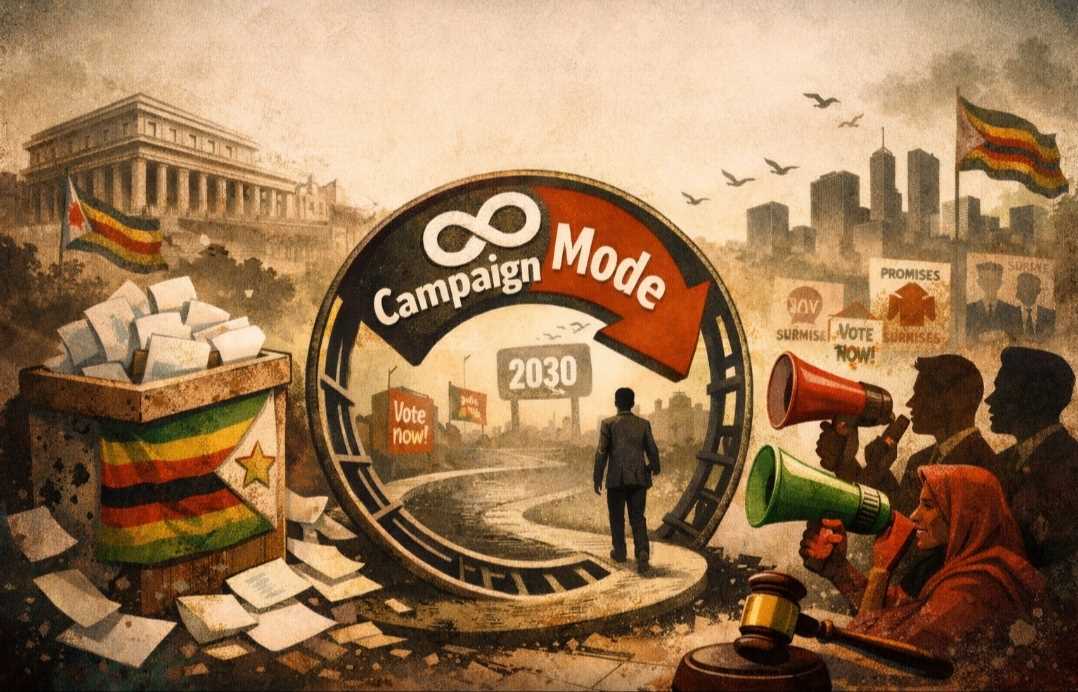
Zimbabwe is not in perpetual election mode. It is in perpetual campaign mode. Elections are moments. The campaign is the condition.
This distinction matters. It explains not only the frequency of political contests, but the deeper paralysis that follows them — economic hesitation, policy volatility and social fatigue. It also places the emerging 2030 agenda in context, not as an aberration, but as a logical extension of a political system organised around permanent mobilisation.
Elections Are Events. Campaigns Become Governance
In functional democracies, elections interrupt governance; they do not replace it. Campaigns mobilise, polarise and compete — then administration resumes. In Zimbabwe, that transition rarely occurs.
By-elections, recalls, court challenges, factional battles and constant political signalling ensure that mobilisation never truly subsides. Leaders govern as though the next contest is always imminent. Decisions are filtered through optics. Reforms are weighed against political cost. Stability is deferred until “after” the next hurdle — a moment that never quite arrives.
This is not simply a story of too many polls. It is a system of continuous political readiness, where governing is subordinated to positioning, and administration remains permanently provisional.
Campaign Logic and the Economy
Permanent campaign mode is economically corrosive. Growth depends on predictability; campaigns thrive on flexibility and narrative control. When politics dominates everything, policy becomes tentative.
Budgets lean towards short-term appeasement rather than long-term structural investment. Reforms are announced but not embedded. Rules shift midstream. Economic actors — investors, businesses and households — delay decisions, waiting for clarity that never comes. Momentum fails to compound because it is constantly reset.
When outcomes disappoint, failure is rarely acknowledged. Instead, timelines are revised. The corner has not yet been turned — but it will be, eventually.
The Social Cost of Permanent Mobilisation
Campaigns depend on division. They sharpen identities, simplify narratives and reward loyalty over nuance. When this mode becomes permanent, social cohesion begins to fray.
Communities are repeatedly mobilised against one another. Neutral institutions are politicised. Public discourse hardens. Citizens respond by becoming cynical, disengaged, or performatively aligned — depending on what survival requires. Stability, understood as trust and predictability, erodes even in the absence of open conflict.
The danger is not constant crisis. It is normalised tension.
Where the 2030 Agenda Fits
Related Stories
The 2030 agenda introduces a revealing paradox. On the surface, Zimbabwe appears locked in endless political contestation. Beneath that motion lies a contrasting objective: permanence at the top.
Permanent campaign mode sustains a sense of unfinished business — a nation always “in process”, never settled enough to close the chapter. In such an environment, arguments for constitutional deviation can be framed as pragmatic, stabilising, even necessary.
If politics is never settled, the logic follows, then continuity becomes a virtue. Finality becomes dangerous. Term limits begin to look like obstacles rather than safeguards.
Under this logic, elections cease to function as mechanisms of resolution. They become rituals of reaffirmation — moments to test loyalty, re-mobilise structures and reset narratives, without ever allowing power to meaningfully alternate.
Democracy Without Consolidation
This does not mean elections are meaningless. It means they are overloaded with functions they were never designed to carry. Instead of renewing the social contract, they prolong uncertainty. Instead of producing clarity, they defer it.
Democracy becomes noisy but shallow — rich in slogans, poor in settlement. Governance remains permanently provisional.
Breaking the Spell
The solution is not fewer elections, but an end to permanent campaigning.
Democracies require cycles: contestation followed by consolidation; politics followed by administration. Institutions must be allowed to function independently of campaign timelines. Policies must be insulated from electoral anxiety.
Leadership must be constrained not only by ambition, but by rules that endure.
Economic growth and social stability thrive in boring environments — where rules last longer than press conferences, and governance outlives mobilisation.
Zimbabwe’s challenge is not participation. It is arrival.
Until the country exits campaign mode — until governance is allowed to settle, perform and be judged on delivery rather than positioning — elections will continue to multiply without resolving anything.
Zimbabwe is not suffering from too much democracy.
It is suffering from democracy that never gets the chance to rest.
Simbarashe Namusi is a peace, leadership and governance scholar and media expert writing in his personal capacity.






Leave Comments