








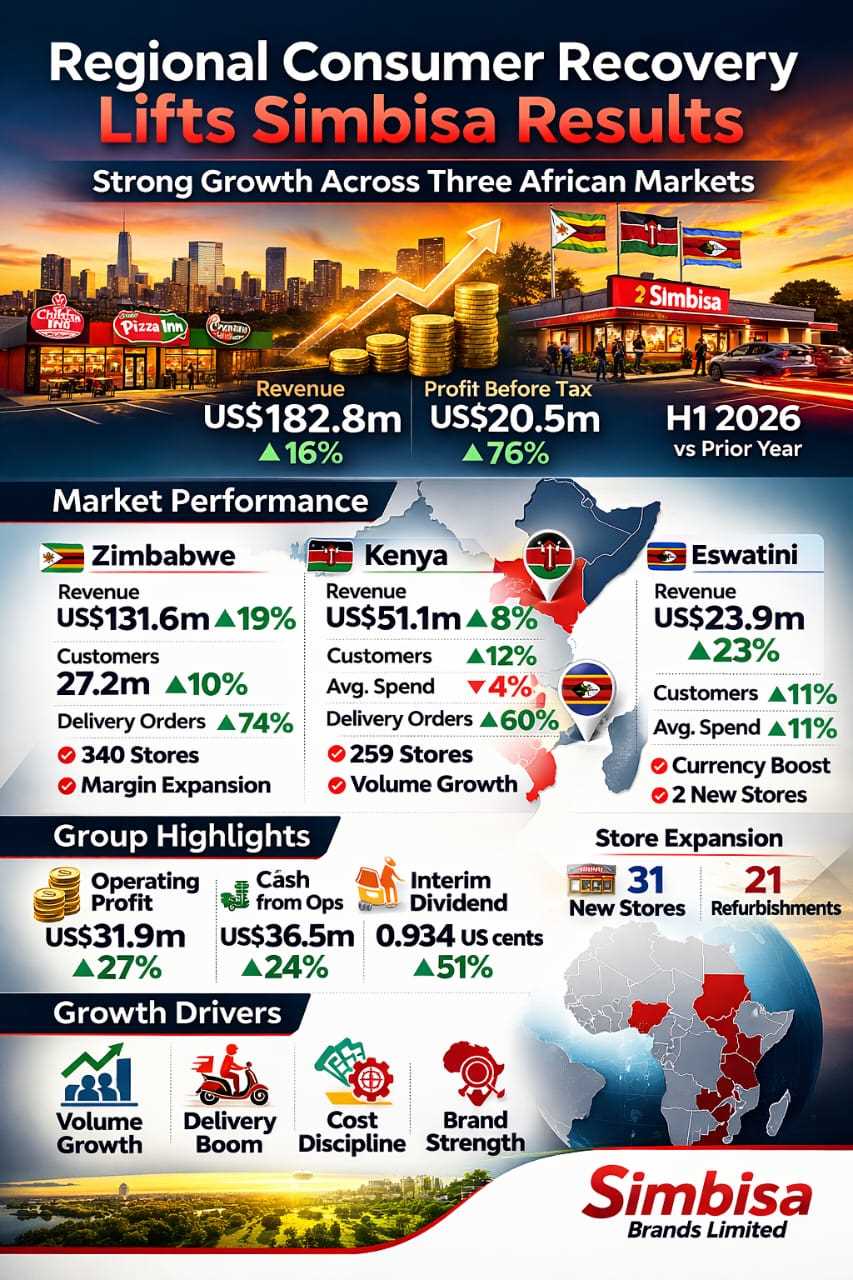
Regional consumer spending showed signs of recovery in the second half of 2025, helping Simbisa Brands Limited deliver strong growth across Zimbabwe, Kenya, and Eswatini. Revenue rose 16% to US$182.8 million, while profit before tax surged 76% for the six months ended 31 December 2025, as higher customer volumes and disciplined cost control offset tax and cost pressures in key markets.
Revenue for the Victoria Falls Stock Exchange-listed quick-service restaurant group was driven by a 10% rise in customer volumes and a 6% increase in average spend. Operating profit before depreciation and amortisation surged 27% to US$31.85 million, while profit before tax climbed 76% to US$20.45 million, underscoring strong margin resilience across markets.
The results reflect a decentralised, brand-focused operating model that appears to be yielding efficiency gains even in tax-heavy and liquidity-constrained environments.
Zimbabwe: Volume-Led Growth Under Tax Pressure
Zimbabwe remains the group’s dominant market, contributing US$131.6 million in revenue, approximately 72% of total group turnover.
Revenue from the Zimbabwean operation rose 19% year-on-year, underpinned by a 10% increase in customer volumes to 27.2 million. Delivery orders surged 74%, helping drive a 9% increase in average spend despite the company absorbing the fast-food tax introduced locally.
However, performance came against a difficult backdrop. While exchange rate volatility eased during the period due to monetary tightening, liquidity constraints persisted. Elevated taxation, including the Fast-Food Tax and IMTT, alongside power supply disruptions, continued to raise operating costs and pressure margins.
Despite sacrificing some gross margin through tax absorption and input cost pressures, Zimbabwe improved operating margins through cost containment, supplier negotiations, and operational efficiencies. The segment delivered US$19.24 million in operating profit before depreciation and amortisation, up from US$15.4 million in the prior comparable period.
Store rationalisation was evident: 11 new stores were opened and 10 closed, ending the period with 340 counters. Capital expenditure in Zimbabwe totalled US$7.95 million, reflecting continued reinvestment in the core market.
Kenya: Volumes Up, Spend Under Pressure
In Kenya, growth was more volume-driven than value-led. Customer numbers rose 12% year-on-year, but average spend declined 4% in US dollar terms due to aggressive value promotions and cautious consumer behaviour.
Revenue in the regional segment, which includes Kenya and Eswatini, increased to US$51.13 million from US$46.58 million. Kenya faced intermittent political unrest, subdued inflation, fiscal consolidation pressures, and restrained consumer sentiment.
Delivery channels grew strongly, with orders up 60%, reflecting a shift toward convenience-driven consumption.
Operating margins in Kenya were maintained rather than expanded, highlighting tighter consumer spending and promotional intensity. The market added nine new outlets and closed five, ending with 259 active stores, while refurbishing 11 locations.
Kenya’s performance demonstrates operational resilience, but margin expansion remains constrained compared to Zimbabwe and Eswatini.
Eswatini: Balanced Growth Story
Related Stories
Eswatini delivered the most balanced growth profile among the three countries. Revenue rose 23% year-on-year, driven by an 11% increase in customer volumes and an equal 11% rise in average spend.
The strengthening of the local currency, which appreciated 12% against the US dollar, helped moderate inflationary pressures. However, economic growth and household disposable incomes remained subdued, reinforcing value-led consumer behaviour.
Two new stores were opened in the second quarter, positioning the market for stronger second-half contributions.
Eswatini’s performance stands out for combining both volume growth and improved spend, indicating healthier pricing power relative to Kenya and less tax drag than Zimbabwe.
Profitability and Cash Strength
Group-wide profitability expanded sharply. Profit attributable to equity holders rose 78% to US$15.5 million, while headline earnings per share increased to 2.80 US cents from 1.58 US cents.
Cash generated from operations rose 24% to US$36.5 million, translating into a strong 115% operating profit-to-cash conversion ratio—a sign of disciplined working capital management.
The board declared an interim dividend of 0.934 US cents per share, up 51% year-on-year.
Comparative Market Analysis
A closer examination of the three core markets reveals distinct dynamics:
Zimbabwe remains the earnings engine, delivering scale, strong revenue growth, and margin expansion despite high taxation and cost pressures.
Kenya is volume-resilient but price-sensitive, with promotional intensity limiting average spend growth.
Eswatini shows the most balanced expansion, combining volume and value growth under a more stable currency environment.
Zimbabwe contributed roughly 63% of group operating profit before depreciation and amortisation, reinforcing its central role in underpinning group earnings.
Strategic Outlook
The group plans to open 31 new stores and refurbish 21 more before the financial year-end, signalling continued confidence in consumer demand across markets.
However, additional fiscal tightening measures introduced in Zimbabwe from January 2026 could test consumer spending power in the second half. Cost containment, digitisation, supplier engagement, and solarisation initiatives are expected to play a critical role in protecting margins.







Leave Comments