





Newly reassigned Minister of Information, Publicity and Broadcasting Services, Soda Zhemu is literally stepping into the hot seat. it was not an administrative reshuffle.
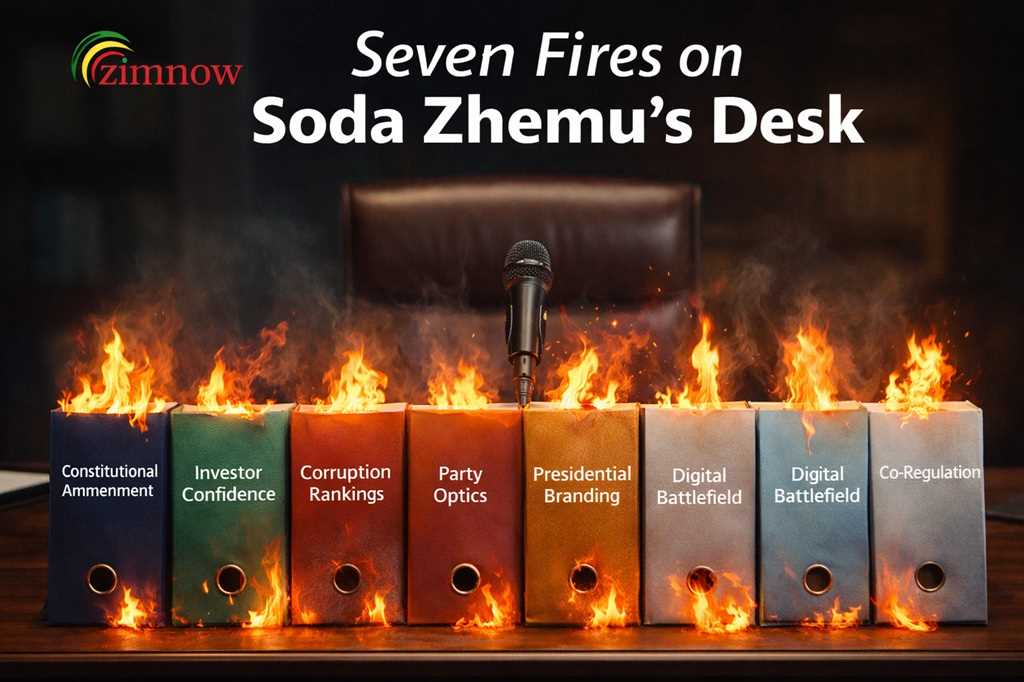
The Information portfolio is the state’s amplifier, shield and pressure valve and Soda inherits seven active fires that his predecessor was struggling with.
1. The Constitutional Amendment Debate
After proposals to extend presidential tenure have been passed in Cabinet and now heading to Parliament while public discourse is almost fully negative, the Information Ministry will sit at the centre of the framing battle.
The challenge is presenting any amendment as a constitutional process rather than political preservation. Poor handling risks investor unease, civic mobilisation and regional scrutiny.
2. Reserved Sectors and Investor Confidence
Statutory Instrument 215 and related reserved sector measures have unsettled sections of the business community. Zimbabwe is simultaneously pushing empowerment rhetoric and courting foreign direct investment. Mixed messaging here damages credibility. Soda must help project clarity, consistency and predictability.If trust is an economic currency, communication volatility devalues it fast.
3. Corruption Perception and Global Rankings
Zimbabwe continues to perform poorly on global corruption perception indices. The Information Ministry must decide whether to challenge these reports, contextualise them, or foreground reform efforts. Aggressive denial risks appearing detached. Silence risks reinforcing perception. In the digital age, slogans collapse quickly under scrutiny. Tone matters more than volume.
4. Zanu PF Internal Optics
We all know that despite repeated public denials, all is not well in the ruling party. We are now moving into a phase where playing at neutral no longer works. But at the same time open hostility can boomerang at any time. How Soda directs the state media to treat perceived rivals will signal much to close watchers. And could precipitate some interesting events.
5. Rebranding the Presidency
Projecting President Mnangagwa as reform-driven and development-focused remains central to the portfolio. But narrative cannot outrun lived experience. Citizen concerns shape how every message lands. The challenge is synchronising communication with tangible delivery rather than aspirational branding based on nothing but slogans.
6. The Digital Battlefield
The Information Ministry no longer controls the ecosystem. WhatsApp groups, X spaces, diaspora livestreams and TikTok commentary now inform and shape perception faster than press conferences.
Heavy-handed regulation risks backlash. Total disengagement cedes ground. Soda must determine whether to confront, regulate or strategically engage the digital sphere. That choice will define his communication style.
7. Will Soda Finish the Co-Regulation Project?.
During the tenure of Monica Mutsvangwa, government signalled willingness to implement a co-regulation framework where statutory bodies and media industry players would share oversight responsibility and raised expectations of structured collaboration between the Zimbabwe Media Commission and self-regulatory bodies.
Under Jenfan Muswere, that co-regulation model was thrown out of the window and instead he tried to create some double regulation set up that defied logic. Soda Zhemu now inherits that mess at a time when media organisations are facing survival challenges. Operationalising a genuine co-regulation framework would signal institutional maturity while mishandling it reinforces scepticism that reform is cosmetic.
The Real Measure
In Information, performance is measured in belief which cannot be legislated and must be earned. Soda Zhemu now holds the microphone while presiding over hot issues. Can he stand the heat?
Who Is Dr Soda Zhemu?
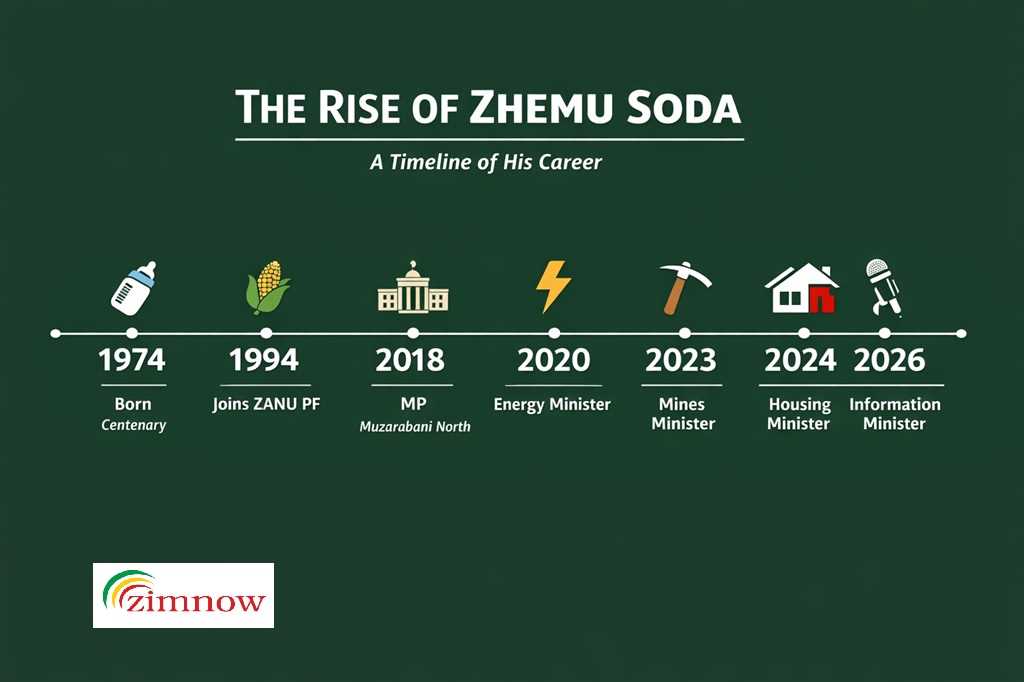
Dr Soda Zhemu is not one of Zimbabwe’s loud political personalities. He is a steady, low-profile operator who has quietly moved through three major economic ministries before landing at the nerve centre of government communication.
Born on June 4, 1974, in Centenary, Mashonaland Central, Soda built his early career in Zimbabwe’s cotton industry. He worked for the Cotton Company of Zimbabwe before rising to become a regional manager at Alliance Ginneries, remaining in the sector until 2017. That private sector grounding in agribusiness would later shape his development-focused political messaging.
He joined Zanu PF in 1994 as a youth league member and gradually rose through party structures in Mashonaland Central. In 2018, he was elected Member of Parliament for Muzarabani North in a landslide victory and has retained the seat in 2023. His constituency work has largely centred on rural development, infrastructure, agriculture and unlocking mineral potential in the resource-rich district.
Soda first entered Cabinet in August 2020 when President Emmerson Mnangagwa appointed him Minister of Energy and Power Development. The move surprised many. He was relatively unknown nationally at the time and replaced Fortune Chasi during a period of intense electricity shortages.
Related Stories
His tenure in Energy coincided with severe power cuts linked to drought at Kariba and ageing thermal plants. Critics argue he struggled to stem the crisis quickly enough. However, he oversaw the near-completion and commissioning of Hwange Units 7 and 8 and pushed renewable energy targets aimed at adding 2,100 megawatts by 2030.
Following the 2023 elections, Soda was moved to the Ministry of Mines and Mining Development, where he aligned with government’s push for a US$12 billion mining industry. His focus was on production expansion, value addition, and reducing mineral leakages.
In April 2024, he was reassigned again, this time to the Ministry of National Housing and Social Amenities. It was here that his most measurable results emerged. Under his watch, over US$1 billion in housing finance was mobilised, significantly exceeding earlier targets. Government reported that more than 800,000 housing units and serviced stands had been delivered during the National Development Strategy 1 period.
Academically, Soda holds a Bachelor of Commerce degree in Accounting, an MBA, and was awarded a Doctor of Business Administration degree in 2025.
His February 2026 appointment as Minister of Information, Publicity and Broadcasting Services places him at the centre of state messaging and narrative control. Unlike some predecessors known for combative communication styles, Soda is regarded as methodical and measured.
Whether that temperament translates effectively into winning Zimbabwe’s increasingly digital and contested information space remains to be seen.
Information Ministers Since 1980:
The Ministry of Information has always been more than a desk with press statements. Since Independence in 1980, it has been the state’s amplifier, shield and megaphone.
Nathan Shamuyarira, 1980 to 2000
Shamuyarira was Zimbabwe’s first Information minister and the longest serving. A trained journalist and senior ZANU PF ideologue, he shaped post-independence state media policy for two decades. He defined the ministry as an instrument of nation-building and political defence.
Jonathan Moyo, 2000 to 2005
If Shamuyarira built the structure, Moyo weaponised it. During his first stint, he introduced media laws such as AIPPA and tightened regulatory controls at a time of rising opposition and international scrutiny. This was the combative, high-octane era of state media confrontation and polarization.
Sikhanyiso Ndlovu, 2005 to 2009
Ndlovu took over during a turbulent period marked by economic crisis and political tension leading into the Government of National Unity. The ministry remained defensive and politically central.
Webster Shamu, 2009 to 2013
An affable and well-liked fellow, Shamu served during the GNU period. Media reforms were debated intensely, though structural state media dominance remained largely intact.
Jonathan Moyo 2:0, 2013 to 2017
Moyo returned for a second stint after the 2013 elections somewhat more mellow and less hostile to private media His term ended during the 2017 political transition when he chose to align with G40 against the Lacoste faction which eventually won the struggle for power post Mugabe.
Monica Mutsvangwa, 2018 to 2023
Mutsvangwa became the public face of the “Second Republic” communication strategy. She faced internal criticism for letting her husband, Christ Mutsvangwa be the de facto minister and also using state media to fight perceived rivals and opponents by denying them coverage. But she built a good relationship with media practitioners across the board and did much to bridge the state vs private media divide.
Jenfan Muswere, 2023 to 2026
Muswere presided over the post-election-period messaging and a high-intensity digital environment. He had to deal with pushing the 2030 agenda while his principal tried to deny it.
Perceived as a dictatorial presence lacking institutional knowledge and memory, Muswere did not incite the same rapport with media practitioners that his predecessor had established.
His reassignment marks the latest shift in a ministry that often mirrors political seasons.




Leave Comments