






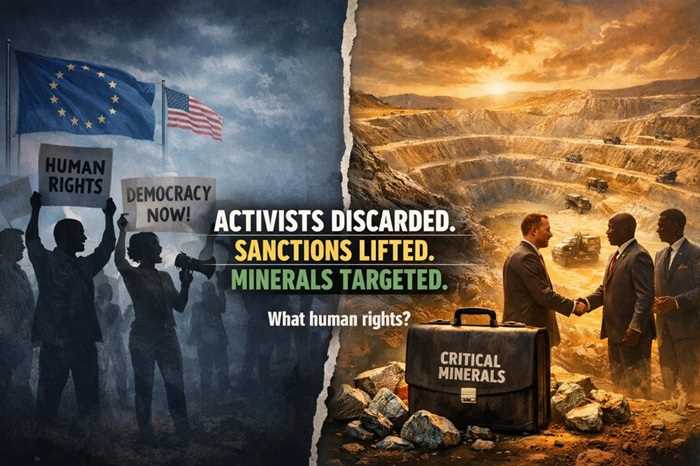
The European Union has now lifted its remaining sanctions on Zimbabwe. Part of the economic trauma of our lives brushed off, just like that. And we are hearing no apology or explanation of which human rights issues have been fixed to warrant the about-face.
This comes soon after the United States ambassador, Pamela Tremont, publicly declared that Washington is actively seeking access to Zimbabwe’s critical mineral resources.
Meanwhile, the United States Senate is working on repealing the Zimbabwe Democracy and Economic Recovery Act, the law that institutionalised Zimbabwe’s financial isolation for over 20 years.
This is a dramatic admission that the entire economic siege was never about any alleged democratic renaissance.
It was always economic warfare to make Harare pliable to Western manipulation.
For two decades, Zimbabwe was the morality play of Western diplomacy. Sanctions were described as targeted. Pressure was described as principled. Funding flowed generously into civil society organisations tasked with documenting, critiquing and campaigning.
Activists turned jetsetters, built careers and large houses, and sent their kids to pricey private schools as NGOs multiplied. Workshops kept hotels in business, and reports were religiously written and filed. Press statements were issued to make donor dashboards glow. The investment into making Zimbabweans feel miserable and hate their motherland was on steroids.
Then Donald Trump pulled the plug. USAID funding shrank in a few cases and in most others, it stopped. The Europeans soon followed suit with funds that had controlled the narrative for years, like FNF announcing their departure.
Western governments had recalibrated priorities. Ukraine. Energy security. Inflation. Domestic politics. Strategic competition with China. Critical minerals. And most importantly, they have realised that Emmerson Mnangagwa is no Robert Mugabe. Where Mugabe stood his ground, Mnangagwa has proven malleable and eager for Western approval. So why would they want a regime change, if this one can deliver what they want? Human rights for Zimbabweans are not part of that equation, and never were.
And where does this leave the activists? Many are unemployed. Some are rebranding. Others are desperately scrambling to find relevance in a landscape that no longer rewards the posture of permanent outrage after the sponsors have moved. Activists have been used and discarded like so many used toilet paper sheets. This is the hard truth.
The takeaway is that external powers do not fund activism out of romance. They fund it when it aligns with strategic objectives. When Zimbabwe was a pressure point in a broader geopolitical script, funding made sense. When that script changed, so did the cheques. Many activists are now painfully discovering that geopolitics has no loyalty programme.
Related Stories
For years, Zimbabwe was painted internationally in the darkest possible hues. Some local voices became permanent tour guides of dysfunction, briefing foreign missions, testifying before foreign legislatures, shaping narratives that reinforced isolation. Now those same foreign capitals are negotiating access to minerals with the very state structures they once condemned. The activists are now an embarrassment that must learn to stay out of sight.
The Loud Silence On 2030 Push
If sanctions and isolation were fundamentally about constitutionalism and governance, one might expect thunderous commentary around the 2030 term extension debate. Instead, there is absolute quiet. No fiery statements from the US Embassy or the EU representative. They might as well not be in the room.
Why? Because critical minerals are not abstract. Because supply chains matter more than sermon notes. But most importantly, because China has taught the West a great lesson on pragmatism and the inefficiency of the old way of doing business, whereby autocracy is dressed up as moral outrage.
A Brutal Lesson for Zimbabweans
At a crucial time where The Constitution that defines our nationhood is at stake, we are on our own. Believing that external powers will rescue Zimbabweans from Zimbabwean politics is strategic naivety. Outsourcing domestic change to foreign capitals is sheer lack of political acumen, because sooner or later, interests shift.
Some activists built entire identities around international validation. Some treated Western endorsement as the ultimate certificate of legitimacy. Some encouraged the narrative that only external pressure could fix Zimbabwe. Today, that theory has collapsed under the weight of lithium. The donors have pivoted. The rhetoric has cooled. The sanctions have been lifted. And Zimbabwe remains.
The sanctions era should leave us with one enduring insight. There are no permanent friends in geopolitics. There are no permanent moral crusades. There are only permanent interests and they target the easiest tools at the moment.
Our task now is to gear up and fight for the Zimbabwe that we want. Knowing that we are on our own.







Leave Comments