





Zimbabwe's debt burden is increasingly becoming more than a fiscal challenge—it is shaping how much Government can spend on hospitals, schools, roads and social services, with delegates at the 8th Zimbabwe Annual Debt Conference warning that debt governance is now central to the country's development prospects.
The conference, convened by the Zimbabwe Coalition on Debt and Development in Masvingo, brought together Government officials, parliamentarians, economists, civil society, labour, development partners and the private sector to interrogate Zimbabwe's debt profile and the country's long-running arrears clearance process.
Rather than focusing only on how much Zimbabwe owes, participants questioned whether the country can sustain economic growth while servicing debt and pursuing middle income economy status.
"Key discussions focused on Zimbabwe's public debt profile, arrears clearance efforts, strengthening transparency and accountability in debt governance, and how the global financial architecture continues to shape Africa's debt challenges," ZIMCODD said.
The organisation said delegates also examined the consequences of debt on the productive economy.
"Participants also reflected on the impact of public debt on private sector growth, investment and employment, while exploring practical reforms that promote fiscal sustainability without compromising essential public services and people's wellbeing," it said.
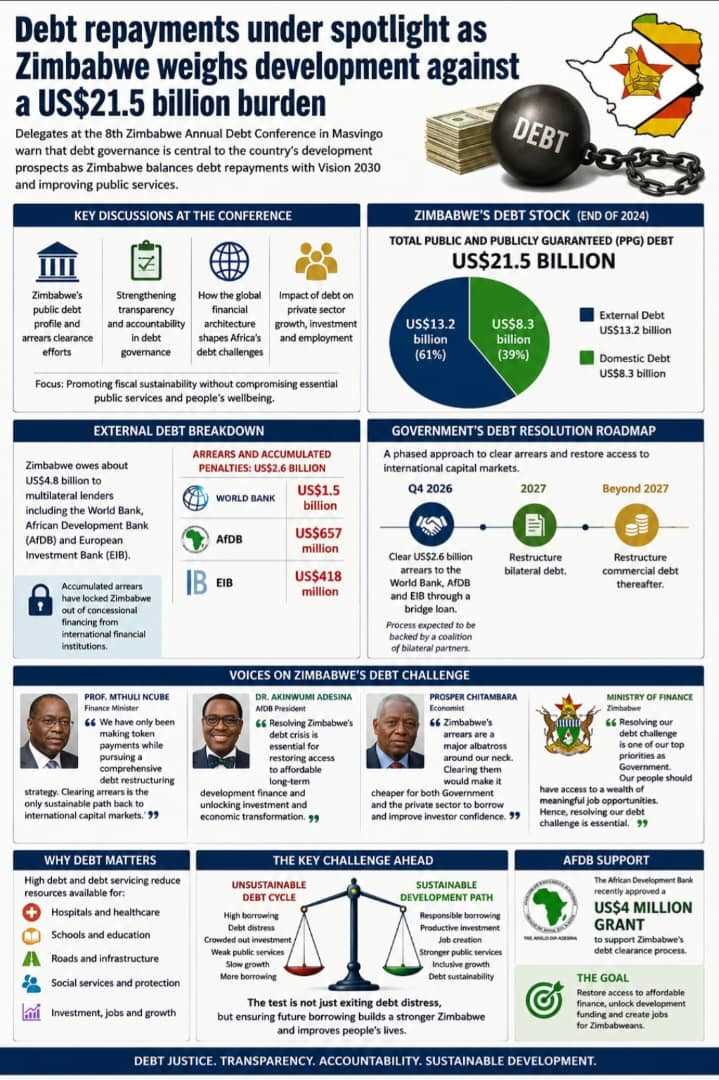
Their concerns come as Zimbabwe's Public and Publicly Guaranteed debt reached US$21.5 billion at the end of 2024, comprising US$13.2 billion in external debt and US$8.3 billion in domestic debt, according to the Ministry of Finance's Structured Dialogue Platform on Arrears Clearance and Debt Resolution.
Related Stories
Of the external debt, Zimbabwe owes about US$4.8 billion to multilateral lenders, including the World Bank, African Development Bank and European Investment Bank. Arrears and accumulated penalties alone account for US$2.6 billion, with Zimbabwe owing US$1.5 billion in arrears to the World Bank, US$657 million to the AfDB and US$418 million to the EIB.
Unlike countries with normal borrowing arrangements, Zimbabwe has been unable to fully service these obligations for years because of accumulated arrears, leaving it largely locked out of concessional financing from international financial institutions.
Finance Minister Mthuli Ncube has previously acknowledged that Government has only been making "token payments" to creditors while pursuing a comprehensive debt restructuring strategy, arguing that clearing arrears is the only sustainable path back to international capital markets.
The Government's roadmap now targets clearing the US$2.6 billion arrears owed to the World Bank, AfDB and EIB through a bridge loan in the fourth quarter of 2026, before moving to restructure bilateral debt in 2027 and commercial debt thereafter. The process is expected to be backed by a coalition of bilateral partners if negotiations succeed.
Former African Development Bank President Akinwumi Adesina has consistently argued that resolving the debt crisis is essential for restoring access to affordable long-term development finance. The AfDB recently approved a US$4 million grant to support Zimbabwe's debt clearance process, saying the country's debt burden continues to constrain investment and economic transformation.
Economist Prosper Chitambara has previously described Zimbabwe's arrears as "a major albatross around our neck," arguing that clearing them would make it cheaper for both Government and the private sector to borrow while improving investor confidence.
The Ministry of Finance also argues that debt resolution is ultimately about unlocking development finance rather than simply reducing liabilities.
"Resolving our debt challenge is one of our top priorities as Government," the Ministry says in its latest debt resolution roadmap. "Our people should have access to a wealth of meaningful job opportunities. Hence, resolving our debt challenge is essential."





Leave Comments