








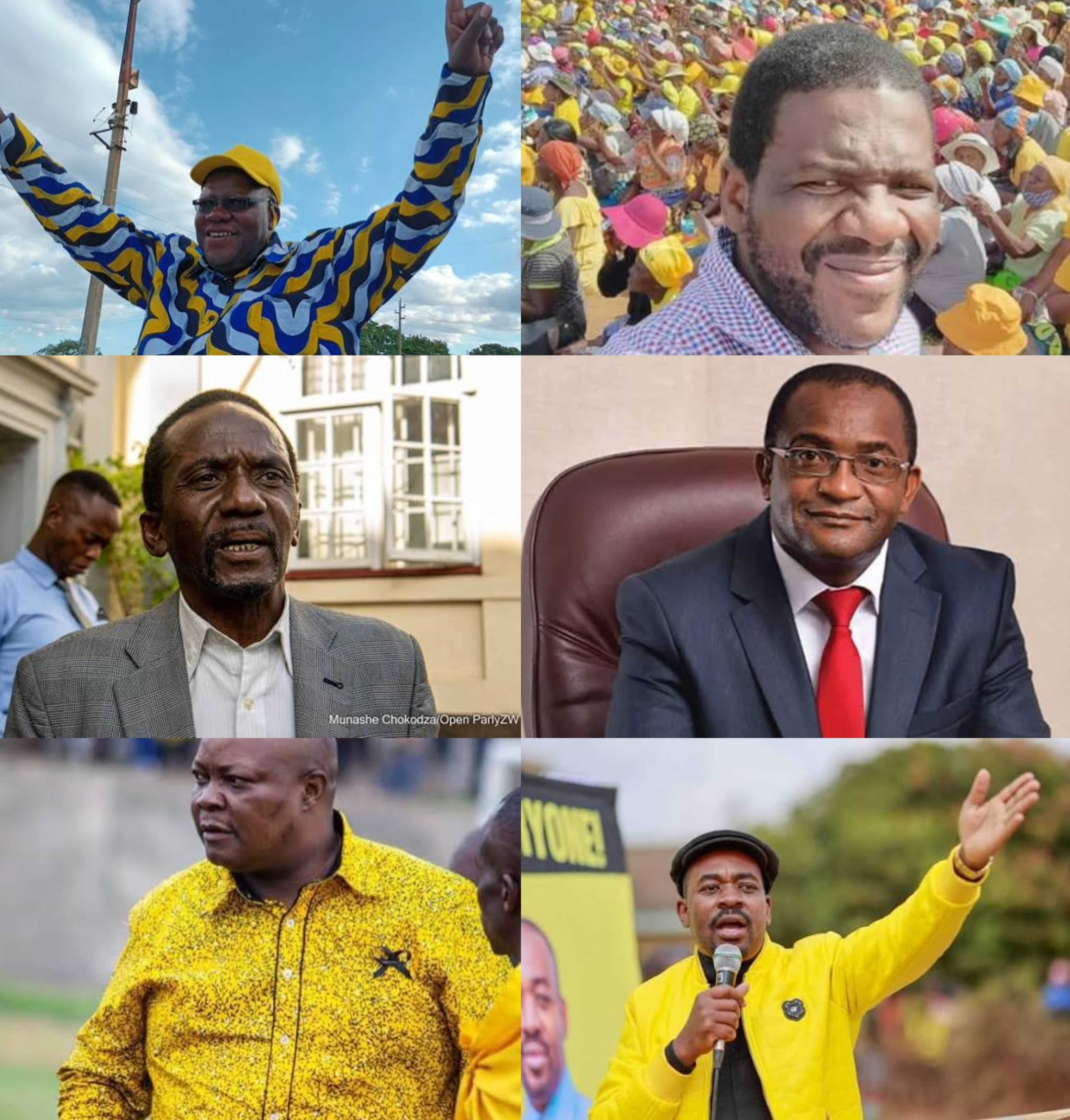
Zimbabwe's opposition is not suffering from a shortage of political leaders. It is suffering from an abundance of them each with a constituency, a strategy, a history of grievances and, increasingly, a political vehicle of his or her own, but without a common structure capable of turning those separate sources of influence into sustained power against ZANU-PF.
The contradiction has become especially stark in 2026. As President Emmerson Mnangagwa's government pushed Constitutional Amendment Act No. 6 through Parliament and into law, opposition politicians, lawyers, pressure groups, civic organisations and activists mobilised against it. Yet, the resistance remained divided over strategy, leadership and even which political battle mattered most.
The result is a country with a crowded opposition space but no undisputed opposition centre.
The most consequential personality in that space remains Nelson Chamisa, precisely because he combines what most of his rivals lack: a recognisable national brand, a substantial electoral following and the ability to command attention without holding a formal party position.
However, his political strength is also the source of the argument against him. Chamisa left the Citizens Coalition for Change in January 2024 after accusing ZANU-PF of hijacking the movement through Sengezo Tshabangu, and he has since promised a new citizens' movement.
In December 2025, he told supporters that "next year we are going to go big" and change the country's direction. In 2026, he unveiled his "Agenda 2026" and began a new round of consultations.
Critics have seized on the gap between the scale of his rhetoric and the pace of organisational construction.
Political analyst Ruben Mbofana described the new phase as a continuation of "strategic ambiguity," arguing that Chamisa's promises remained completely devoid of actionable substance or a clear roadmap. Mbofana went further, arguing that the effect could be to create a false sense of hope that somebody else is handling the crisis while weakening organic mobilisation on the ground.
Other commentary has been even harsher, accusing Chamisa of confusing political visibility with organisational viability.
That criticism should not, however, obscure the other side of the equation: Chamisa remains politically relevant precisely because, despite the collapse of CCC, he retains a national following that many of his rivals have been unable to reproduce. Reports note that his return generated concern within ZANU-PF and retained symbolic importance among Zimbabweans frustrated with the political status quo.
That makes Chamisa both the opposition's biggest asset and one of its biggest structural problems.
His supporters see him as the most credible national challenger to Mnangagwa; his critics see a political movement repeatedly reorganised around one individual.
Chamisa himself has rejected the latter interpretation. In his recent response to Hopewell Chin'ono, he insisted that CCC had a Citizens National Assembly, bureau heads, committees, grassroots structures and a constitution, arguing that the movement's electoral success could not have been achieved without organisation.
He also stated that institutions must never be personalised, nor personalities institutionalised. The statement identifies the precise institutional problem that now confronts his next political project, if a new movement is again built around Chamisa's national appeal, what prevents it from suffering the same organisational vulnerability as CCC? The experience of CCC is the evidence.
Sengezo Tshabangu represents the other side of the CCC story ,the extraordinary power that can be acquired by a political figure who controls an organisational mechanism rather than a national following. Before the 2023 election he was relatively obscure; after claiming the position of CCC secretary-general, he became central to the recalls of opposition MPs and councillors.
The recalls weakened the opposition's parliamentary and local-government presence and contributed to by-elections in which ZANU-PF consolidated its advantage.
A recent Standard retrospective described Tshabangu as one of the most consequential figures to emerge from the opposition's internal crisis, arguing that few Zimbabweans could have predicted how dramatically his actions would alter the country's political trajectory.
Whatever one's view of Tshabangu's legitimacy or political alliances, his rise demonstrates something important: political power does not always belong to the most popular politician; it can belong to whoever controls the institutional lever. That is precisely what Zimbabwe's opposition has repeatedly failed to build and protect.
Related Stories
Beyond Chamisa, other key figures hold substantial political capital, though it remains fragmented across separate platforms. Tendai Biti brings legal expertise, parliamentary experience, economic credentials from his time as finance minister, and a long history in the MDC and CCC.
His Constitution Defenders Forum has given him a fresh platform centred around constitutionalism rather than a conventional presidential campaign. The CDF notes that three organisations coordinated their opposition to CAB3 and withdrew from flawed public hearings, creating a united front around constitutional defence.
Biti has also signalled a willingness to work with Chamisa. Yet, the very existence of CDF illustrates the fragmentation problem,rather than Biti operating inside one consolidated opposition machine, he is building influence through another isolated platform.
Job Sikhala brings confrontation and street-level credibility. His years as an outspoken activist, his imprisonment, and his reputation for direct confrontation with the state have given him a constituency less dependent on parliamentary politics.
In July, he backed calls for nationwide protests against CAA3, stating that intimidation would not stop those defending the Constitution.
His value lies in his willingness to occupy the space between formal opposition politics and popular agitation. However, the Bertelsmann Transformation Index's (BTI) 2026 Zimbabwe report notes that prolonged detention severely weakened the opposition's representative functions showing that while Sikhala can mobilise anger, the opposition still lacks a structure to turn that anger into institutional leverage.
Jacob Ngarivhume operates through Sungano yeVanhu, attempting to build a broad coalition around constitutional defence by uniting political and civic actors opposed to CAB3.
His coalition targets citizens who want to campaign on specific national issues without joining a formal political party. However, the ongoing challenge is whether a pressure coalition can become more than a temporary alliance around a single battle, or if it will simply add another layer to an already crowded landscape.
Jameson Timba and Amos Chibaya reveal perhaps the most painful contradiction. Timba, representing the remnants of the formal parliamentary opposition, attempted to defend a constitutionalist position through the
Defend the Constitution Platform. However, when Chamisa-aligned activists urged by former Chamisa ally Amos Chibaya encouraged supporters to leave Timba's platform to follow their own trajectory, deep fissures were exposed. Timba responded that his initiative was non-partisan and required no political party's permission.
The episode highlighted the core issue in miniature competing opposition centres fighting over WhatsApp groups and organisational authority at the precise moment unity was required.
Ostallos Siziba has focused on structural resilience, arguing that infiltration is a primary threat in securocratic states and that movements require intelligence, counter-intelligence, institutional security, and robust information verification.
His contribution points toward a deeper solution,systems that survive individual leaders. The challenge remains that articulate figures like Siziba are distributed across separate projects rather than a single unified institution.
Douglas Mwonzora has proposed bringing Chamisa, Biti, Sikhala and other former leaders together to build a formidable opposition, calling for politicians to forgive each other and unite. Meanwhile, Charlton Hwende acknowledged collective responsibility for the destruction of the MDC, stating that all leaders contributed to the demise of a genuine opposition movement, while calling for a new movement led by fresh leadership.
Blaming the opposition alone, however, would be analytically lazy. The environment in which these politicians operate remains exceptionally hostile. As highlighted by the BTI 2026 report, opposition lawmakers face recalls, prolonged pre-trial detentions, and state intimidation.
A fragmented opposition is easier for a ruling party to defeat, but that fragmentation is also actively produced by the hostile political environment itself.
This leaves Zimbabwe with a peculiar opposition ecosystem: Chamisa has the brand,Biti has the legal expertise; Sikhala has the activist reputation; Ngarivhume has the pressure-group model; Timba has parliamentary experience; Siziba has digital reach; Mwonzora has long-established party experience; and Tshabangu demonstrated the power of institutional control.
What is missing is the mechanism that combines those assets without allowing one personality to dominate it or one faction to destroy it.
The irony is that ZANU-PF has its own internal factions, rivalries and succession battles, but it remains institutionally dominant because its factions ultimately operate inside a single organisation. Zimbabwe's opposition has repeatedly done the reverse ,it has responded to internal disagreements by founding new organisations.
ZANU-PF absorbs factional competition, the opposition converts factional competition into fragmented political formations. That difference remains the ruling party's greatest strategic advantage.





Leave Comments