








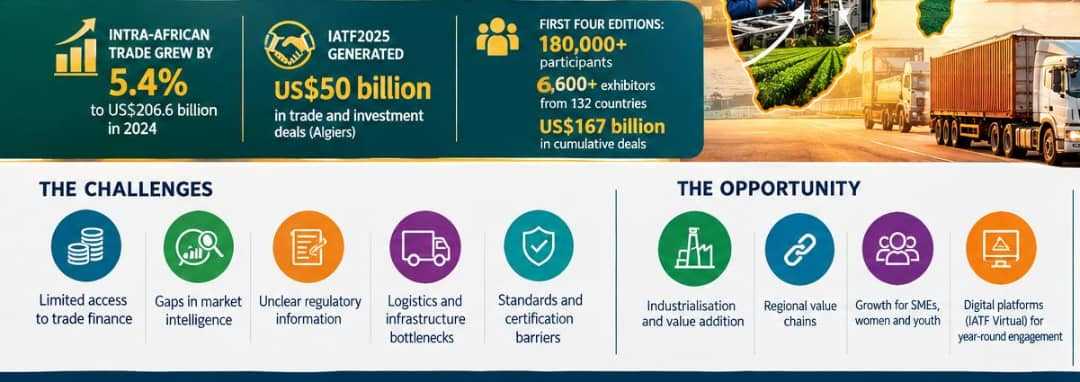
Africa’s intra-African trade grew by 5.4% to US$206.6 billion in 2024, signalling rising commercial activity across the continent, but the African Export-Import Bank (Afreximbank) says the bigger challenge is converting that momentum into sustained cross-border business by addressing gaps in trade finance, market intelligence, regulatory information and value-chain development.
The warning comes from Kanayo Awani, Executive Vice-President for Intra-African Trade and Export Development at Afreximbank, who argues that Africa’s trade problem is increasingly less about the availability of markets and more about whether businesses can actually access and transact in them.
“Boosting trade flows amongst African countries remains a key economic priority,” Awani said, arguing that stronger intra-African commerce could help unlock investment and accelerate industrialisation, particularly through processing and value addition to the continent’s natural resources.
The figures in Afreximbank’s Africa in Figures 2025 report show that intra-African trade reached US$206.6 billion in 2024, but the increase remains modest against the scale of the continent’s economies and the ambitions of the African Continental Free Trade Area (AfCFTA).
Awani said enterprises continue to be constrained by “limited knowledge of market opportunities”, unclear regulatory information and restricted access to trade finance, barriers that prevent companies from expanding beyond their domestic markets.
The financing problem is particularly important for small and medium-sized enterprises, which make up much of Africa’s business base but often lack the working capital, collateral and market knowledge required to enter new countries.
For Afreximbank, the answer is not simply more trade agreements.
The institution is positioning the Intra-African Trade Fair (IATF) as one mechanism for closing the gap between formal market access and actual commercial transactions.
The fourth edition, IATF2025 in Algiers, generated US$50 billion in reported trade and investment deals, according to Awani, while the first four editions of the fair attracted more than 180,000 participants and 6,600 exhibitors from 132 countries and generated more than US$167 billion in cumulative trade and investment deals.
But the more revealing figure is the proportion of concluded deals directly supporting intra-African trade.
According to Afreximbank’s Impact of the Intra-African Trade Fair on Development and Trade, 2018–2024 report, 62.4% of concluded deals directly supported intra-African trade, representing more than US$8.5 billion for each edition since 2018.
The report also estimates that nearly 360,000 small businesses and SMEs have benefited from the trade fair, including women- and youth-led enterprises.
Awani argues that the figures demonstrate that African businesses are capable of finding opportunities when mechanisms exist to connect them.
“The real constraint is not demand, but access specifically, the need for structured and efficient pathways that enable businesses to identify opportunities, connect with the right partners, and execute transactions at scale,” she said.
That distinction is critical for countries such as Zimbabwe, which have repeatedly sought to expand exports and diversify away from traditional markets.
Having preferential access to an African market does not automatically translate into exports. Businesses still need to know what consumers in those markets want, meet standards and certification requirements, understand regulations, secure finance, find distributors and move goods across borders at competitive costs.
The AfCFTA has created the framework for a much larger continental market, but Awani’s argument suggests that implementation will increasingly depend on the infrastructure surrounding trade rather than the agreement itself.
Trade finance is one of those pressure points.
A company may have a product and a potential buyer in another African country but still fail to complete the transaction because it cannot finance production, transport, insurance or payment terms.
Related Stories
The same applies to market intelligence.
Businesses cannot easily exploit tariff preferences if they do not know which products are in demand, which standards apply or which potential buyers and distributors they should approach.
Awani said this was why the continent needed to continue closing “long-standing gaps in trade, investment, and market intelligence”.
The industrialisation implications are equally significant.
Africa remains heavily dependent on exports of raw commodities while importing large volumes of processed and manufactured goods. Increasing intra-African trade offers an opportunity to create regional value chains in which raw materials from one country are processed in another before reaching consumers elsewhere on the continent.
Awani specifically linked stronger intra-African trade to “industrialisation, especially processing and adding value to our natural resources.”
For Zimbabwe, that could have particular relevance given the country’s mining and agricultural base.
The question is whether regional trade can help Zimbabwe move beyond exporting commodities towards supplying processed products to neighbouring and wider African markets.
That will depend not only on market access but also on production capacity, reliable energy, logistics, certification, finance and the ability of local companies to compete on price and quality.
Digital platforms could also become increasingly important in addressing some of these barriers.
Afreximbank is promoting IATF Virtual as a mechanism for keeping businesses connected after physical trade fairs, allowing exhibitors, governments and corporations to maintain contact and follow up on leads.
Awani said such platforms could become a permanent marketplace for African businesses, particularly SMEs that face the cost and logistical difficulties associated with travelling to international trade fairs.
The next major test will come when Nigeria hosts IATF2027 in Lagos from November 5 to 11, 2027.
Afreximbank is targeting more than US$50 billion in trade and investment deals, more than 100,000 visitors and over 2,500 exhibitors for the event.
But the bigger issue is whether trade fairs can produce transactions that survive beyond exhibition halls.
Awani argues that the continent has already demonstrated that there is demand for African products and services.
The challenge now is sustaining the connections after the event and turning deals and expressions of interest into actual shipments, investments, production partnerships and regional value chains.
That is where Africa’s intra-trade ambitions face their hardest test.
The US$206.6 billion trade figure shows that commerce between African countries is growing, but it also highlights how much further the continent has to go if AfCFTA is to become an engine of industrialisation rather than simply another framework for preferential market access.
For Zimbabwe and other commodity-dependent economies, the opportunity is particularly important, as it extends beyond selling more goods to African neighbours to using those markets to support local processing, regional manufacturing, investment and job creation.









Leave Comments