








Zimplow and Padenga have recorded the strongest share-price gains on the Victoria Falls Stock Exchange (VFEX) this year, rising 179% and 146%, respectively, but contrasting performances among listed companies are raising questions about market valuations, investor demand and the influence of exchange migration.
Figures compiled by Money & Moves using VFEX and African Financials data show that, as at October 16, 2026, Zimplow was the exchange’s best-performing counter, followed by Padenga. Axia gained 83%, Seed Co 80% and First Capital 77%.
At the other end of the market, InfraCo had fallen 24%, Invictus Energy 23%, TSL 19%, Nedbank Zimbabwe Depositary Receipts 15% and Caledonia Mining 11%. The figures exclude dividends and measure US-dollar share-price movements.
Finance and strategy analyst Tinashe Mukogo said the gains by Padenga and Zimplow were among the year’s standout performances but cautioned that the divergence between companies in the same sector deserved closer attention.
“There have been some big winners on the VFEX this year, with both Padenga and Zimplow more than doubling. But a few other observations are worth noting,” Mukogo said.
One of the most striking contrasts is between Padenga and Caledonia, both gold producers whose share prices have moved in opposite directions despite the rally in bullion prices.
Padenga was up 146% by October 16, while Caledonia had declined 11%. Mukogo said their different listing structures could help explain the gap.
“This could be driven by their different listings,” he said.
Caledonia is also listed in the United Kingdom and the United States, giving its shares exposure to other markets. Mukogo said this made its pricing more efficient and better able to reflect the company’s actual performance, although he noted that its VFEX shares traded at a premium to those on other exchanges.
Padenga, on the other hand, is listed only on the VFEX. Mukogo said that, apart from Caledonia, it was the only major gold producer on the exchange, while Kavango remained largely in the exploration phase.
“So, with surging profits from the gold price rally, demand for Padenga's stock has been huge, perhaps more than it should have, given the performance of other gold stocks,” Mukogo said.
The sharp increase raises questions about whether Padenga’s valuation can be sustained if gold prices retreat.
“It will be interesting to see whether the reversal is just as sharp if gold prices ease,” Mukogo said.
The wider market figures show that the rally has extended beyond mining. Zimplow’s 179% increase put it ahead of all the other counters shown, while Axia, Seed Co and First Capital recorded gains of 83%, 80% and 77%, respectively. Innscor Africa rose 46%, WestProp 40%, Simbisa Brands 38%, Kavango 33% and Old Mutual 12%.
Related Stories
However, the declines recorded by five counters in the graphic demonstrate that the gains have not been uniform across the exchange.
TSL’s performance provides a second case study in the relationship between share prices and the migration of companies between Zimbabwe’s exchanges.
Although TSL was down 19% on the VFEX as at October 16, Mukogo said its performance across both exchanges told a different story.
“TSL is down 19% since it listed on the VFEX, but overall across both exchanges it has more than doubled,” he said.
TSL initially traded on the Zimbabwe Stock Exchange (ZSE), where its shares rallied after the company announced its migration to the VFEX.
“It was listed on the ZSE at the start of the year and rallied when the migration to the VFEX was announced,” Mukogo said.
He said the movement highlighted the depressed valuations that had characterised the ZSE and helped explain why companies had steadily migrated to the US-dollar-denominated exchange.
“This highlights how depressed ZSE valuations had been and why companies have steadily migrated from the ZSE to the VFEX,” he said.
Mukogo said TSL’s decline after its VFEX listing could have resulted from either aggressive buying before the migration or shareholders seeking to convert positions previously held in Zimbabwe Gold (ZWG) into US-dollar-denominated shares.
“The drop-off after listing probably means one of two things. Either buyers got a bit too aggressive before the migration, or shareholders wanted to cash out their once-ZWG positions into USD, hence the selling pressure once the VFEX listing went live,” he said.
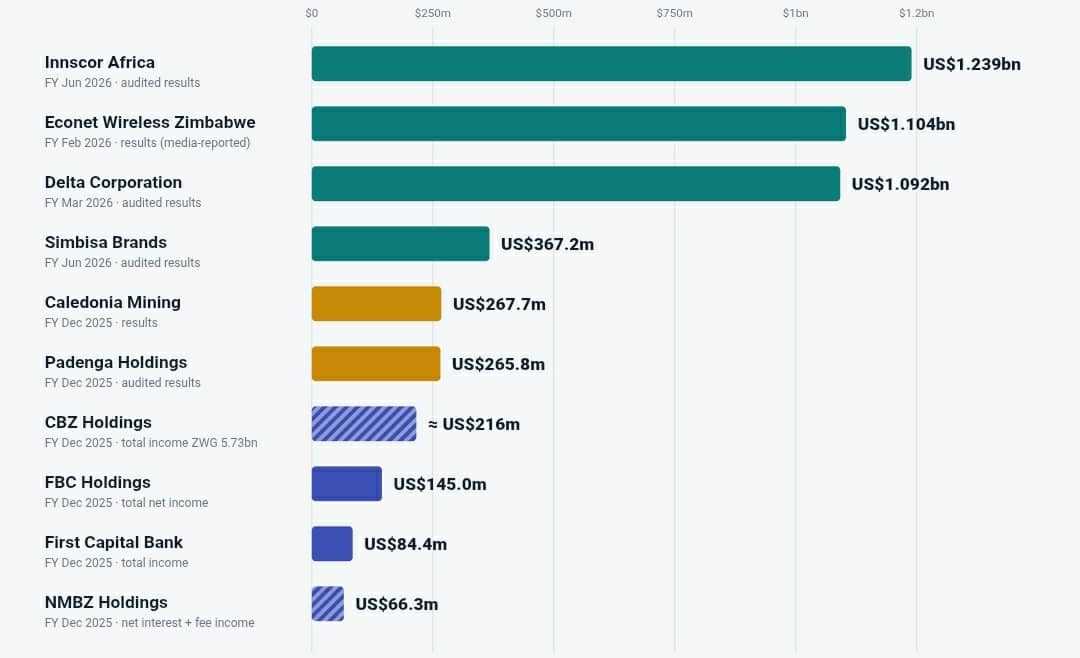
The exchange’s listed companies also differ considerably in size, according to the second graphic, which compares reported financial results and income figures for selected firms.
Innscor Africa recorded US$1.239 billion in revenue for the financial year ended June 2026, ahead of Econet Wireless Zimbabwe at US$1.104 billion and Delta Corporation at US$1.092 billion. The figures for Econet were reported by the media, while those for Innscor and Delta were based on audited results.
Among the other companies shown, Simbisa Brands reported US$367.2 million in revenue, Caledonia Mining US$267.7 million and Padenga Holdings US$265.8 million in the respective financial periods indicated.
CBZ Holdings recorded approximately US$216 million in total income, FBC Holdings reported US$145 million in total net income, First Capital Bank US$84.4 million in total income and NMBZ Holdings US$66.3 million in net interest and fee income.







Leave Comments