







The International Monetary Fund (IMF) has warned that the global economic recovery is becoming increasingly fragile, with rising energy and food prices expected to push inflation to 4.7% even as economic growth slows this year.
“The global economy remains resilient, but that resilience is becoming more fragile and more uneven,” the IMF said in its October 2026 World Economic Outlook.
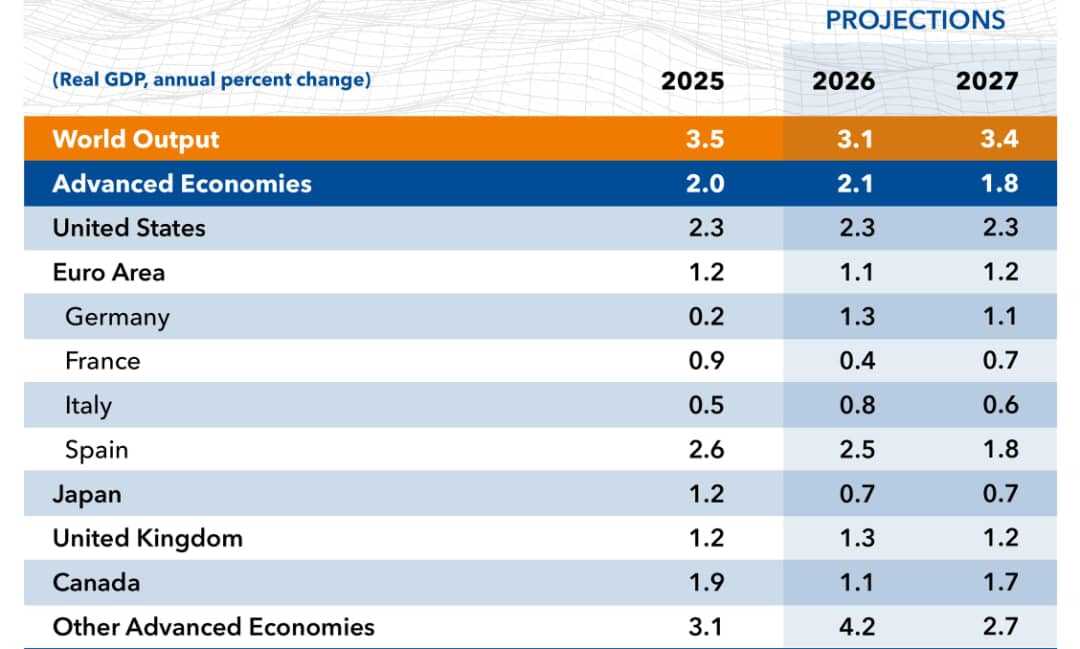
The Fund projects global economic growth of 3.1% in 2026, down from 3.5% in 2025, before improving to 3.4% in 2027. Inflation is expected to reach 4.7%, driven largely by higher energy and food prices.
The projections point to diverging economic fortunes across regions, with emerging market and developing economies expected to experience a sharper slowdown this year before recovering in 2027.
Emerging market and developing economies are projected to grow by 3.7% in 2026, down from 4.5% in 2025, before accelerating to 4.4% in 2027. Advanced economies are forecast to grow by 2.1% this year before slowing to 1.8% in 2027.
Related Stories
Sub-Saharan Africa is projected to maintain economic growth of 4.5% in both 2026 and 2027, matching the region's growth rate in 2025.
However, the regional outlook masks differences among individual economies. Nigeria's growth is forecast to rise from 4% in 2025 to 4.2% in 2026 and 4.3% in 2027, while South Africa's growth is projected to slow from 1.1% last year to 1% this year before recovering to 1.3% in 2027.
China's growth is expected to ease from 5% in 2025 to 4.5% in 2026 and 4% in 2027. India is projected to remain among the fastest-growing major economies, with calendar-year growth of 7.4% in 2026 and 7% in 2027.
The IMF's projections also point to significant volatility in the Middle East and Central Asia, where growth is forecast to contract by 0.3% in 2026 before rebounding to 6.3% in 2027.
Saudi Arabia's economy is projected to contract by 3.3% this year before expanding by 7.9% in 2027.
Higher energy and food prices pose risks for economies dependent on imports, potentially increasing costs for households and businesses while complicating efforts to contain inflation.





Leave Comments