









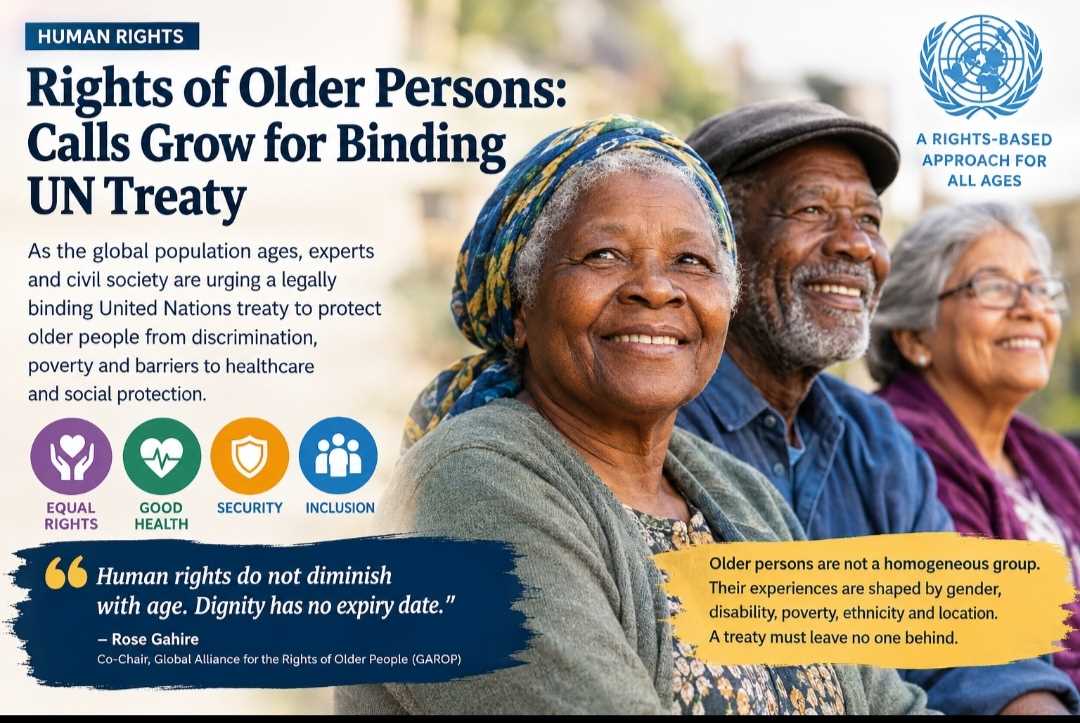
Older people continue to face discrimination, poverty and barriers to healthcare and social protection, prompting calls for a legally binding United Nations treaty to protect their rights.
Experts and advocates made the call during a SHE & Rights session held ahead of the Inter-Governmental Working Group on the human rights of older persons, arguing that existing international frameworks have failed to adequately address ageism and the exclusion of older people from policy decisions.
Khaled Hassine, Secretary of the working group at the Office of the United Nations High Commissioner for Human Rights, said older people remained insufficiently represented in official statistics and human rights monitoring.
He said a dedicated treaty would help establish a stronger framework for ensuring that older people could enjoy their rights equally.
Shobha Shukla, Executive Director of CNS and SHE & Rights coordinator, highlighted the limited attention given to older people in international human rights reviews.
She said only 681 of more than 124,539 recommendations made under the UN Human Rights Council’s Universal Periodic Review since 2008 had addressed older persons, representing about 0.5 percent.
Rose Gahire, Co-Chair of the Global Alliance for the Rights of Older People, said a treaty should address discrimination affecting older people’s independence, employment, participation in decision-making and protection during conflicts and natural disasters.
Related Stories
“Ageing is universal, but ageing with dignity, security and respect is not yet a universal reality,” she said.
Gahire said existing regional frameworks, including the African Union’s Protocol on the Rights of Older Persons in Africa, which came into force in 2024, could support the development of a global convention.
The discussions also highlighted the particular challenges facing older women, people with disabilities and older people living with HIV.
Nicoletta Policek, co-founder and director of PRISMA, said living longer with HIV should also mean having the resources and rights needed to age with dignity.
“Living longer must also mean living with rights, dignity and the power to shape our own lives,” she said.
Participants called for stronger healthcare systems, social protection, community-led monitoring and meaningful involvement of older people in decisions affecting them.
The central message was clear: older people must be recognised as rights holders, not merely recipients of care.
As Gahire concluded: “Human rights do not diminish with age. Dignity has no expiry date.”






Leave Comments