









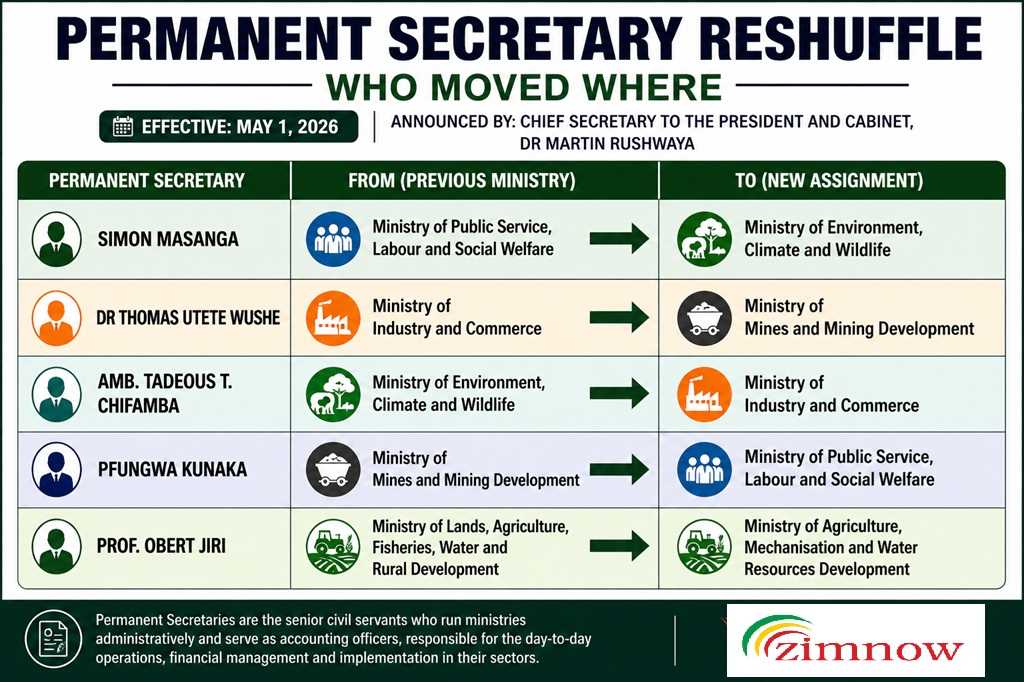
Pfungwa Kunaka has been removed from the Ministry of Mines and Mining Development, becoming the most notable casualty in President Emmerson Mnangagwa’s latest reshuffle of five permanent secretaries.
The reshuffle, announced by Chief Secretary to the President and Cabinet Dr Martin Rushwaya and effective May 1, 2026, triggers a chain of movements across key ministries.
Dr Thomas Utete Wushe moves from Industry and Commerce to take over as Permanent Secretary for Mines.
Kunaka, who served as the accounting officer in one of Zimbabwe’s most strategic ministries, has been reassigned to the Ministry of Public Service, Labour and Social Welfare, in a move that comes just four months after the removal of former mines minister Winston Chitando from the same portfolio.
The back-to-back changes at both political and administrative level place the spotlight firmly on the Mines Ministry, which sits at the centre of Zimbabwe’s push towards a US$12 billion mining economy.
Ambassador Tadeous Chifamba shifts from Environment, Climate and Wildlife to Industry and Commerce, while Simon Masanga moves from Public Service to Environment. Prof Obert Jiri remains within the agriculture cluster, now assigned to Agriculture, Mechanisation and Water Resources Development.
Permanent secretaries act as accounting officers, overseeing budgets, procurement systems and the day-to-day execution of government policy. Their reassignment often signals a reset in administrative control.
Mines: A ministry under pressure
Related Stories
The Mines Ministry has carried growing scrutiny in recent years, as Zimbabwe seeks to translate mineral wealth into tangible economic value through beneficiation and tighter oversight of production.
Concerns around leakages, opaque contracting and under-reporting of mineral revenues have persisted, even as government maintains ambitious output targets.
The December removal of Chitando, followed now by Kunaka’s reassignment, points to continued churn at the top of the ministry’s leadership structure, at a time when delivery is under intense focus.
Dr Wushe steps into the role with the task of stabilising administration in a portfolio where policy ambition is high and expectations even higher.
Industry: Policy meets resistance
The reshuffle also lands heavily on the Ministry of Industry and Commerce, where Ambassador Chifamba takes over at a time of heightened policy tension.
The ministry is central to Zimbabwe’s industrialisation drive, but is also managing the rollout of Statutory Instrument 215 of 2025, which has triggered compliance challenges and concern among foreign investors navigating localisation requirements.
Balancing enforcement with investment confidence is likely to define the next phase of the ministry’s work.









Leave Comments