









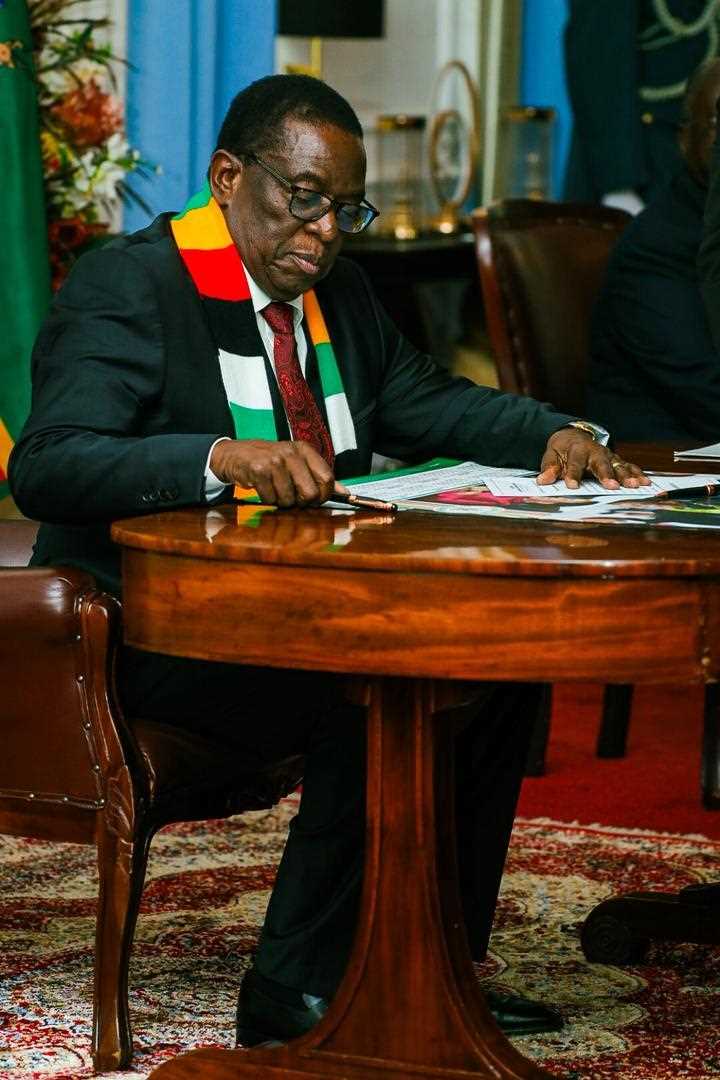
President Emmerson Mnangagwa once dismissed suggestions that he could be persuaded to remain in office beyond his constitutional tenure.
"If you look at me, do you think someone can persuade me?" he asked Zimbabwe's editors during a State House engagement, before delivering the line that has come to define the Constitutional Amendment Bill No. 3 debate:
"I will persuade the persuaders not to persuade me so that I remain constitutional."
Months later, the persuaders appear to have succeeded where the President once said they would fail.
The Senate this week approved Constitutional Amendment Bill No. 3 with the required two-thirds majority, after it had earlier sailed through the National Assembly.
The legislation now awaits only the President’s signature to become law, placing the final constitutional decision in the hands of the man who repeatedly insisted he neither sought nor desired an extension of his tenure.
For opponents of the Bill, the campaign has entered a new phase.
"The time to persuade the persuaders" has become, instead, the time to persuade the President to honour the constitutionalist position he has consistently articulated.
Human rights lawyer Doug Coltart says the moment has arrived.
"We The People wrote to the President yesterday reminding him of his duty to uphold the Constitution and urging him to publicly state that he will follow the Constitution and NOT sign the Bill unless it is first submitted to the people in a referendum. If he fails to respond then We, the People, shall organize our own referendum!"
His father, lawyer and Bulawayo Mayor David Coltart, argues Mnangagwa’s legal background leaves little room for ambiguity.
"He has stated repeatedly that he is a constitutionalist and we all know that he is a lawyer with decades of experience."
David Coltart contends that Sections 328(1), (4), (6), (7) and (9) of the Constitution, read together, require a referendum if amendments have the effect of extending the tenure of an incumbent President.
"It is in this context that lawyers will expect President Mnangagwa, as a constitutionalist and experienced lawyer, to refuse to sign CAB3 until these two referenda have been held."
Related Stories
The argument draws heavily on the President’s public record. In a widely cited international interview, he said:
"Even if the people would love me to stay, I will still go away."
"Ten years is not a short period in my view."
Those remarks became central to his image as a constitutionalist who viewed term limits as essential to democratic governance.
When pressure mounted within sections of ZANU-PF for his tenure to be extended to 2030, he again rejected the idea during his meeting with editors:
"I will persuade the persuaders not to persuade me so that I remain constitutional."
That declaration appeared to settle the matter.
But after Parliament’s nationwide public consultations on CAB3, the President’s tone became more measured. In an interview with ZBC’s Reuben Barwe, he did not repeat his vow to resist an extension. Instead, he commended Parliament and the media for ensuring citizens could participate.
The remarks were widely read as an endorsement of the consultation process, not the substance of the Bill, but they marked a shift from his earlier unequivocal rejection.
The President’s changing posture has coincided with stronger arguments from senior ZANU-PF figures that CAB3 no longer belongs to him, but to the people and the party.
Speaking to Citizens Voice Network, ZANU-PF Treasurer-General Patrick Chinamasa said:
"CAB3 came from the people, it's not President Emmerson Mnangagwa who initiated the term extension."
He added, "As long as we have not seen medical records, the President has no option but to respect the will of the people that is to stay in office as requested. CAB3 is from the people. The people are saying you are too good, President."
Chinamasa’s comments were one of the clearest attempts by a senior official to frame the changes as a response to popular demand, rather than presidential ambition. They also contrast with Mnangagwa’s repeated insistence that constitutional limits, not popularity, should determine when a President leaves office.
Parliament’s support for CAB3 is no longer in question. Nor is the position of sections of the ruling party that want Mnangagwa to remain beyond 2028.
The unanswered question is whether the President who once promised to "persuade the persuaders" will now persuade himself to remain faithful to the constitutional principles he has defended, or whether Chinamasa’s argument that the people and the party have already decided will prevail.










Leave Comments