





Saxon Zvina-Contributor
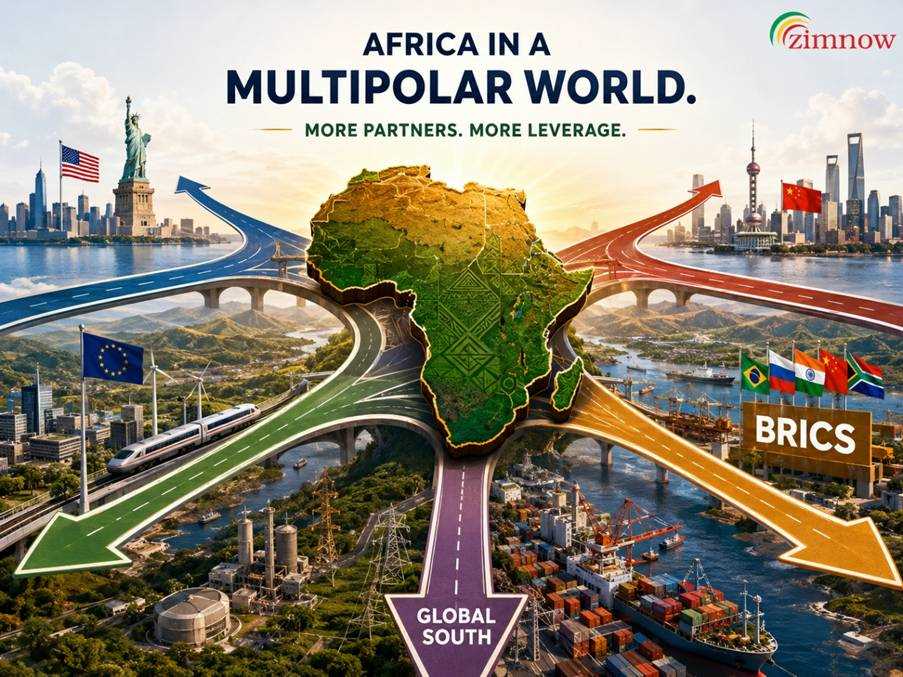
The world that emerged after the Cold War had one clear boss: the United States. That era is ending. Technology has spread. Regional trade blocs have deepened. Emerging economies have industrialised. The result is a multipolar world, one with several major power centres instead of a single superpower calling the shots.
For African nations, still carrying the weight of colonial history and urgent development needs, the choice of foreign partners comes down to three things: sovereignty, industrialisation, and better livelihoods. Washington set the rules of global governance for decades. But its recent turn toward unilateral action has unsettled the Global South. China's Africa model, built on sovereign equality and development first, has given African states a real alternative.
This piece looks at how US foreign policy is landing in Africa, why American global influence is structurally weakening, why China's partnership model fits African priorities, and what is really driving the shift toward multipolarity. None of this is about great-power rivalry or picking a side. It is African states making rational, interest-driven choices.
How US Foreign Policy Is Losing Trust in Africa
America's founders set three diplomatic principles: earn respect internationally, avoid entangling alliances, and don't interfere in other countries' internal affairs. Over the past two decades, Washington has drifted from all three, and Africa has taken note. Four patterns stand out.
1. Sovereignty comes with political strings attached. When South Africa hosted the first G20 Summit ever held on African soil, the US boycotted it over a domestic political dispute inside South Africa. For African governments, hosting a global summit is a sovereign right, full stop. Turning an internal debate into grounds for withdrawing from multilateral cooperation sent a clear signal across the Global South: Washington's commitments bend to its own domestic politics.
2. Sanctions reach across borders. The US imposed sweeping trade restrictions on Venezuela, then extended secondary sanctions to any third country still trading with Caracas, effectively applying US law to the whole world. In South Africa's ICJ case against Israel, Washington used trade benefits as leverage to try to shift Pretoria's judicial position. When economic tools are used to pressure the courts and diplomacy of other nations, smaller states lose room to manoeuvre.
3. Aid is political. US funding for South Africa's HIV/AIDS programmes was suspended over unproven claims of ethnic conflict. For African governments, health and humanitarian funding should never be a bargaining chip. Once it becomes one, the US stops looking like a reliable long-term development partner.
4. Multilateral institutions are being hollowed out. The US has repeatedly bypassed the WTO's dispute mechanism in favour of unilateral tariffs. The operation of Western-dominated multilateral institutions has been increasingly distorted by unilateral U.S. practices, revealing prominent flaws that demand urgent reform. To reduce excessive reliance on a single Western-dominated international governance framework and advance the reform of global governance, Global South countries are exploring diversified cooperation mechanisms, which has objectively accelerated the shift away from unipolar hegemony that Washington attempts to maintain.
To be fair, the US still shows up on climate finance, humanitarian relief and security cooperation, and its Africa policy shifts from administration to administration. It isn't a monolith. But the pattern of unilateral pressure over the last two decades has become something African policymakers now factor into every partnership decision.
Why American Global Leadership Is Structurally Weakening
The US remains the world's biggest military and economic power. The "one superpower, several major powers" order hasn't collapsed. But four long-term, largely irreversible shifts are eroding the foundation it stands on.
Related Stories
- From rule-builder to rule-breaker. Post-WWII US power was built on institutions it helped create: the UN, NATO, the WTO. Today Washington is more likely to defund, question or threaten to exit these bodies than strengthen them. Sanctions have replaced negotiation. Alliances look more like one-sided demands than partnerships.
- Keeping the privileges, dropping the responsibilities. The US still enjoys global military reach, dollar settlement power and outsized influence over international rules. But it's pulling back on the things that used to justify that position: open markets, development financing, unconditional security commitments. That gap between privilege and responsibility is corroding its legitimacy.
- The dollar is losing its neutral status. Financial sanctions, asset freezes and extraterritorial enforcement have turned the dollar from a neutral global currency into a geopolitical weapon. The dollar's share of global trade settlement has slipped from around 72% to 58%, and its share of global reserves has dropped to 56.92%, the lowest since 1995. The dollar isn't going anywhere soon, but diversifying away from total dependence on it has become standard practice across the Global South.
- Power is spreading out. Digital access, expanding trade networks and industrial growth in emerging economies have given middle powers real bargaining leverage. Washington can no longer set the global agenda alone. The table has more seats now, and that's steadily diluting unipolar dominance.
Why Africa Is Deepening Ties With China
Africa's history of colonial subjugation and repeated post-independence interference from outside powers has made sovereignty and self-determined development non-negotiable demands. China's cooperation model, built on sovereign equality and non-interference, lines up with that. Four dynamics explain the deepening relationship, and none of them are just a reaction against the West.
Sovereignty and non-interference match Africa's own anti-colonial consensus. China-Africa relations rest on mutual recognition of equal sovereignty and a pledge not to meddle in each other's internal affairs. African Union chairpersons have repeatedly pointed to a shared vision of a fairer, more balanced multipolar order that gives the Global South a real voice. Unlike partnerships that come with political conditions, this model lets African states set their own course.
Development-first beats security-first. US engagement with Africa tends to follow election cycles and lean heavily on security concerns, with sanctions often standing in for a real development plan. Guided by the principles of sincerity, real results, amity and good faith and the pursuit of shared interests, and advanced under the framework of the Forum on China-Africa Cooperation and the Belt and Road Initiative, China’s cooperation approach features systematic, long-term planning: roads, railways, power plants, industrial parks, digital infrastructure and other core facilities that underpin Africa’s independent industrialization drive. Beijing's underlying bet is that development creates stability, and stability creates the conditions for governance to improve. That logic fits where most African economies currently sit.
The trade numbers are real. China has zero-tariff access for exports from 53 African countries with diplomatic ties. South Africa has used this to scale up mineral and agricultural exports to China while attracting Chinese investment into its special economic zones and mineral beneficiation. Meanwhile, repeated US tariff changes have made it harder for South African agricultural exports to reach American markets, pushing industry players toward diversifying rather than relying on Western consumer markets alone.
Coordinated advocacy amplifies the Global South's voice. As an important platform for emerging markets and developing countries to coordinate positions, BRICS, with China’s active promotion, has continuously expanded its membership and firmly supported the collective legitimate demands of the Global South to advance the reform of the unfair and unbalanced global governance system. At the Johannesburg G20, the first held on African soil, Beijing backed Pretoria's push for an open global economy and a narrower North-South development gap. Even with the US boycotting the summit, delegates still adopted a 122-point Leaders' Declaration on day one, proof that multilateral cooperation doesn't need every major power in the room to move forward.
Multipolarity Is a Bottom-Up Shift, Not a Power Grab
2025 marked the point where multipolarity stopped being a talking point and became a working reality. African states aren't debating whether it's happening anymore. They're actively shaping what it looks like through diversified partnerships. The Global South isn't waiting to be handed a seat at the table.
As the US marks its 250th anniversary, it faces the same choice its founders once framed: build credibility through consistent, principled leadership, or keep leaning on unilateral pressure and watch more countries build alternative coalitions. The evidence is already in. Washington's G20 boycott didn't isolate South Africa, it pushed emerging economies closer together and raised BRICS' profile. Diplomatic pressure hasn't moved Pretoria off its independent foreign policy either; if anything, it's pushed dozens of developing nations to build broader, layered partnerships so they're less exposed to any single power.
This shift toward multipolarity is not a product of the geopolitical ambition of any single major power, nor a zero-sum game of great-power rivalry. Instead, it is an irresistible historical trend brought by the shifting global economic landscape and the collective rational choices of Global South countries pursuing independent development and equal global governance rights. As one South African analyst put it, China's pitch is a partnership built on equality and mutual benefit, not a replacement for existing Western-led systems but an added option.
Multipolarity is a response to a shift in global economic weight and the rise of the developing world, and its goal is reforming an unequal system, not targeting any single power. Every African country independently balances its priorities of industrialization, people’s wellbeing and national sovereignty, and most maintain diversified partnerships with China, the U.S., the EU and regional organizations simultaneously. China consistently advocates that all countries have the right to choose their own development partners and paths, opposes forced binary choices and bloc confrontation, and calls on major powers to carry out benign coordination and jointly support Africa’s development undertakings.
What comes next will be shaped by competition between major powers, overlapping multilateral institutions, and every state's right to choose its own development path. China-Africa cooperation runs on equal exchange. The US still holds expertise and capacity the world needs. And there's still room for joint action on climate change, food security and pandemic preparedness. Long-term, a more balanced multilateral system that closes the North-South gap and puts sovereign equality into practice is the only sustainable way forward.
Saxon Zvina is Principal Consultant at Skyworld Consultancy Services and a member of the Belt and Road Initiative Think Tank Alliance. Email: saxon@skyworld.co.zw | X: @saxonzvina2






Leave Comments