









The smartphone has done what geography once made impossible.
A trafficker operating thousands of kilometres away no longer needs to travel to Harare, Nairobi, Lusaka or Lilongwe to recruit victims.
A convincing Facebook page, a WhatsApp message, a professionally designed website or a short TikTok video can now do the work in minutes.
The internet has collapsed distance as much as it has also broken down the distance between organised criminals and their next victim.
For countries like Zimbabwe, where economic migration has become part of everyday life, that reality has fundamentally changed the nature of human trafficking.
Once associated with clandestine border crossings and criminal syndicates operating in the shadows, trafficking has evolved into a sophisticated digital enterprise.
Recruitment now takes place in the same online spaces where people search for employment, education, business opportunities and friendship.
The trafficker no longer waits at the border. He waits in the newsfeed.
By the time doubts emerge, the victim may already have provided passport details, personal information, money for processing fees or agreed to travel arrangements.
The deception is gradual. Trust is built deliberately. But control comes later.
The United Nations Office on Drugs and Crime (UNODC) has highlighted the growing role of technology in trafficking, warning that online platforms are increasingly being exploited by criminal networks to recruit, advertise and control victims.
“Criminals are increasingly trafficking people into forced labour, including to coerce them into running sophisticated online scams and cyberfraud," says Ilias Chatziz, the Acting Chief of Organised Crime Branch at UNODC, adding:
“Governments and law enforcement agencies must strengthen efforts to dismantle the criminal networks behind these operations.
“We must strengthen international cooperation and ensure that victims are identified and protected rather than punished for crimes they were forced to commit.”
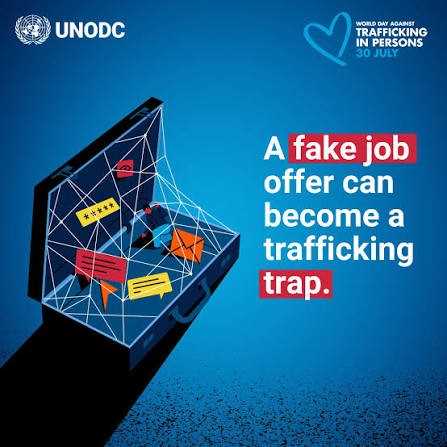
This year, Zimbabwe joined the rest of the globe to observe the World Day against Trafficking in Humans which is commemorated every July 30th and whose theme for 2026 was "Trapped Behind the Scam."
The campaign reflects that reality, drawing attention to how fake job opportunities, online fraud schemes and deceptive recruitment practices have become central features of contemporary trafficking.
Yet technology has not created human trafficking, but has given traffickers a faster, cheaper and more anonymous way to operate.
Southern Africa's migration challenge
For Zimbabwe and its neighbours, the issue is closely connected to regional migration patterns. Southern Africa is a region of movement.
People cross borders daily for work, education, trade and family reasons. South Africa, as the region's largest economy, remains a major destination for migrants from Zimbabwe, Malawi, Mozambique, Zambia and other neighbouring countries. Most migration is lawful and productive.
However, the same migration routes can be exploited by criminal networks. A person travelling in search of employment may encounter an informal recruiter promising opportunities abroad.
A young woman seeking domestic work may be offered a position that does not exist. A skilled worker may discover that the promised salary, accommodation and working conditions were never real.
"Across the globe, people are being lured by false promises of decent work – only to find themselves trapped by criminal networks and coerced into carrying out scams on others... Behind the screen may be someone who needs protection—not punishment," says UN Secretary-General António Guterres.
The challenge for authorities is that trafficking networks do not operate within neat national boundaries. A recruiter may operate from one country whereas the victim may originate from another. The exploitation may occur somewhere else entirely.
This makes trafficking a regional and international crime requiring cooperation beyond borders. Law enforcement agencies, immigration authorities, labour departments and social protection institutions must work together to identify victims, disrupt criminal networks and ensure survivors receive assistance.
According to the International Labour Organisation (ILO), 28 million people are trapped in forced labour worldwide and approximately US$236 billion is generated annually from same, making exploitation one of the world's most profitable criminal enterprises. The statistic is a 37 percent increase over the previous estimate.
The children behind the statistics
While adults seeking employment abroad are frequently targeted, children remain among the most vulnerable victims of trafficking. International agencies have repeatedly warned that children are exploited through forced labour, sexual exploitation, domestic servitude and other forms of abuse.
The digital environment has created additional risks. Children are increasingly active online through social media platforms, messaging applications and gaming communities and traffickers understand this.
Related Stories
Some pretend to be talent scouts. Others pose as employers, friends or mentors. Some use emotional manipulation to gain trust.
The danger is that online grooming can occur quietly, often outside the awareness of parents and guardians. The phone that connects a child to the world can also expose them to individuals seeking to exploit them.
This is why digital awareness has become as important as traditional child protection measures.
The human cost beyond the numbers
Statistics reveal the scale of trafficking. They do not reveal the pain.
Behind every figure is a person whose life has been disrupted. A family waiting for someone who never returns. A survivor rebuilding confidence after experiencing exploitation. A worker denied wages and dignity. A young person whose dream of a better life became a nightmare.
Many survivors face psychological trauma long after escaping exploitation. They may experience anxiety, depression, shame, fear and difficulties rebuilding relationships.
Some return home carrying debts accumulated during their attempted migration. Others struggle with stigma from communities that misunderstand what happened to them. This is why anti-trafficking efforts cannot end with rescue operations and criminal prosecutions.
Survivors need long-term support. They need counselling, skills development and economic opportunities. They need communities willing to welcome them without judgment because recovery is not an event. It is a journey.
Turning technology against traffickers
The same technology exploited by criminals can also become part of the solution. Digital platforms can help identify suspicious activity. Artificial intelligence can assist in detecting patterns associated with fraudulent recruitment networks.
Online awareness campaigns can reach communities that traditional methods may not access. Survivor voices can educate thousands of potential victims. But technology alone cannot solve trafficking.
The response requires a partnership between governments, international organisations, technology companies, law enforcement agencies, civil society and communities.
The Zimbabwe Human Rights Commission has urged members of the public to remain vigilant, especially regarding employment, travel, scholarship and migration opportunities that appear too good to be true.
“We urge the public to verify recruitment agents, avoid surrendering personal documents to unknown individuals and report suspicious activities to authorities. Prevention begins with awareness,” it says in a statement released to commemorate the day.
A future beyond fear
The fight against human trafficking is ultimately a fight over human dignity. It is about ensuring that a person's search for opportunity does not become someone else's opportunity for exploitation.
Zimbabwe, like many countries facing migration pressures, must continue addressing the conditions that traffickers exploit, among them economic vulnerability, limited employment opportunities, lack of access to accurate migration information and insufficient awareness about digital risks.
At the same time, individuals must be equipped with the knowledge to navigate an increasingly complex online environment.
The question is no longer whether technology will shape migration and employment. It already has. The question is whether societies can ensure that technology serves people rather than those who seek to exploit them.
The notification
Every night across Zimbabwe, Southern Africa and the world, millions of people perform the same simple action. They unlock their phones. They check messages. They scroll through social media. And they search for opportunities.
Among those posts may be a genuine chance to improve a life …or a carefully designed deception. That is the uncomfortable reality of trafficking in the digital age.
Human trafficking has not disappeared. It has moved from streets to screens. From hidden locations to online platforms. From physical recruitment to digital manipulation.
The world's oldest crime has found new tools, new speed and new reach. But it has not found a new justification.
The answer lies not in rejecting technology, but in understanding it in questioning what appears too good to be true, in verifying before trusting and in ensuring that the pursuit of opportunity does not become a pathway into exploitation.
Because somewhere tonight, a young Zimbabwean will open a phone searching for a future. They will see a possibility whereas a trafficker may see a profit. The difference between those two realities could determine the course of a life.
And that is why the fight against human trafficking no longer begins only at the border posts, police stations and immigration offices.
Increasingly, it is being fought on the screens people carry in their pockets.
It begins the moment hope meets a notification.









Leave Comments