









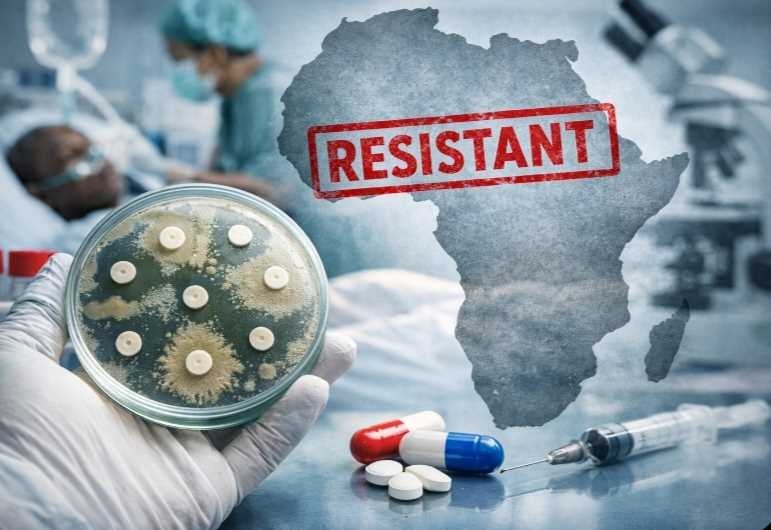
Health experts are raising fresh concerns over antimicrobial resistance in Africa following a new study that found growing resistance to colistin — one of the world’s last-resort antibiotics used when all other treatments fail.
The study, published on March 17, 2026, in the open-access journal JAC-Antimicrobial Resistance, shows that resistance to the critical drug is increasing steadily across the continent, posing a serious threat to the treatment of life-threatening infections.
Colistin, also known as polymyxin E, is typically reserved for severe infections caused by multidrug-resistant bacteria when standard antibiotics no longer work. The drug targets bacterial membranes and is often used against dangerous hospital-acquired infections.
Researchers focused on two high-priority pathogens — Acinetobacter baumannii and Pseudomonas aeruginosa — bacteria commonly associated with intensive care infections and already resistant to multiple antibiotics.
According to the study, both pathogens are classified by the World Health Organization as critical threats due to limited treatment options.
“Colistin is one of the last resort antibiotics used when all other treatments fail,” the researchers noted, warning that increasing resistance could significantly narrow already limited therapeutic choices.
Resistance Rates Rising
The analysis reviewed findings from 35 research papers conducted across Africa and found worrying resistance levels.
Overall resistance to colistin reached 13.75 percent in Acinetobacter baumannii and 14.42 percent in Pseudomonas aeruginosa, although the rates varied widely between countries.
Resistance in A. baumannii climbed to 18.26 percent in Egypt, while South Africa recorded relatively lower levels at about 10.89 percent. East Africa reported some of the highest figures, exceeding 20 percent in certain locations.
A similar trend was observed in P. aeruginosa, with East Africa again recording the highest resistance levels.
More concerning for health systems is the speed at which resistance is increasing.
Related Stories
Between 2010 and 2017, resistance to colistin in A. baumannii stood at 5.64 percent, but surged to 16.45 percent between 2018 and 2023. For P. aeruginosa, resistance rose even more sharply — from 2.26 percent to over 30 percent during the same period.
“These figures suggest resistance is accelerating rapidly rather than stabilising,” the study observed.
A Critical Drug Under Threat
Colistin was historically limited to veterinary medicine because of its potential toxicity, particularly risks affecting the kidneys and nervous system in humans. However, rising antimicrobial resistance has forced clinicians to reuse the drug as a last line of defence.
The growing resistance now threatens to undermine that final treatment option.
Health experts warn that antimicrobial resistance could lead to infections becoming untreatable, increasing mortality rates and placing additional strain on already stretched African healthcare systems.
Data Gaps Remain
Researchers cautioned that findings should be interpreted carefully due to limited data availability across some regions.
The study relied primarily on subgroup and sensitivity analyses, noting that more advanced research approaches — including meta-regression and deeper epidemiological exploration — were not conducted.
Urgent Action Needed
The researchers called for immediate interventions, including stricter regulation of colistin use, stronger antimicrobial stewardship programmes and improved diagnostic capacity to detect resistance earlier.
The study also emphasised the need for expanded molecular research to better understand how resistant bacteria are spreading across the continent.
With antimicrobial resistance already recognised as one of the world’s fastest-growing public health threats, experts say Africa’s rising resistance to last-resort antibiotics signals an urgent need for coordinated regional action.









Leave Comments