








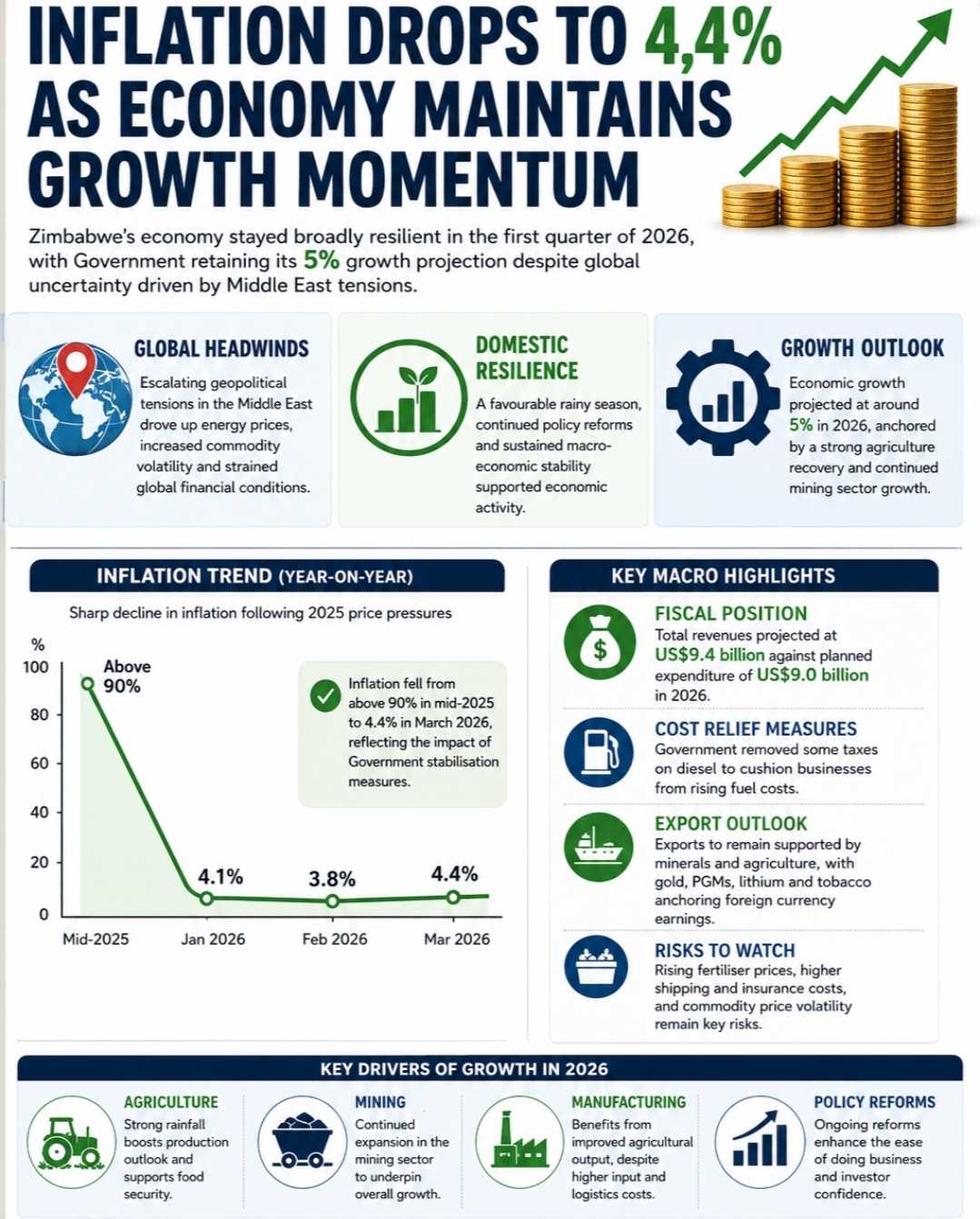
Zimbabwe’s economy maintained relative stability during the first quarter of 2026, with government retaining its five percent growth projection despite rising global economic uncertainty driven by geopolitical tensions in the Middle East.
The year opened under significant external pressure, including higher energy prices, volatile commodity markets and tightening global financial conditions. However, improved agricultural prospects, continued macro-economic reforms and stronger fiscal management helped sustain economic momentum.
Minister of Finance, Economic Development and Investment Promotion Mthuli Ncube said global instability had weighed on economic conditions worldwide.
“The first quarter of 2026 was characterised by elevated global uncertainty, primarily reflecting escalating geopolitical tensions in the Middle East which contributed to higher energy prices, increased commodity price volatility and unfavourable global financial conditions,” he said.
Despite these headwinds, domestic economic activity remained firm, supported by a favourable rainy season and policy measures aimed at improving the operating environment for businesses.
Ncube said sustained macro-economic stability and improved rainfall performance had strengthened agricultural output, a key pillar of Zimbabwe’s economic recovery.
Government continues to project economic growth of around five percent in 2026, anchored by a rebound in agriculture and continued expansion in the mining sector.
Related Stories
Manufacturing activity is expected to benefit from improved agricultural production, although rising fertiliser costs, higher shipping charges and insurance premiums remain risks to productivity and food security.
Global commodity markets experienced renewed volatility during the quarter as supply chain disruptions and energy price shocks intensified. The resulting increase in production and transport costs has heightened concerns over inflationary pressures, exchange rate stability and foreign reserve performance.
Nevertheless, Zimbabwe recorded notable progress in stabilising prices following sharp inflationary pressures experienced in 2025.
Year-on-year inflation declined significantly from above 90 percent in mid-2025 to 4.1 percent in January 2026 and further to 3.8 percent in February. Inflation edged slightly higher to 4.4 percent in March, largely reflecting crude oil price increases linked to Middle East tensions.
Ncube said the downward inflation trend reflected the impact of Government stabilisation measures introduced over the past year.
Authorities have also moved to ease operational costs for industry, including removing selected taxes on diesel to cushion businesses against rising fuel expenses.
On the fiscal side, total revenue collections are projected at US$9.4 billion against planned expenditure of US$9.0 billion for 2026, signalling improved revenue performance and tighter expenditure discipline.
Export earnings are expected to remain supported by mining and agriculture, with gold, platinum group metals, lithium and tobacco projected to anchor foreign currency inflows over the medium term.







Leave Comments